











Popular Examples of Platform as a Service (PaaS) Platforms
Platform as a Service (PaaS) provides developers with a complete cloud-based environment to build, deploy, and manage applications without handling infrastructure. Understanding popular examples of PaaS platforms helps students and professionals see how real-world applications are developed efficiently using cloud technology.Popular Examples of PaaS Platforms
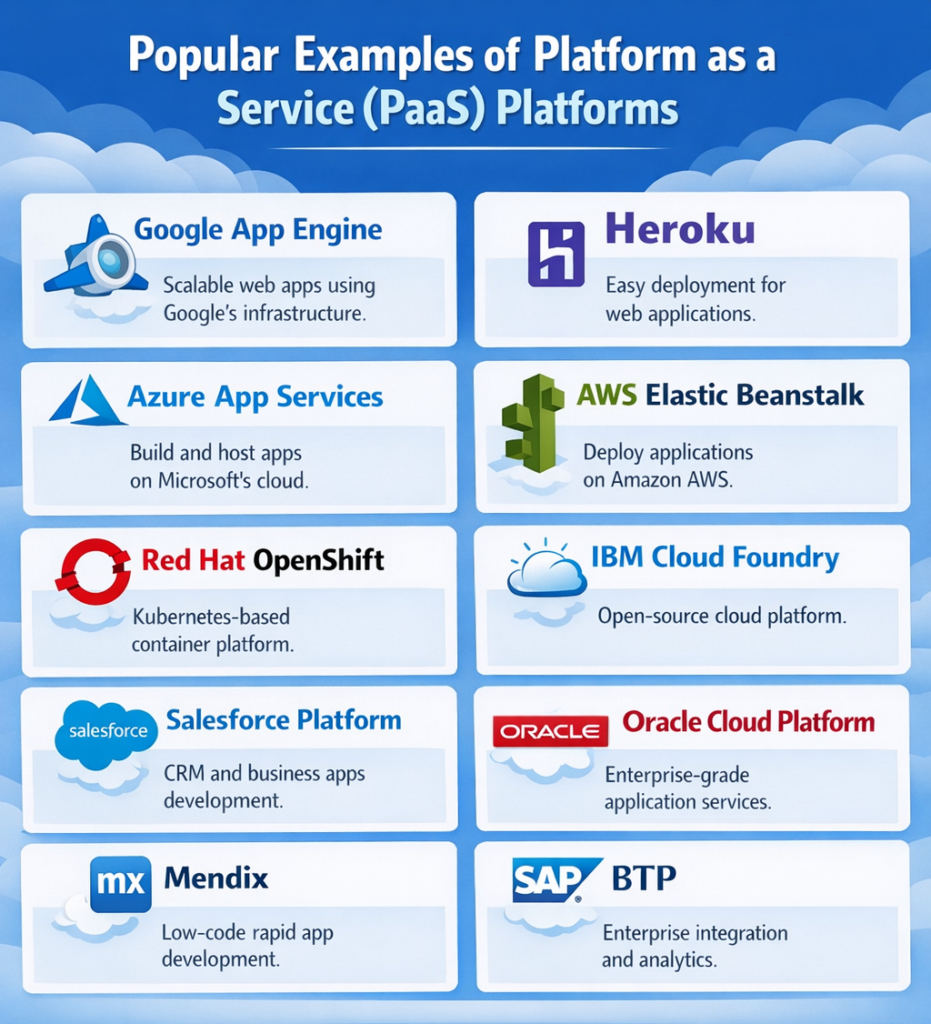
Let us explore some of the most popular examples of Platform as a Service (PaaS) platforms in detail.
1. Google App Engine
Google App Engine is a fully managed PaaS platform that allows developers to build scalable web applications using Google’s infrastructure.
How It Works
- Automatic scaling: Adjusts resources based on application demand.
- Built-in services: Provides databases, authentication, and APIs.
- Supports multiple languages: Includes Python, Java, and Node.js.
Example
A developer builds a web application and deploys it on Google App Engine without managing servers.
2. Heroku
Heroku is a simple and developer-friendly PaaS platform widely used for deploying web applications.
How It Works
- Easy deployment: Applications can be deployed using Git commands.
- Supports multiple languages: Includes Ruby, Python, Java, and Node.js.
- Add-ons marketplace: Offers tools like databases and monitoring.
Example
A student uploads a project to Heroku, and it becomes live within minutes.
3. Microsoft Azure App Services
Azure App Services is a PaaS offering from Microsoft that enables developers to build and host web apps and APIs.
How It Works
- Integrated development tools: Works with Visual Studio and GitHub.
- Auto-scaling: Adjusts resources automatically based on traffic.
- High security: Includes authentication and access control features.
Example
A company builds and hosts its business application using Azure App Services.
4. AWS Elastic Beanstalk
AWS Elastic Beanstalk is a PaaS service that simplifies application deployment on Amazon Web Services.
How It Works
- Automatic environment setup: Handles server configuration and deployment.
- Supports multiple languages: Includes Java, Python, PHP, and Node.js.
- Monitoring tools: Tracks application performance.
Example
A developer uploads code to Elastic Beanstalk, and AWS automatically deploys and manages the app.
5. Red Hat OpenShift
OpenShift is a Kubernetes-based PaaS platform designed for enterprise application development.
How It Works
- Container-based deployment: Uses containers for application management.
- DevOps integration: Supports CI/CD pipelines.
- High scalability: Handles large-scale applications efficiently.
Example
A large organization uses OpenShift to manage containerized applications.
6. IBM Cloud Foundry
IBM Cloud Foundry is an open-source PaaS platform used for building cloud-native applications.
How It Works
- Cloud-native support: Designed for modern application development.
- Multi-language support: Supports Java, Node.js, and more.
- Continuous delivery: Enables automated deployment pipelines.
Example
A business develops and deploys applications quickly using IBM Cloud Foundry.
7. Salesforce Platform
Salesforce Platform is a PaaS solution focused on building business applications and CRM solutions.
How It Works
- Low-code development: Allows building apps with minimal coding.
- Integration tools: Connects with various business systems.
- Cloud-based services: Fully managed environment.
Example
A company builds a customer management system using Salesforce tools.
8. Oracle Cloud Platform
Oracle Cloud provides PaaS services for building enterprise-grade applications.
How It Works
- Database integration: Strong support for enterprise databases.
- Application development tools: Provides tools for app creation.
- Security features: Ensures data protection and compliance.
Example
A large enterprise uses Oracle Cloud to manage its business applications.
9. Mendix
Mendix is a low-code PaaS platform that enables rapid application development.
How It Works
- Visual development tools: Drag-and-drop interface for building apps.
- Fast deployment: Applications can be launched quickly.
- Collaboration features: Supports team-based development.
Example
A business builds a mobile app using Mendix without extensive coding.
10. SAP Business Technology Platform
SAP BTP is a PaaS platform designed for enterprise application development and integration.
How It Works
- Enterprise integration: Connects different business systems.
- Data analytics tools: Provides insights and reporting.
- Application development: Supports custom app creation.
Example
A company integrates its business processes using SAP cloud services.
Why These Examples Matter
Understanding these platforms helps users connect theory with real-world applications.
For Students
- Helps understand practical cloud tools
- Useful for projects and assignments
For Developers
- Helps choose the right platform
- Improves development efficiency
For Businesses
- Enables faster application development
- Improves scalability and performance
Conclusion
Popular PaaS platforms like Google App Engine, Heroku, AWS Elastic Beanstalk, and Azure App Services play a crucial role in modern application development.
- Provide ready-to-use development environments
- Reduce infrastructure complexity
- Enable faster deployment
Learning these platforms helps students and professionals build real-world cloud applications efficiently.