












Why Cloud Deployment Models Are Important
Cloud deployment models define how cloud infrastructure is set up, who can access it, and how data is managed. Understanding the importance of cloud deployment models helps students, developers, and businesses choose the right cloud environment for security, cost, and performance.
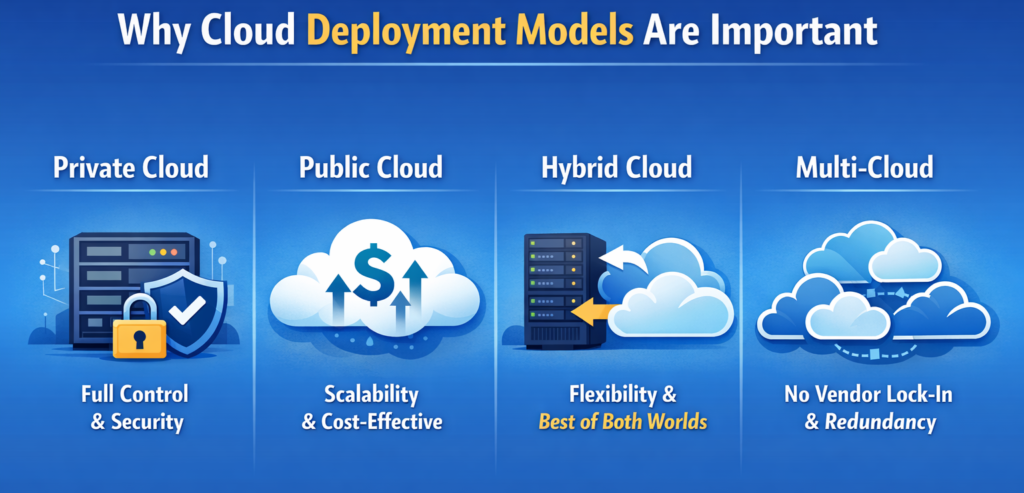
What Makes Cloud Deployment Models Important?
Cloud deployment models are important because they determine how resources are used, shared, and protected in a cloud environment.
Key Idea
-
Defines access control: Determines who can use the cloud resources.
-
Ensures data security: Helps protect sensitive information.
-
Optimizes resource usage: Allocates resources efficiently based on needs.
1. Helps Choose the Right Cloud Environment
Different organizations have different needs, and deployment models help select the most suitable option.
How It Helps
-
Public cloud for cost savings: Ideal for startups and students.
-
Private cloud for security: Suitable for sensitive data.
-
Hybrid cloud for flexibility: Combines benefits of both.
Example
A company chooses a hybrid cloud to balance cost and security.
2. Improves Data Security and Privacy
Deployment models allow organizations to manage how and where their data is stored.
Benefits
-
Controlled access: Limits who can view or use data.
-
Data protection: Ensures sensitive data is stored securely.
-
Compliance support: Meets industry regulations and standards.
Example
A hospital uses a private cloud to protect patient records.
3. Cost Optimization
Cloud deployment models help reduce unnecessary expenses.
Benefits
-
Public cloud reduces cost: No need for infrastructure investment.
-
Pay-as-you-go model: Users pay only for what they use.
-
Efficient resource usage: Avoids wastage of resources.
Example
A startup uses public cloud services to minimize initial costs.
4. Provides Scalability and Flexibility
Deployment models allow systems to grow and adapt easily.
Benefits
-
Easy scaling: Increase or decrease resources as needed.
-
Flexible usage: Choose the best environment for different tasks.
-
Dynamic performance: Adjust to changing workloads.
Example
An online store scales its servers during peak sales periods.
5. Supports Business Continuity
Cloud deployment models help ensure systems remain operational during failures.
Features
-
Backup systems: Data is stored safely and can be restored.
-
Disaster recovery: Systems recover quickly after failures.
-
High availability: Reduces downtime.
Example
A company recovers data quickly after a system crash using cloud backup.
6. Enables Better Performance Management
Deployment models help optimize application performance.
Benefits
-
Efficient resource allocation: Ensures smooth operation.
-
Load balancing: Distributes workload evenly.
-
Reduced latency: Improves speed and user experience.
Example
A streaming platform uses cloud resources to deliver smooth video playback.
7. Supports Collaboration and Accessibility
Cloud deployment models enable easy access and collaboration across locations.
Benefits
-
Remote access: Users can access systems from anywhere.
-
Team collaboration: Multiple users can work together.
-
Global reach: Applications can serve users worldwide.
Example
Teams collaborate on cloud-based applications from different countries.
8. Helps in Compliance and Regulation
Different industries have strict rules about data handling, and deployment models help meet these requirements.
Benefits
-
Regulatory compliance: Meets industry standards like healthcare or finance rules.
-
Data control: Keeps sensitive data in secure environments.
-
Audit support: Enables monitoring and reporting.
Example
A financial institution uses a private cloud to meet compliance standards.
Conclusion
Cloud deployment models are important because they define how cloud systems are structured, accessed, and secured.
-
Help choose the right cloud environment
-
Improve security and cost efficiency
-
Enable scalability and performance
Understanding their importance helps students, developers, and businesses use cloud computing effectively in real-world scenarios.