












Types of Cloud Deployment Models Explained
Cloud deployment models define how cloud infrastructure is organized, who can access it, and how resources are managed. Understanding the types of cloud deployment models helps students and professionals choose the right environment based on cost, security, and performance needs.
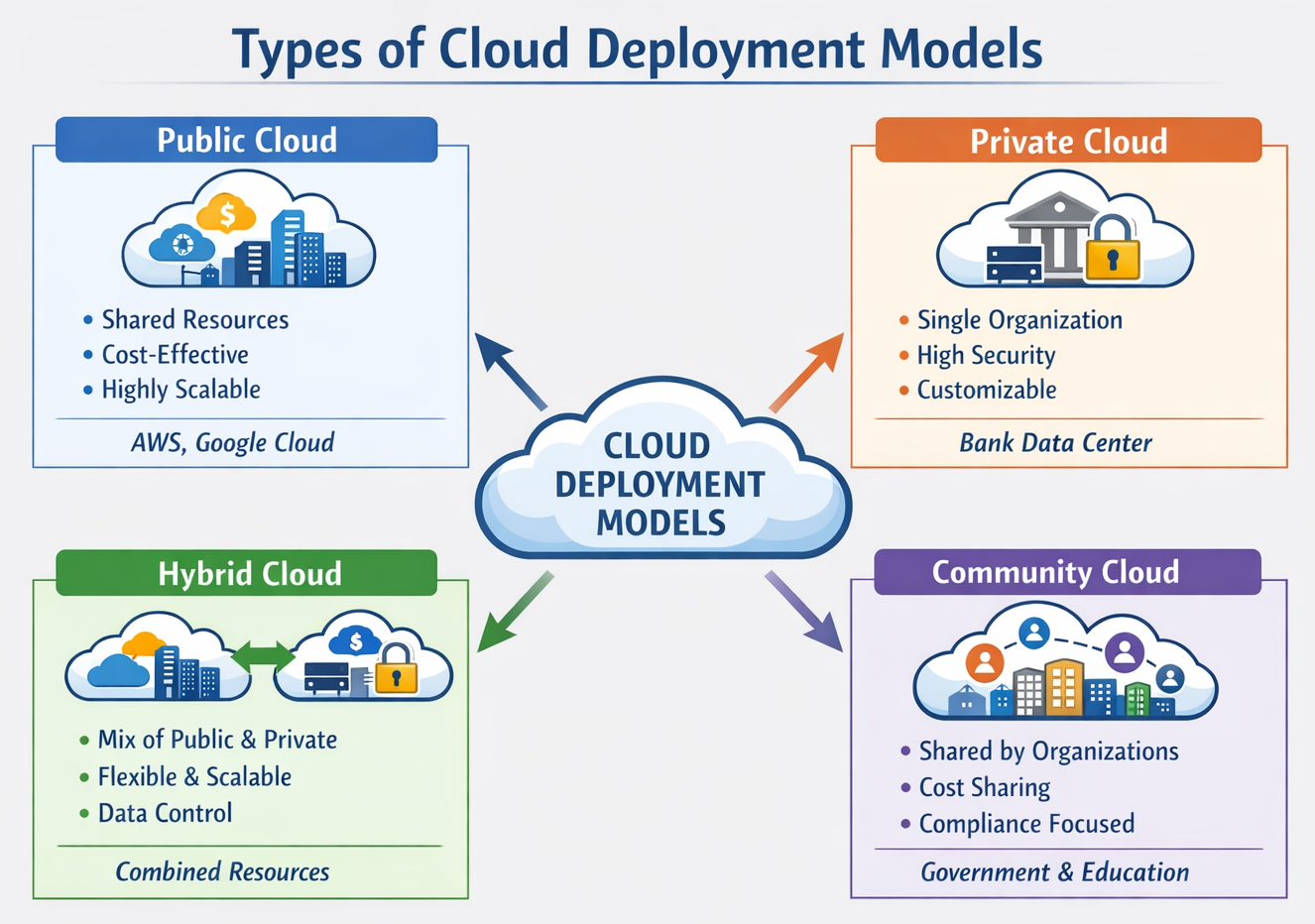
Let us explain each type of cloud deployment model in detail.
1. Public Cloud
Public cloud is a cloud deployment model where services are provided over the internet and shared among multiple users or organizations.
Key Features
-
Shared infrastructure: Multiple users use the same cloud resources, reducing overall cost.
-
Cost-effective: No need to invest in hardware or maintenance.
-
High scalability: Resources can be increased or decreased easily based on demand.
Example
Platforms like AWS, Google Cloud, and Microsoft Azure provide public cloud services.
2. Private Cloud
Private cloud is a cloud environment dedicated to a single organization, offering greater control and security.
Key Features
-
Exclusive access: Only one organization can use the infrastructure.
-
High security: Suitable for handling sensitive data.
-
Customization: Can be tailored to specific business requirements.
Example
A bank uses a private cloud to store confidential customer information securely.
3. Hybrid Cloud
Hybrid cloud combines both public and private cloud environments to provide flexibility and efficiency.
Key Features
-
Flexible deployment: Allows use of both public and private resources.
-
Data control: Sensitive data remains in private cloud while other tasks use public cloud.
-
Scalability: Public cloud can handle extra workload when needed.
Example
A company stores important data in a private cloud and uses public cloud for hosting websites.
4. Community Cloud
Community cloud is shared by multiple organizations that have similar needs, such as security or compliance requirements.
Key Features
-
Shared among organizations: Used by a group with common goals.
-
Cost sharing: Expenses are distributed among participants.
-
Compliance support: Meets industry-specific standards.
Example
Government agencies or educational institutions share a community cloud for collaboration.
Key Differences Between Deployment Models
Each cloud deployment model has unique characteristics that suit different use cases.
Comparison Overview
-
Public Cloud: Low cost, shared environment
-
Private Cloud: High security, dedicated environment
-
Hybrid Cloud: Combination of both flexibility and control
-
Community Cloud: Shared among similar organizations
When to Use Each Deployment Model
Choosing the right model depends on the specific needs of users and organizations.
Use Public Cloud When
-
You need cost-effective solutions
-
You want easy scalability
Use Private Cloud When
-
You require high security
-
You manage sensitive data
Use Hybrid Cloud When
-
You need both flexibility and security
-
You want to balance cost and performance
Use Community Cloud When
-
Organizations share common requirements
-
Need compliance and collaboration
Real-World Scenario
Cloud deployment models are used across industries to optimize performance and security.
Example: E-commerce Company
- Uses public cloud for hosting website
- Uses private cloud for storing sensitive customer data
- Combines both using hybrid cloud
Why Understanding These Types is Important
Learning these models helps in making better decisions in cloud computing.
For Students
- Helps in exams and assignments
- Builds strong cloud knowledge
For Developers
- Helps choose the right deployment environment
- Improves application performance
For Businesses
- Enhances security and scalability
- Reduces cost and improves efficiency
Conclusion
Cloud deployment models define how cloud environments are structured and accessed.
- Public cloud is affordable and scalable
- Private cloud offers high security
- A hybrid cloud provides flexibility
- Community cloud supports shared needs
Understanding these types helps users select the best cloud deployment model for their specific requirements.