












Public vs Private vs Hybrid Cloud Comparison
Cloud deployment models—public cloud, private cloud, and hybrid cloud—offer different levels of security, cost, control, and scalability. Understanding their differences helps students, developers, and businesses choose the right cloud solution based on their needs.
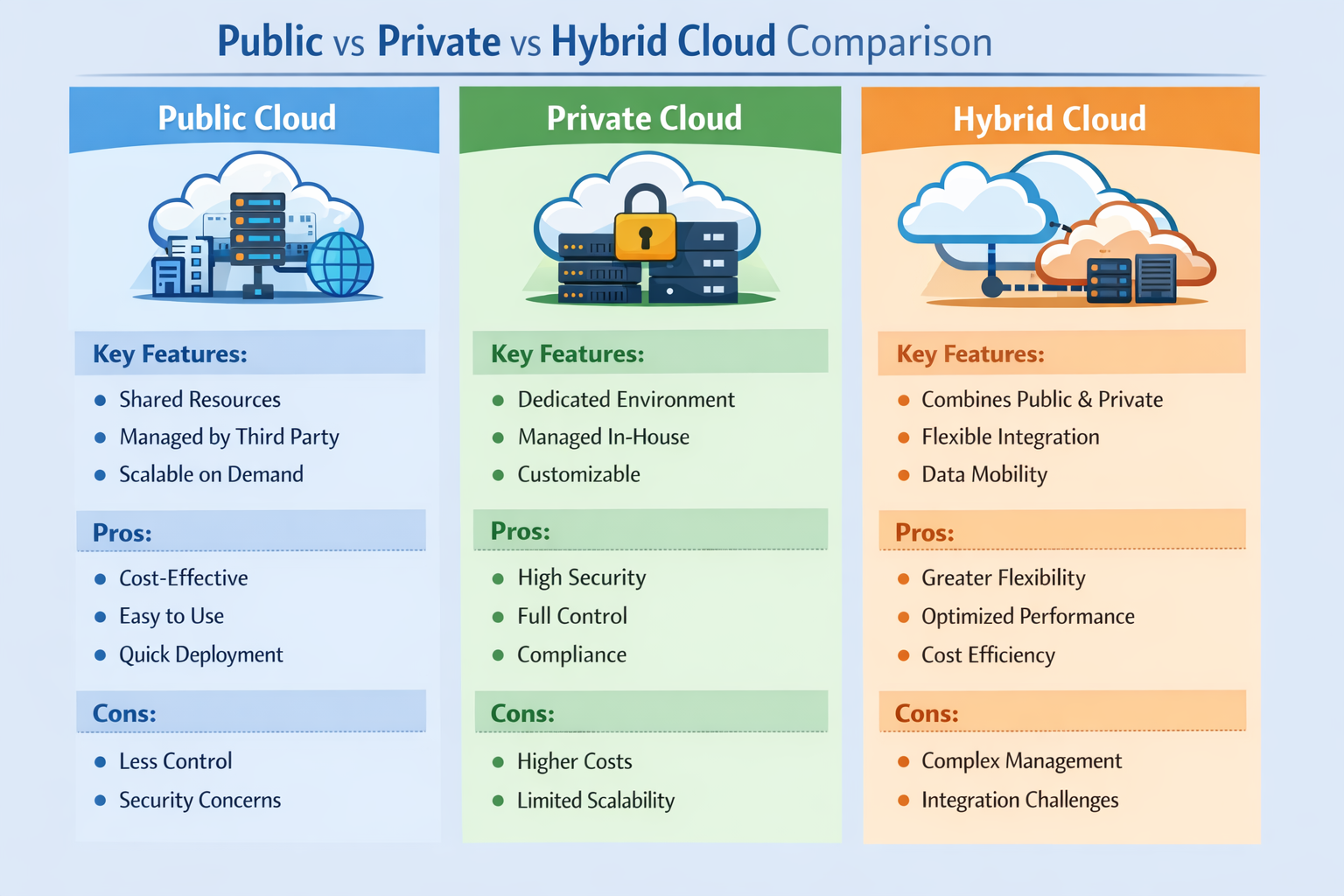
What Are These Cloud Models?
These three models define how cloud infrastructure is deployed and accessed.
Quick Overview
- Public Cloud: Shared cloud environment managed by third-party providers
- Private Cloud: Dedicated cloud environment for a single organization
- Hybrid Cloud: Combination of public and private cloud
Public vs Private vs Hybrid Cloud: Key Differences
Each model has unique characteristics that make it suitable for different use cases.
1. Ownership and Access
This defines who owns the infrastructure and who can access it.
- Public Cloud: Owned by providers and accessible to multiple users
- Private Cloud: Owned by a single organization with restricted access
- Hybrid Cloud: Combination of both shared and private access
2. Cost
Cost varies based on infrastructure and usage model.
- Public Cloud: Low cost with pay-as-you-go pricing
- Private Cloud: High cost due to dedicated infrastructure
- Hybrid Cloud: Balanced cost depending on usage
3. Security
Security depends on how resources are shared and controlled.
- Public Cloud: Moderate security with shared environment
- Private Cloud: High security with dedicated resources
- Hybrid Cloud: High security for sensitive data (private part)
4. Scalability
Scalability defines how easily resources can be expanded.
- Public Cloud: Highly scalable with on-demand resources
- Private Cloud: Limited scalability
- Hybrid Cloud: Highly scalable using public cloud support
5. Control
Control refers to how much authority users have over infrastructure.
- Public Cloud: Limited control
- Private Cloud: Full control
- Hybrid Cloud: Partial control
6. Flexibility
Flexibility shows how easily workloads can be adjusted.
- Public Cloud: High flexibility
- Private Cloud: Moderate flexibility
- Hybrid Cloud: Very high flexibility
7. Performance
Performance depends on resource availability and usage.
- Public Cloud: May vary due to shared resources
- Private Cloud: High and consistent performance
- Hybrid Cloud: Optimized performance
Comparison Table
| Feature | Public Cloud | Private Cloud | Hybrid Cloud |
|---|---|---|---|
| Ownership | Third-party provider | Single organization | Both provider and organization |
| Access | Public/shared | Restricted | Mixed |
| Cost | Low | High | Moderate |
| Security | Moderate | High | High (for sensitive data) |
| Scalability | Very high | Limited | High |
| Control | Low | Full | Partial |
| Flexibility | High | Moderate | Very high |
| Performance | Variable | Stable | Optimized |
Real-World Example
Public Cloud
- Used for hosting websites and applications
- Example: Startup hosting its website on cloud servers
Private Cloud
- Used for sensitive data and secure systems
- Example: Bank storing customer financial data
Hybrid Cloud
- Used for combining security and scalability
- Example: E-commerce company storing payment data privately and hosting website publicly
When to Choose Each Model
Choosing the right model depends on your requirements.
Choose Public Cloud When
- You need low cost and high scalability
- You are a startup or student
Choose Private Cloud When
- You need high security and control
- You handle sensitive data
Choose Hybrid Cloud When
- You need both security and flexibility
- You want to optimize cost and performance
Top 5 FAQs (Interview & Exam Focused)
1. What is the main difference between public and private cloud?
Public cloud is shared among multiple users, while private cloud is dedicated to one organization.
Private cloud offers more security and control compared to public cloud.
2. Why is hybrid cloud used?
Hybrid cloud is used to combine the benefits of public and private cloud.
It provides both scalability and security in one system.
3. Which cloud model is most secure?
Private cloud is the most secure because it is dedicated to a single organization.
Hybrid cloud also provides high security for sensitive data.
4. Which cloud model is cheapest?
Public cloud is the cheapest because it uses shared resources and pay-as-you-go pricing.
Private cloud is more expensive due to dedicated infrastructure.
5. Which cloud model is best for businesses?
It depends on the business needs and requirements.
Many businesses prefer hybrid cloud for balance between cost and security.
Conclusion
Public, private, and hybrid cloud models each serve different purposes.
- Public cloud is cost-effective and scalable
- Private cloud is secure and controlled
- Hybrid cloud combines both for flexibility
Understanding these differences helps in selecting the right cloud deployment model for real-world applications.