












When to Use IaaS vs PaaS vs SaaS
Choosing between IaaS, PaaS, and SaaS depends on your requirements, technical expertise, and the level of control you need. Each model is designed for specific use cases, from full control to complete convenience.
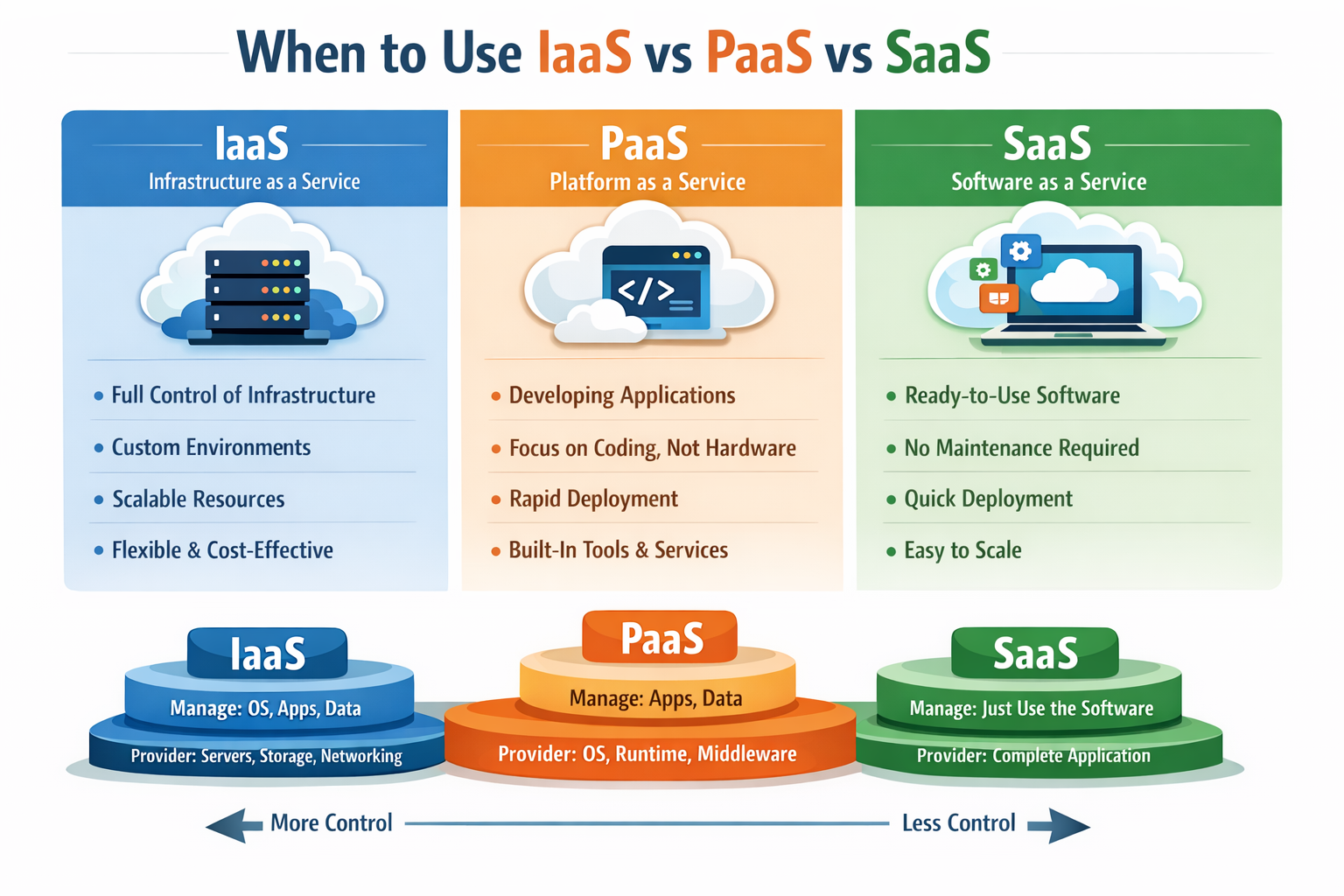
Understanding When to Use Each Model
Each cloud service model serves a different purpose and fits different types of users and projects.
- IaaS: Best when you need full control over infrastructure
- PaaS: Best when you want to develop applications quickly
- SaaS: Best when you need ready-to-use software
When to Use IaaS
IaaS is suitable when you need complete control over servers, operating systems, and configurations.
Ideal Scenarios
- Custom Application Hosting: Used when applications require specific server configurations and environments.
- Testing and Development Environments: Helps create temporary environments for testing and development.
- Backup and Disaster Recovery: Useful for storing and recovering large amounts of data securely.
Why Choose IaaS
- Full Control: Allows complete control over system setup and management.
- High Flexibility: Enables customization based on specific needs.
- Scalability: Resources can be increased or decreased easily.
Best suited for IT professionals, system administrators, and organizations with technical expertise.
When to Use PaaS
PaaS is ideal when you want to focus on building and deploying applications without managing infrastructure.
Ideal Scenarios
- Web and Mobile App Development: Useful for building applications quickly using ready tools.
- API Development: Helps in creating and managing backend services efficiently.
- Rapid Prototyping: Allows quick testing and launching of new ideas.
Why Choose PaaS
- No Infrastructure Management: Servers and operating systems are handled by the provider.
- Faster Development: Built-in tools speed up the development process.
- Reduced Complexity: Simplifies deployment and management.
Best suited for developers, startups, and teams focusing on application development.
When to Use SaaS
SaaS is suitable when you need software that is ready to use without installation or maintenance.
Ideal Scenarios
- Email and Communication: Used for services like email and video meetings.
- Office Productivity: Helps in document creation and collaboration.
- Business Applications: Useful for CRM, accounting, and project management tools.
Why Choose SaaS
- Ease of Use: Requires no setup or technical knowledge.
- Accessibility: Can be accessed from anywhere with internet.
- Low Maintenance: Provider handles updates and security.
Best suited for end users, small businesses, and non-technical users.
Quick Comparison for Usage
This comparison helps in selecting the right model based on use cases.
| Use Case | Best Model |
|---|---|
| Full control over servers | IaaS |
| Build and deploy apps | PaaS |
| Use ready-made software | SaaS |
| Quick setup needed | SaaS |
| Custom system required | IaaS |
| Fast development | PaaS |
Deep Concept: Decision Based on Needs
Choosing the right model depends on control, skills, and time requirements.
Control
- IaaS: Provides full control over infrastructure and systems.
- PaaS: Provides partial control focused on applications.
- SaaS: Provides minimal control with full convenience.
Technical Skill
- IaaS: Requires high technical knowledge.
- PaaS: Requires moderate development skills.
- SaaS: Requires minimal or no technical skills.
Time and Effort
- IaaS: Requires more time for setup and management.
- PaaS: Requires moderate setup time.
- SaaS: Requires no setup and is ready to use.
Real-World Example
A company building a digital solution may use all three models together.
- IaaS is used to host servers and infrastructure.
- PaaS is used to develop and deploy applications.
- SaaS is used for communication and business tools.
This combination improves flexibility and efficiency.
Benefits of Choosing the Right Model
Selecting the correct model improves system performance and efficiency.
- Better Performance: Uses appropriate resources for each task.
- Cost Optimization: Avoids unnecessary spending.
- Faster Development: Reduces time required to build applications.
- Improved Productivity: Allows teams to focus on important tasks.
Conclusion
Understanding when to use IaaS, PaaS, and SaaS is important for building effective cloud solutions. Each model serves a different purpose, and choosing the right one helps achieve better scalability, performance, and cost efficiency.