









Advantages of Private Cloud
Private cloud is a cloud deployment model where computing resources are dedicated to a single organization. It offers greater control, security, and customization compared to public cloud. Understanding the advantages of private cloud helps organizations choose it for sensitive and critical workloads.
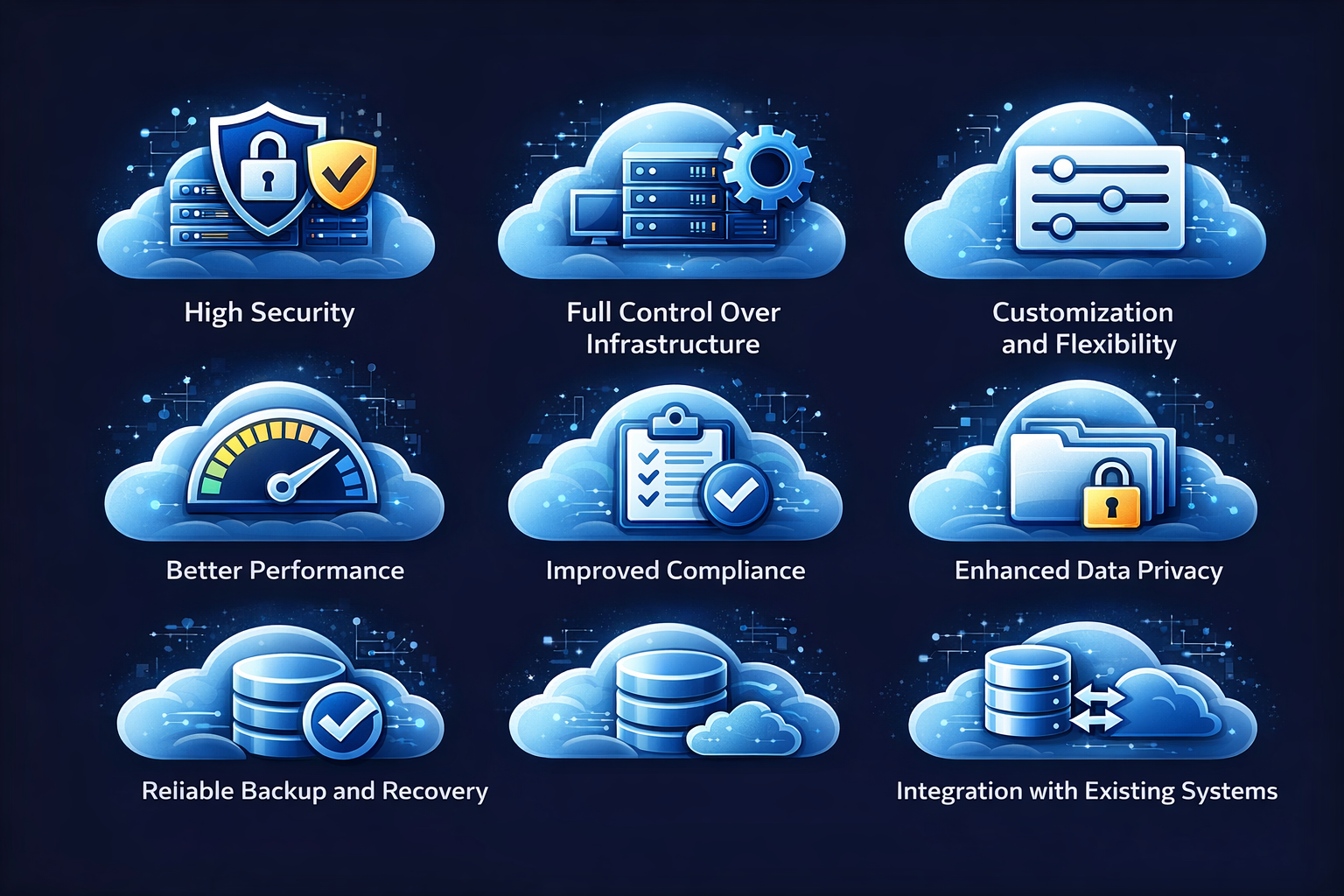
Let us explain each advantage of the private cloud in detail.
1. High Security in Private Cloud
Private cloud offers a highly secure computing environment because all resources are dedicated to a single organization. Unlike public cloud, where multiple users share the same infrastructure, private cloud ensures that sensitive data and applications remain isolated. This level of control allows organizations to design and implement strong security measures based on their specific needs, making it ideal for industries that handle confidential information.
Benefits of High Security
- Isolated Environment: All data and applications are hosted on dedicated infrastructure, which minimizes exposure to external threats and reduces the risk of data breaches.
- Restricted Access: Access is strictly controlled through authentication and authorization mechanisms, ensuring that only approved users can interact with the system.
- Custom Security Policies: Organizations can implement tailored security strategies such as firewalls, encryption standards, intrusion detection systems, and compliance controls.
- Data Privacy and Compliance: Private cloud makes it easier to comply with strict regulatory requirements such as financial, healthcare, or government data protection laws.
- Reduced Risk of Multi-Tenancy Issues: Since resources are not shared with other users, risks related to data leakage or unauthorized access from other tenants are eliminated.
- Better Monitoring and Control: IT teams can continuously monitor systems, detect vulnerabilities early, and respond quickly to potential security threats.
Example
A banking institution uses a private cloud to store customer financial records and transaction data. By keeping the infrastructure exclusive, the bank ensures strict access control, follows regulatory compliance, and protects sensitive information from unauthorized access or cyber threats.
2. Full Control Over Infrastructure
Private cloud gives organizations complete control over their computing environment, including servers, storage, networking, and software configurations. Unlike public cloud, where infrastructure is managed by the provider, private cloud allows businesses to customize and manage everything according to their specific requirements. This level of control is especially important for organizations that need flexibility, performance optimization, and strict governance.
Benefits of Full Control Over Infrastructure
- Custom Configurations:
Organizations can design and configure infrastructure based on their exact needs, ensuring optimal performance for specific applications and workloads. - Control Over Data Management:
Businesses decide how data is stored, processed, and secured, which improves data governance and ensures compliance with internal policies. - Flexible Resource Allocation:
Resources such as CPU, memory, and storage can be allocated and adjusted as needed, giving better control over system performance. - Independent System Management:
IT teams have full authority to manage updates, maintenance, and system operations without relying on third-party providers. - Performance Optimization:
Infrastructure can be fine-tuned to meet high-performance requirements, making it suitable for critical applications and large-scale systems. - Enhanced Reliability and Stability:
Since systems are dedicated, organizations can ensure consistent performance without being affected by other users.
Example
A large enterprise runs its business-critical applications on a private cloud. The IT team configures servers, storage, and network settings based on workload requirements, ensuring high performance, strong security, and full operational control.
3. Customization and Flexibility
Private cloud provides a highly customizable and flexible environment where organizations can design their infrastructure according to specific business needs. Unlike standardized public cloud services, private cloud allows full freedom to tailor systems, applications, and configurations. This makes it ideal for businesses with unique workloads, specialized applications, or strict operational requirements.
Benefits of Customization and Flexibility
- Tailored Infrastructure Design:
Organizations can build infrastructure that perfectly matches their workload requirements, ensuring better efficiency and performance. - Support for Specialized Applications:
Private cloud can be customized to run complex or legacy applications that may not work well in standard public cloud environments. - Flexible System Configuration:
IT teams can modify operating systems, software, and network settings based on changing business needs. - Scalable Custom Solutions:
Systems can be expanded or adjusted while still maintaining customized configurations, providing both flexibility and control. - Integration with Existing Systems:
Private cloud can easily integrate with on-premise systems and existing IT infrastructure, ensuring smooth operations. - Adaptability to Business Changes:
Organizations can quickly adjust their environment to support new technologies, processes, or business strategies.
Example
A healthcare organization uses a private cloud to run its medical record system. The infrastructure is customized to meet strict healthcare regulations, support specialized software, and ensure secure handling of patient data while adapting to future needs.
4. Better Performance
Private cloud delivers high performance because all computing resources are dedicated to a single organization. Unlike shared environments, there is no competition for CPU, memory, storage, or network bandwidth. This ensures faster processing, low latency, and consistent system behavior, making private cloud ideal for performance-critical applications.
Benefits of Better Performance
- Dedicated Resources:
All hardware resources such as servers, storage, and networking are reserved for one organization, ensuring consistent and reliable performance. - Low Latency:
Data processing and communication are faster because systems are not overloaded by other users, reducing delays in applications. - Optimized Workloads:
Infrastructure can be tuned specifically for certain applications, improving speed and efficiency. - Consistent Performance Levels:
Applications run smoothly without unexpected slowdowns caused by other users sharing the system. - High-Speed Data Processing:
Ideal for data-intensive tasks such as analytics, real-time processing, and large-scale computations. - Improved User Experience:
Faster response times and stable performance lead to better productivity and satisfaction for users.
Example
A financial trading company uses a private cloud to execute real-time transactions. Because of dedicated resources and low latency, trades are processed instantly without delays, ensuring accurate and high-speed operations.
5. Improved Compliance
Private cloud helps organizations meet strict regulatory and legal requirements by providing full control over data, infrastructure, and security policies. Since the environment is dedicated, businesses can design systems that align with industry standards and government regulations, making compliance easier and more reliable.
Benefits of Improved Compliance
- Regulatory Alignment:
Organizations can configure their systems to comply with industry regulations such as financial, healthcare, or government standards. - Data Residency Control:
Businesses can choose where data is stored, ensuring it remains within specific geographic locations required by law. - Audit Readiness:
Private cloud environments allow detailed logging and monitoring, making it easier to prepare for audits and inspections. - Custom Compliance Policies:
Organizations can implement policies tailored to their compliance needs, including encryption, access control, and data retention rules. - Enhanced Data Governance:
Full control over data lifecycle management ensures proper handling, storage, and deletion of sensitive information. - Reduced Legal Risks:
By meeting compliance requirements, organizations minimize the risk of penalties, fines, and legal issues.
Example
A healthcare organization uses a private cloud to store patient records. The system is configured to comply with healthcare data regulations, ensuring patient privacy, secure data handling, and easy audit tracking.
6. Enhanced Data Privacy
Private cloud ensures a high level of data privacy because all data is stored and managed within a dedicated environment. Unlike shared cloud models, sensitive information is not exposed to other users or organizations. This makes private cloud an ideal choice for businesses that handle confidential, personal, or critical data.
Benefits of Enhanced Data Privacy
- Complete Data Ownership:
Organizations have full control over their data, ensuring it is not accessed, shared, or processed by unauthorized parties. - Strict Access Controls:
Advanced authentication and authorization mechanisms ensure that only approved users can access sensitive information. - Data Isolation:
Since infrastructure is not shared, data remains completely isolated from other organizations, reducing the risk of data leakage. - Custom Privacy Policies:
Businesses can define and enforce their own privacy rules, including encryption, data masking, and access restrictions. - Secure Data Handling:
Data can be securely stored, transmitted, and processed using organization-specific security standards. - Protection of Sensitive Information:
Ideal for industries like healthcare, banking, and government where protecting personal and confidential data is critical.
Example
A government organization uses a private cloud to store citizen records. The data remains fully isolated and protected, with strict access controls ensuring that only authorized officials can view or manage sensitive information.
7. Reliable Backup and Recovery
Private cloud provides strong backup and recovery capabilities, ensuring that data is protected against loss, corruption, or system failures. Since organizations have full control over their infrastructure, they can design customized backup strategies and disaster recovery plans to maintain business continuity.
Benefits of Reliable Backup and Recovery
- Automated Backup Systems:
Organizations can schedule automatic backups at regular intervals, ensuring data is always up to date and protected. - Quick Data Recovery:
In case of system failure, data can be restored بسرعة, minimizing downtime and operational disruption. - Custom Backup Strategies:
Businesses can define backup policies based on data importance, such as full backups, incremental backups, or real-time replication. - Disaster Recovery Planning:
Private cloud supports advanced disaster recovery solutions, including failover systems and geographically distributed backups. - Data Integrity Protection:
Backup systems ensure that data remains accurate, consistent, and free from corruption. - Business Continuity:
Even during unexpected events like hardware failure or cyberattacks, operations can continue with minimal impact.
Example
A large e-commerce company uses a private cloud to back up its customer data and transaction records. In case of a server crash, the system quickly restores data from backups, ensuring that business operations continue without major interruptions.
8. Integration with Existing Systems
Private cloud allows seamless integration with an organization’s existing IT infrastructure, including on-premise systems, legacy applications, and internal networks. This ensures a smooth transition to cloud computing without disrupting current operations. Organizations can extend their current systems rather than replacing them, making private cloud a practical and efficient solution.
Benefits of Integration with Existing Systems
- Seamless Connectivity:
Private cloud can easily connect with existing servers, databases, and applications, ensuring smooth data flow across systems. - Support for Legacy Systems:
Older applications that are critical to business operations can continue to run without requiring major modifications. - Hybrid Environment Compatibility:
Organizations can combine private cloud with on-premise infrastructure, creating a flexible hybrid setup. - Reduced Migration Risk:
Gradual integration reduces the risk of system failure or data loss during migration to the cloud. - Improved Operational Efficiency:
Integrated systems work together efficiently, reducing duplication and improving workflow. - Cost-Effective Transition:
Businesses can reuse existing resources and investments instead of completely rebuilding their IT infrastructure.
Example
A manufacturing company integrates its existing enterprise resource planning (ERP) system with a private cloud. This allows real-time data sharing between departments while maintaining control over critical business processes.
Top 5 FAQs (Interview & Exam Focused)
1. What is the biggest advantage of private cloud?
The biggest advantage is high security and full control over infrastructure.
It is ideal for organizations handling sensitive and confidential data.
2. Why is private cloud more secure?
Because it uses a dedicated environment with restricted access.
Organizations can apply custom security policies for better protection.
3. Who should use private cloud?
Private cloud is suitable for banks, healthcare, and government organizations.
It is best for handling sensitive data and meeting compliance requirements.
4. Does private cloud provide better performance?
Yes, because resources are not shared with other users.
This ensures stable and consistent performance for applications.
5. Can private cloud be customized?
Yes, it allows full customization based on organizational needs.
Systems can be tailored for specific applications and workloads.
Conclusion
Private cloud is a powerful solution for organizations that require high security, full control, and customized environments. It provides a dedicated infrastructure that ensures better performance, strong data privacy, and regulatory compliance. Businesses can design systems according to their needs while maintaining reliability and operational efficiency. With features like backup, recovery, and seamless integration, private cloud supports long-term stability and growth. Overall, it is the best choice for organizations handling sensitive, critical, and high-value data.