












Cloud Infrastructure Explained (Servers, Storage, Networking)
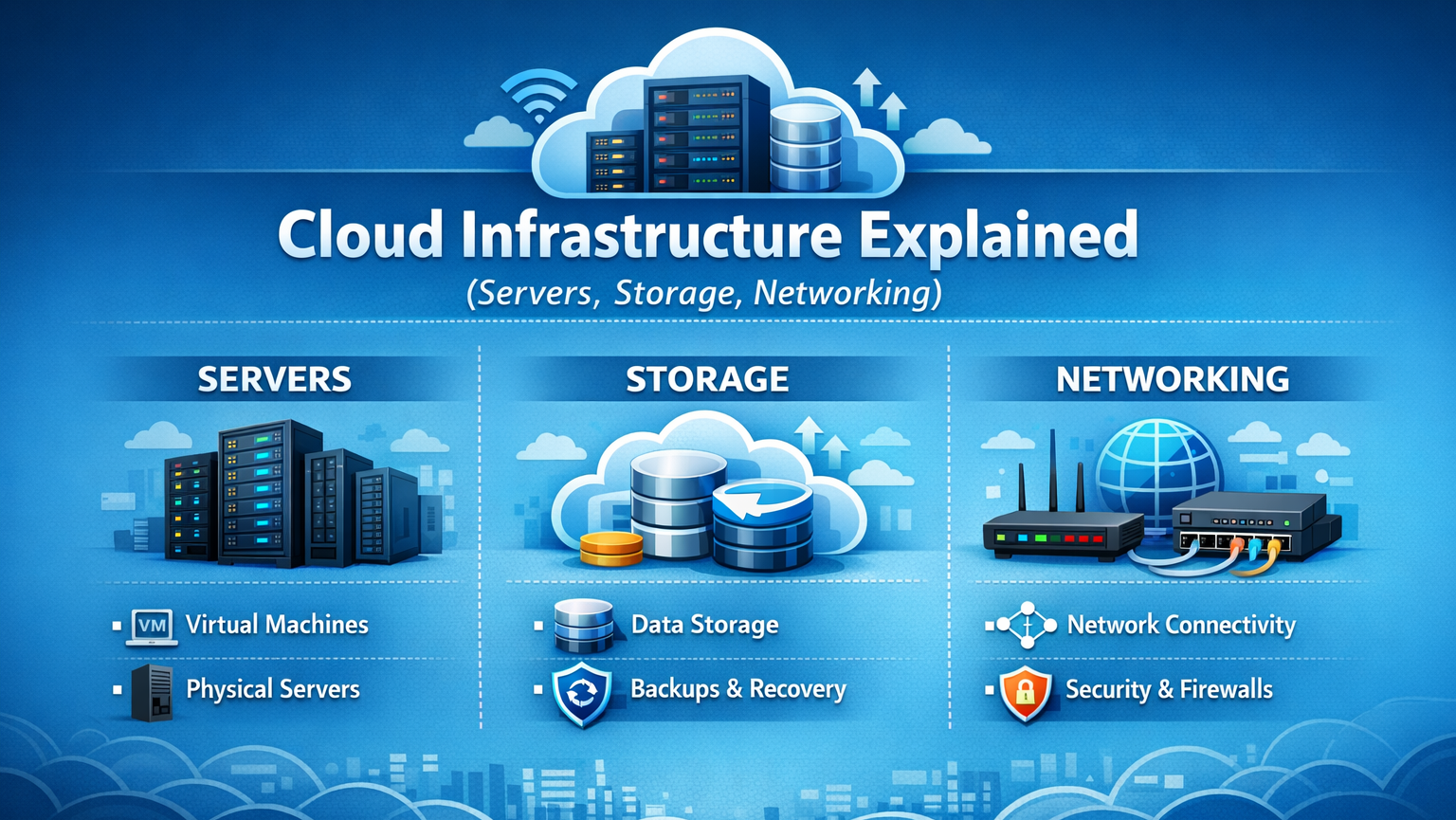
Cloud infrastructure is the core foundation of cloud computing. It includes servers, storage systems, and networking components that work together to deliver cloud services over the internet.
What is Cloud Infrastructure?
Cloud infrastructure refers to the hardware and software resources used to build and run cloud environments.
- Compute Resources: Servers that process data
- Storage Systems: Systems that store data
- Networking: Connects all components and users
Why Cloud Infrastructure is Important
Cloud infrastructure enables applications and services to run smoothly and efficiently.
- Performance: Ensures fast processing of data
- Scalability: Supports growth in users and workloads
- Reliability: Keeps systems available and stable
- Cost Efficiency: Reduces need for physical hardware
Core Components of Cloud Infrastructure
Cloud infrastructure is mainly built on three key components.
Servers (Compute)
Servers are powerful machines that process requests and run applications in the cloud.
What Servers Do
- Execute applications and services
- Handle user requests
- Perform data processing
Key Features
- Virtual Machines: Multiple virtual servers on one physical machine
- High Performance: Designed for heavy workloads
- Scalability: Can increase or decrease resources
Storage Systems
Storage systems are used to store and manage data in the cloud.
What Storage Does
- Store files, databases, and backups
- Provide data access when needed
Types of Storage
- Object Storage: For unstructured data like images and videos
- Block Storage: For high-performance applications
- File Storage: For shared file systems
Key Features
- Durability: Data is protected with backups
- Scalability: Storage grows as needed
- Accessibility: Access data from anywhere
Networking
Networking connects servers, storage, and users in the cloud.
What Networking Does
- Enables communication between systems
- Transfers data between users and cloud
Key Components
- Virtual Networks: Private networks in the cloud
- Load Balancers: Distribute traffic across servers
- Firewalls: Protect systems from threats
How These Components Work Together
Cloud infrastructure works by combining servers, storage, and networking into a unified system.
Step-by-Step Process
- User sends a request through internet
- Networking routes the request to servers
- Servers process the request
- Storage provides required data
- Response is sent back to user
Deep Concepts in Cloud Infrastructure
Understanding these concepts helps in building better systems.
Virtualization
Physical hardware is divided into multiple virtual resources.
This allows efficient use of infrastructure.
Elasticity
Resources automatically adjust based on demand.
This ensures optimal performance and cost efficiency.
Load Distribution
Workloads are shared across multiple servers.
This prevents overload and improves performance.
Redundancy
Multiple systems are used as backups.
This ensures continuous operation during failures.
Benefits of Cloud Infrastructure
Cloud infrastructure provides several advantages.
- Scalability: Easily handle growth
- Flexibility: Adapt to different workloads
- Cost Savings: Pay only for usage
- High Availability: Systems remain active
Challenges of Cloud Infrastructure
Some challenges need to be managed carefully.
- Security Risks: Protecting data and systems
- Complex Management: Requires proper configuration
- Network Dependency: Relies on internet connectivity
Real-World Example
When you open a website:
- Networking sends your request to cloud servers
- Servers process the request
- Storage retrieves data
- Website loads on your screen
This entire process is powered by cloud infrastructure.
Conclusion
Cloud infrastructure, including servers, storage, and networking, forms the backbone of cloud computing. These components work together to deliver scalable, reliable, and efficient services, making cloud technology essential for modern applications.