












Community Cloud Use Cases
Community cloud is used in scenarios where multiple organizations share common goals, security requirements, or compliance standards. It enables collaboration while maintaining controlled access and cost efficiency. Understanding community cloud use cases helps students and professionals connect concepts with real-world applications.
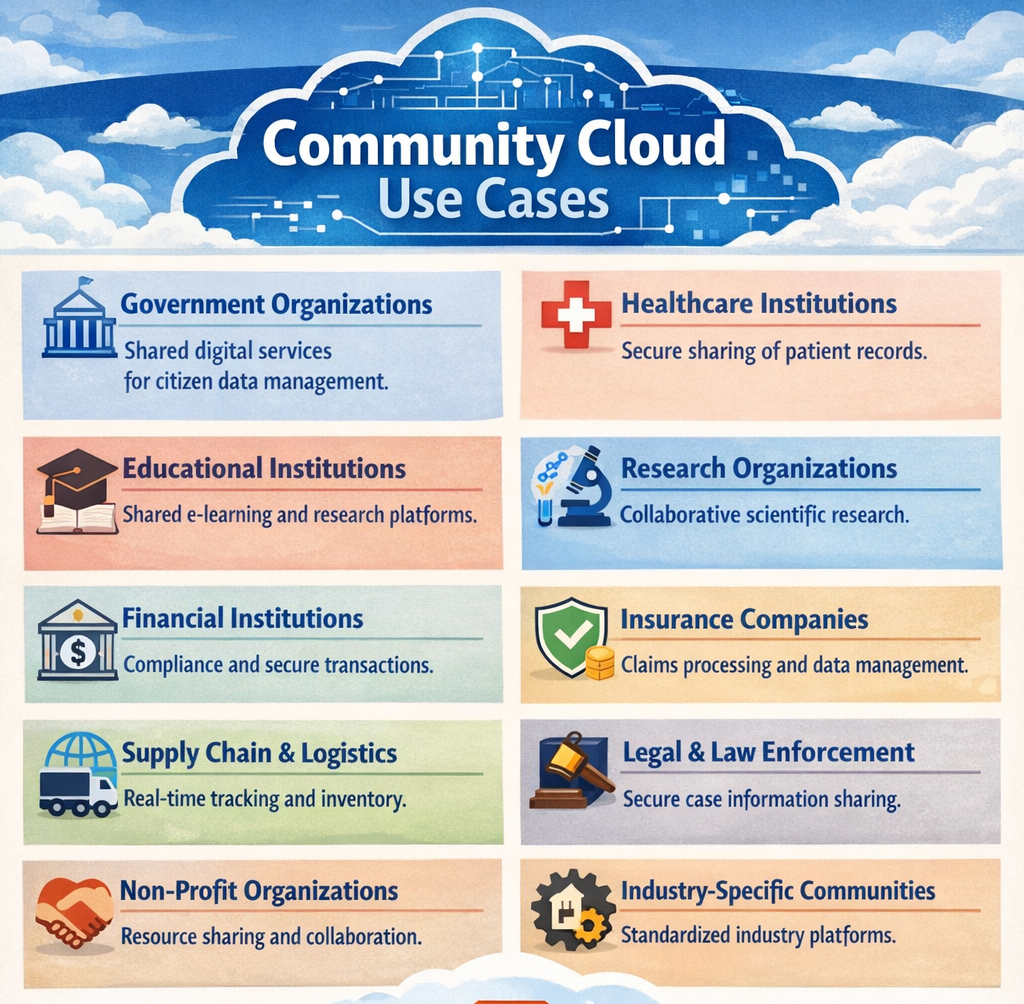
Let us explore the major community cloud use cases in detail.
1. Government Organizations
Community cloud is commonly used by government departments to provide secure and unified digital services.
Use Case Details
- Shared Infrastructure: Multiple government departments use the same cloud platform to improve efficiency.
- Secure Data Sharing: Sensitive citizen data is shared only among authorized agencies.
- Centralized Services: Enables unified portals for services like taxation, identity management, and public records.
Example
Different government departments use a shared cloud system to manage citizen records, reducing duplication and improving service delivery.
2. Healthcare Institutions
Healthcare organizations use community cloud to securely manage patient data and improve collaboration between medical professionals.
Use Case Details
- Patient Data Sharing: Hospitals and clinics can securely access and share medical records.
- Compliance Support: Meets strict healthcare regulations and data protection standards.
- Collaboration: Doctors and specialists can coordinate treatments more effectively.
Example
Hospitals share patient records and treatment history through a secure community cloud system, improving diagnosis and care.
3. Educational Institutions
Community cloud is widely used in education to support learning, research, and administrative activities.
Use Case Details
- Shared Learning Resources: Universities share digital content, e-books, and learning platforms.
- Research Collaboration: Students and researchers collaborate across institutions.
- Centralized Systems: Provides unified platforms for admissions, results, and academic management.
Example
Multiple universities share research data and online learning systems using a common cloud platform.
4. Research Organizations
Research institutions rely on community cloud to handle large datasets and collaborative projects securely.
Use Case Details
- Data Sharing: Researchers can access and share large volumes of data easily.
- Collaborative Environment: Multiple organizations work together on joint research projects.
- Secure Research Data: Protects intellectual property and sensitive findings.
Example
Scientific research organizations use a shared cloud platform to collaborate on experiments and share analytical tools.
5. Financial Institutions
Financial organizations use community cloud to meet strict regulatory requirements while reducing operational costs.
Use Case Details
- Regulatory Compliance: Ensures adherence to financial laws and standards.
- Secure Transactions: Protects sensitive financial data and transactions.
- Shared Infrastructure: Reduces infrastructure and maintenance costs.
Example
Banks and financial institutions use a shared cloud platform to manage compliance, transactions, and customer data securely.
6. Insurance Companies
Community cloud is widely used in the insurance industry to manage customer data, policies, and claims efficiently.
Use Case Details
- Secure Data Sharing: Insurance firms exchange customer and policy data within a trusted environment.
- Process Automation: Automates claims processing, reducing manual work and delays.
- Compliance Support: Ensures adherence to insurance regulations and data protection laws.
Example
Multiple insurance companies use a shared cloud platform to manage claims processing and customer records securely.
7. Supply Chain and Logistics
Community cloud helps organizations in supply chains improve coordination, transparency, and efficiency.
Use Case Details
- Real-Time Tracking: Enables sharing of shipment and logistics data instantly.
- Collaboration: Suppliers, manufacturers, and distributors work together seamlessly.
- Data Visibility: Improves transparency across the entire supply chain.
Example
Companies involved in production and delivery share cloud data to track shipments and manage inventory in real time.
8. Legal and Law Enforcement Agencies
Community cloud is used to securely share sensitive legal and criminal data among authorized agencies.
Use Case Details
- Secure Data Exchange: Case files, evidence, and records are shared securely.
- Restricted Access: Only authorized departments can access confidential information.
- Improved Coordination: Enhances collaboration between law enforcement agencies.
Example
Police and legal departments use a shared cloud system to access criminal records and case information securely.
9. Non-Profit Organizations
Non-profit organizations use community cloud to collaborate, manage resources, and reduce costs.
Use Case Details
- Shared Tools and Platforms: Access common applications for project management and communication.
- Cost Efficiency: Reduces infrastructure and operational expenses.
- Collaboration: Supports teamwork across multiple organizations and regions.
Example
Non-profit groups share a cloud platform to manage donations, campaigns, and social projects.
10. Industry-Specific Communities
Community cloud is ideal for industries with shared standards, workflows, and regulatory requirements.
Use Case Details
- Standardized Systems: Designed according to industry-specific needs.
- Shared Resources: Organizations collaborate using common tools and platforms.
- Regulatory Compliance: Ensures adherence to industry laws and standards.
Example
Manufacturing companies use a shared cloud platform to manage production data and streamline operations.
Top 5 FAQs (Interview & Exam Focused)
1. What are community cloud use cases?
Community cloud is used in sectors like government, healthcare, education, research, and finance where organizations share common goals, security needs, and compliance requirements.
2. Why is community cloud used in healthcare?
It enables secure sharing of patient data among hospitals and clinics while ensuring compliance with healthcare regulations and privacy standards.
3. Can educational institutions use community cloud?
Yes, universities use community cloud for research collaboration, shared learning resources, and centralized academic systems.
4. Is community cloud suitable for financial institutions?
Yes, it helps financial organizations meet regulatory requirements, share infrastructure, and securely manage sensitive financial data.
5. Who should use community cloud?
Organizations with similar requirements such as government agencies, healthcare providers, research institutions, and industry groups benefit the most from community cloud.
Conclusion
Community cloud is widely adopted in industries where organizations share common goals, security requirements, and regulatory standards. It provides a collaborative environment while maintaining controlled access and efficient resource usage.
- Supports Secure Data Sharing: Enables safe exchange of sensitive information within a trusted group.
- Enables Collaboration Across Organizations: Promotes teamwork and joint initiatives across institutions.
- Reduces Cost Through Shared Infrastructure: Distributes infrastructure costs among participants, improving efficiency.
Understanding these real-world use cases helps learners and professionals apply community cloud concepts effectively in practical environments.