












Advantages and Disadvantages of Infrastructure as a Service (IaaS)
Infrastructure as a Service (IaaS) is a cloud computing model that provides virtualized computing resources over the internet. It allows users to rent servers, storage, and networking instead of purchasing physical hardware. Understanding the advantages and disadvantages of IaaS helps students, developers, and businesses make better decisions when adopting cloud technology.
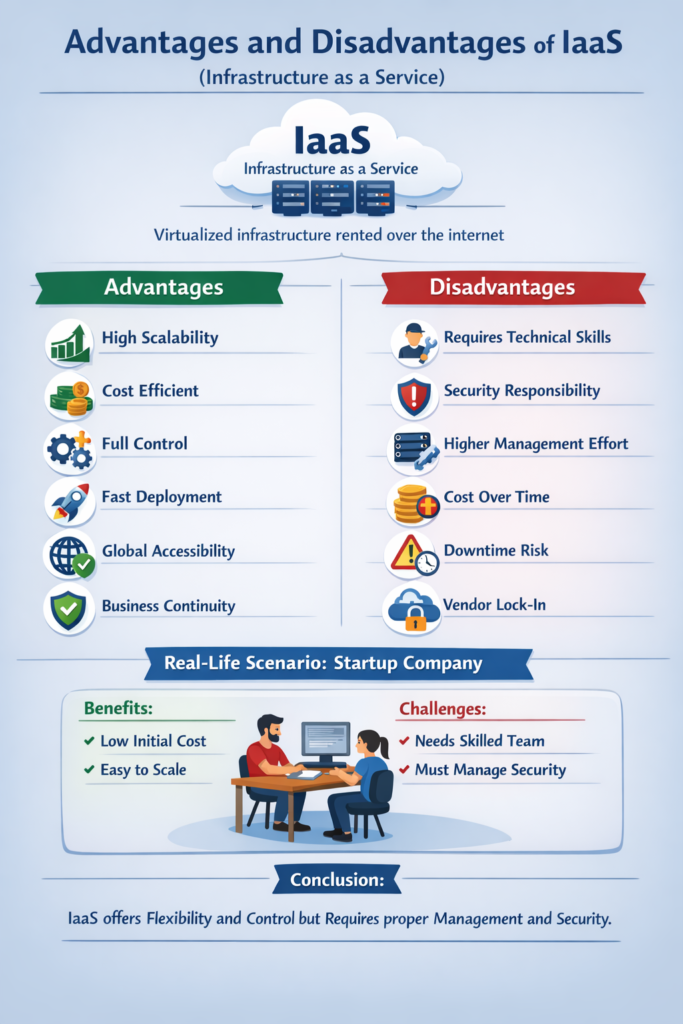
Let us explain each advantage and disadvantage of Infrastructure as a Service (IaaS) in detail.
Advantages of Infrastructure as a Service (IaaS)
IaaS offers several benefits that make it a popular choice for modern computing environments.
1. High Scalability
IaaS allows users to scale resources up or down easily based on demand, making it ideal for growing applications.
How It Helps
Users can increase or decrease:
-
Server capacity
-
Storage
-
Network usage
Example
An e-commerce website increases server capacity during a sale and reduces it afterward to save costs.
2. Cost Efficiency
IaaS reduces the need for upfront investment in hardware and follows a pay-as-you-go model.
Benefits
-
No need to purchase physical servers
-
Lower maintenance costs
-
Flexible pricing
Example
A startup uses cloud servers instead of buying expensive infrastructure.
3. Full Control and Flexibility
IaaS gives users complete control over their computing environment.
What You Control
-
Operating system
-
Applications
-
Software configuration
-
Security settings
Example
A developer installs custom software and tools according to project needs.
4. Fast Deployment
IaaS enables quick setup of servers and infrastructure.
Benefits
-
Saves time
-
Instant availability
-
Faster project launch
Example
A virtual machine can be created in minutes instead of waiting weeks for physical hardware.
5. Global Accessibility
IaaS services can be accessed from anywhere with an internet connection.
Benefits
-
Supports remote work
-
Enables global collaboration
-
Easy access to resources
Example
A developer in one country accesses servers hosted in another country.
6. Backup and Disaster Recovery
IaaS providers offer backup solutions and recovery systems to protect data.
Features
-
Automatic backups
-
Data recovery options
-
Business continuity
Example
If a system crashes, data can be restored from cloud backups.
7. Supports Innovation
IaaS allows businesses to experiment and test new ideas without heavy investment.
Benefits
-
Easy testing environments
-
Risk reduction
-
Faster innovation
Example
A startup tests new applications without buying hardware.
Disadvantages of Infrastructure as a Service (IaaS)
Despite its benefits, IaaS also has some limitations that users should consider.
1. Requires Technical Knowledge
IaaS requires users to have knowledge of system management and networking.
Challenges
-
Learning curve for beginners
-
Complex configurations
Example
A student may struggle to configure a server properly.
2. Security Responsibility
Users are responsible for securing their applications and data.
Risks
-
Misconfigured security settings
-
Data breaches
-
Unauthorized access
Example
Weak security settings can expose sensitive data.
3. High Management Effort
IaaS requires continuous monitoring and maintenance of infrastructure.
Tasks Involved
-
Software updates
-
System monitoring
-
Troubleshooting
Example
A company must regularly update and manage its servers.
4. Cost Can Increase Over Time
Although initially cost-effective, improper usage can increase expenses.
Reasons
-
Running unused resources
-
Poor resource management
Example
Keeping servers running unnecessarily increases billing.
5. Downtime Dependency
IaaS services depend on the cloud provider’s uptime.
Issue
-
Service interruptions during outages
Example
If the provider’s servers go down, applications may become unavailable.
6. Vendor Lock-In
Switching between cloud providers can be difficult.
Challenges
-
Compatibility issues
-
Migration complexity
Example
Moving applications from one provider to another may require major changes.
Why Understanding Advantages and Disadvantages is Important
Knowing both sides of IaaS helps users choose the right cloud solution based on their needs.
For Students
-
Helps in exams and interviews
-
Builds strong cloud concepts
For Developers
-
Helps select the right platform
-
Improves efficiency
For Businesses
-
Reduces risks
-
Optimizes cost
-
Improves decision-making
Conclusion
Infrastructure as a Service (IaaS) is a powerful cloud model that offers flexibility, scalability, and control, but it also requires proper management and technical knowledge.
-
Provides high scalability and flexibility
-
Reduces infrastructure cost
-
Requires security and management responsibility
Understanding both advantages and disadvantages ensures effective and smart use of IaaS in real-world scenarios.