












Benefits of Multi-Cloud Deployment
Multi-cloud deployment is a strategy where organizations use multiple cloud service providers to run applications, store data, and manage workloads. It helps improve flexibility, reliability, and performance by leveraging the strengths of different cloud platforms.
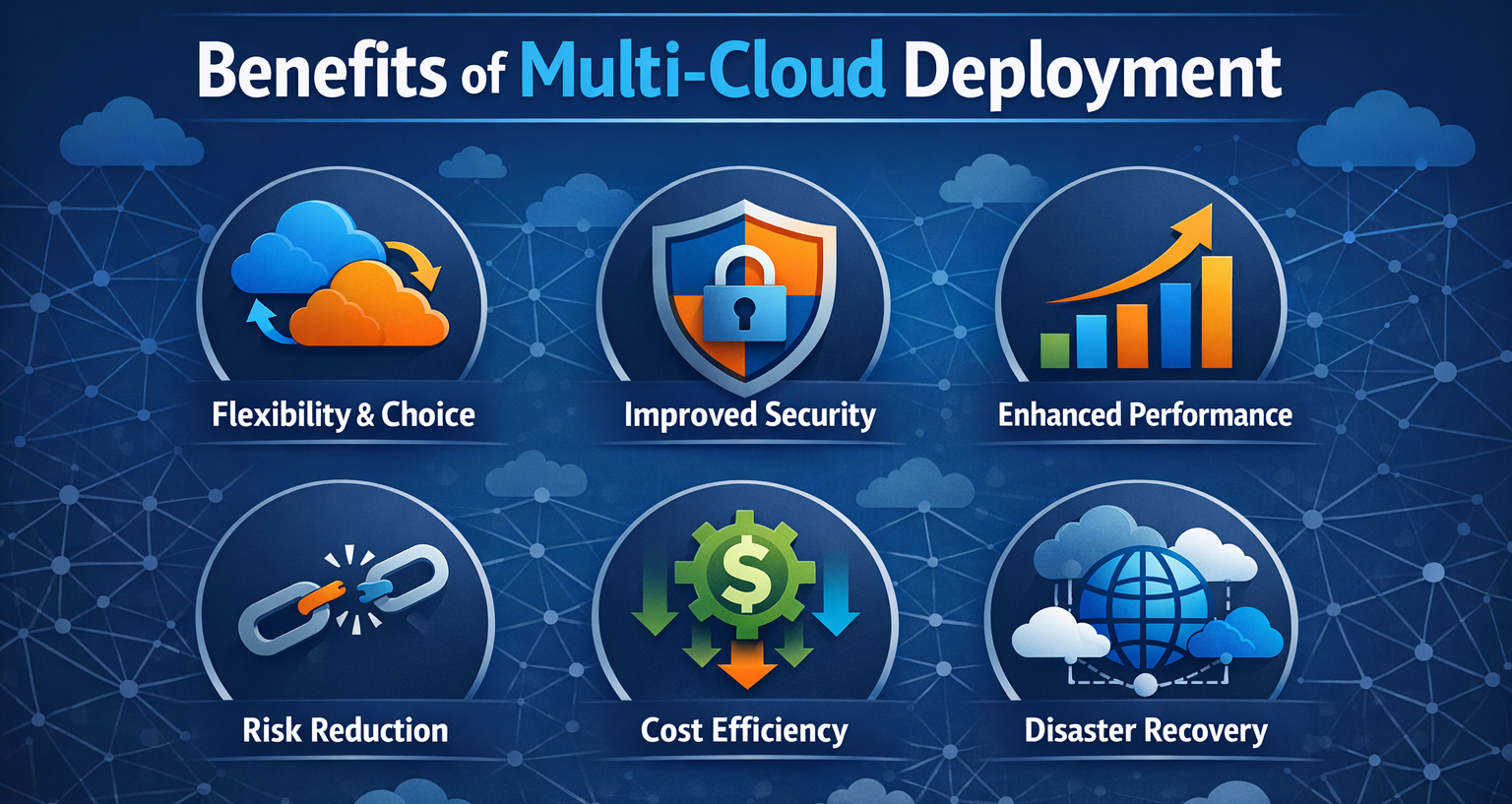
Let us explain each benefit of multi-cloud deployment in detail.
1. Avoids Vendor Lock-In
Multi-cloud helps organizations avoid dependency on a single cloud provider, giving them greater freedom and control.
Benefits
- Freedom of Choice: Organizations can switch providers or services without being restricted.
- Reduced Risk: Critical operations are not dependent on one vendor.
- Stronger Negotiation Power: Companies can choose the most cost-effective and suitable services.
Example
A company uses AWS for application hosting and Google Cloud for analytics, ensuring it is not dependent on a single provider.
2. Improved Reliability and Availability
Using multiple cloud providers increases system uptime and ensures continuous service availability.
Benefits
- Backup Systems: If one provider fails, others can continue operations.
- Reduced Downtime: Services remain available even during outages.
- High Availability: Ensures consistent and reliable application performance.
Example
If one cloud provider experiences downtime, traffic is automatically redirected to another provider to maintain service.
3. Better Performance Optimization
Multi-cloud allows organizations to use the best services from different providers for optimal performance.
Benefits
- Service Specialization: Choose the most efficient tools for each task.
- Improved Speed: Use providers with better infrastructure in specific regions.
- Optimized Workloads: Applications run where they perform best.
Example
A business uses Google Cloud for data analytics and AWS for storage to maximize performance efficiency.
4. Cost Optimization
Multi-cloud enables better cost management by selecting the most affordable services across providers.
Benefits
- Flexible Pricing Options: Choose providers with the best pricing for specific services.
- Avoid Overpricing: No dependency on a single provider’s pricing model.
- Efficient Resource Usage: Allocate resources based on budget and demand.
Example
A company uses one provider for low-cost storage and another for computing to reduce overall expenses.
5. Enhanced Flexibility
Multi-cloud provides flexibility in deploying and managing applications across different platforms.
Benefits
- Multiple Deployment Options: Applications can run on different cloud environments.
- Adaptability: Easily adjust strategies based on business needs.
- Platform Independence: No restriction to a single ecosystem.
Example
Developers deploy applications across different clouds depending on performance, cost, or feature requirements.
6. Geographic Distribution
Multi-cloud supports global deployment, improving performance for users worldwide.
Benefits
- Global Reach: Applications can serve users across different regions.
- Low Latency: Data centers closer to users improve speed.
- Better User Experience: Faster response times enhance usability.
Example
A streaming service uses multiple cloud providers to deliver content quickly to users around the world.
7. Enhanced Security
Multi-cloud improves security by distributing workloads and reducing single points of failure.
Benefits
- Risk Distribution: Data is spread across multiple platforms.
- Provider Diversity: Different providers offer unique security features.
- Reduced Impact of Breaches: Limits damage if one system is compromised.
Example
A company stores sensitive data across multiple cloud providers to increase protection and resilience.
8. Supports Innovation
Multi-cloud encourages innovation by providing access to diverse tools and technologies.
Benefits
- Access to Advanced Services: Use AI, analytics, and specialized tools from different providers.
- Faster Development: Developers can experiment with multiple platforms.
- No Limitations: Avoid being restricted by a single provider’s capabilities.
Example
Developers use AI services from one provider and big data tools from another to build advanced applications.
Top 5 FAQs (Interview & Exam Focused)
1. What is the main benefit of multi-cloud deployment?
The main benefit of multi-cloud deployment is flexibility and avoidance of vendor lock-in. Organizations are not dependent on a single cloud provider, which allows them to choose the best services from different platforms. This helps improve performance, optimize costs, and maintain greater control over their cloud environment.
2. How does multi-cloud improve reliability?
Multi-cloud improves reliability by distributing workloads across multiple cloud providers. If one provider experiences downtime or failure, other providers continue to operate without interruption. This ensures high availability of applications and reduces the risk of service disruption.
3. Is multi-cloud cost-effective?
Yes, multi-cloud can be cost-effective because organizations can select services based on pricing from different providers. This flexibility helps avoid overpaying and allows efficient use of resources. By choosing cost-effective solutions for specific tasks, businesses can better manage their overall cloud expenses.
4. How does multi-cloud improve performance?
Multi-cloud enhances performance by allowing workloads to run on the most suitable cloud platform. Organizations can choose providers that offer better speed, lower latency, or specialized services for specific tasks. This results in improved efficiency and a better user experience.
5. Who should use multi-cloud?
Multi-cloud is most suitable for large enterprises, global applications, and organizations with complex or distributed workloads. It is ideal for businesses that require flexibility, high performance, and strong reliability across different regions and services.
Conclusion
Multi-cloud deployment is a powerful cloud strategy that offers significant advantages for modern organizations.
- Avoids Vendor Lock-In: Reduces dependency on a single cloud provider
- Improves Reliability and Performance: Ensures high availability and optimized workload execution
- Optimizes Cost and Flexibility: Enables better pricing choices and adaptable deployment strategies
These benefits make multi-cloud an ideal solution for building scalable, resilient, and efficient cloud systems in today’s digital world.