












Binary to Octal Conversion Examples
Binary to octal conversion is an important concept in computer science, digital electronics, and number systems. It allows long binary numbers (base-2) to be represented in a shorter and more readable octal form (base-8). This conversion is especially useful in low-level programming, memory addressing, and simplifying binary data representation.
What is Binary to Octal Conversion?
Binary to octal conversion is the process of converting a base-2 number into its equivalent base-8 number. Since 8 = 2³, the conversion becomes simple by grouping binary digits into sets of three bits and converting each group into its octal equivalent.
In this article, we will discuss binary to octal conversion examples and some examples of the fractional part as well. Let’s start
Steps for Binary to Octal Conversion
Binary to octal conversion follows a straightforward grouping method. The step-by-step process is explained below:
- Write the given binary number
- Group the digits into sets of three (from right to left for integer part)
- For fractional part, group from left to right
- Add zeros if required to complete groups
- Convert each group of 3 binary digits into its octal equivalent
- Combine all octal digits to get the final answer
Octal to Decimal Conversion Examples
Let’s explain 15 examples of octal to decimal conversion. Work through each one by hand first, then confirm your answer with an octal to decimal converter with steps.
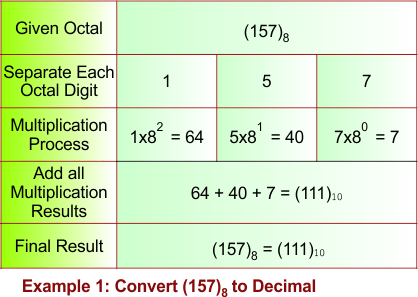
Example 1: Convert (157)₈ to Decimal
Solution:
The following diagram shows the conversion of the octal number (157)₈ into its equivalent decimal number.
Description:
To convert (157)₈ into decimal, multiply each digit by its corresponding power of 8, starting from the rightmost digit (8⁰).
(157)₈ = 1×8² + 5×8¹ + 7×8⁰
(157)₈ = 64 + 40 + 7
(157)₈ = (111)₁₀
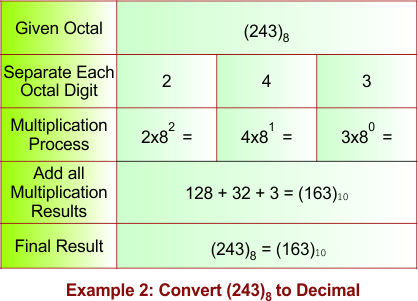
Example 2: Convert (243)₈ to Decimal
Solution:
The following diagram shows the conversion of the octal number (243)₈ into its equivalent decimal number.
Description:
To convert (243)₈ into decimal, multiply each digit by its corresponding power of 8, starting from the rightmost digit (8⁰).
(243)₈ = 2×8² + 4×8¹ + 3×8⁰
(243)₈ = 128 + 32 + 3
(243)₈ = (163)₁₀
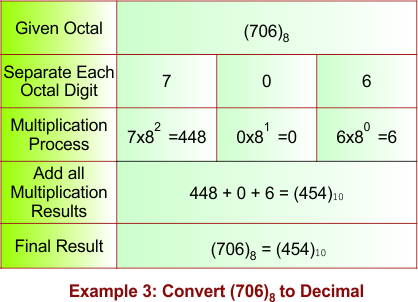
Example 3: Convert (706)₈ to Decimal
Solution:
The following diagram shows the conversion of the octal number (706)₈ into its equivalent decimal number.
Description:
To convert (706)₈ into decimal, multiply each digit by its corresponding power of 8, starting from the rightmost digit (8⁰).
(706)₈ = 7×8² + 0×8¹ + 6×8⁰
(706)₈ = 448 + 0 + 6
(706)₈ = (454)₁₀
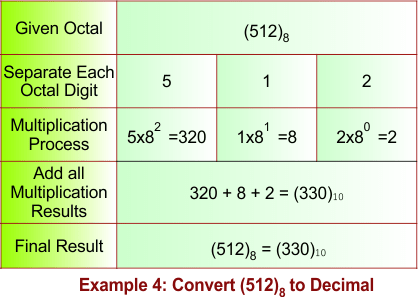
Example 4: Convert (512)₈ to Decimal
Solution:
The following diagram shows the conversion of the octal number (512)₈ into its equivalent decimal number.
Description:
To convert (512)₈ into decimal, multiply each digit by its corresponding power of 8, starting from the rightmost digit (8⁰).
(512)₈ = 5×8² + 1×8¹ + 2×8⁰
(512)₈ = 320 + 8 + 2
(512)₈ = (330)₁₀
Example 5: Convert (365)₈ to Decimal
Solution:
The following diagram shows the conversion of the octal number (365)₈ into its equivalent decimal number.
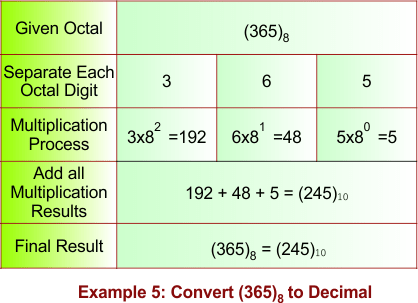
Description:
To convert (365)₈ into decimal, multiply each digit by its corresponding power of 8, starting from the rightmost digit (8⁰).
(365)₈ = 3×8² + 6×8¹ + 5×8⁰
(365)₈ = 192 + 48 + 5
(365)₈ = (245)₁₀
Example 6: Convert (1234)₈ to Decimal
Solution:
The following diagram shows the conversion of the octal number (1234)₈ into its equivalent decimal number.
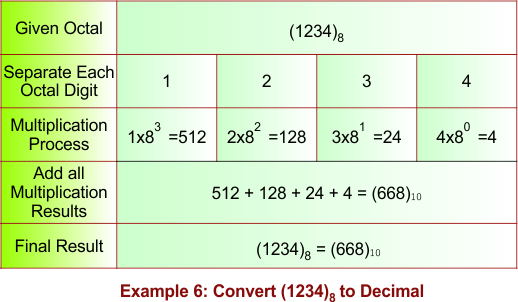
Description:
To convert (1234)₈ into decimal, multiply each digit by its corresponding power of 8, starting from the rightmost digit (8⁰).
(1234)₈ = 1×8³ + 2×8² + 3×8¹ + 4×8⁰
(1234)₈ = 512 + 128 + 24 + 4
(1234)₈ = (668)₁₀
Example 7: Convert (5672)₈ to Decimal
Solution:
The following diagram shows the conversion of the octal number (5672)₈ into its equivalent decimal number.
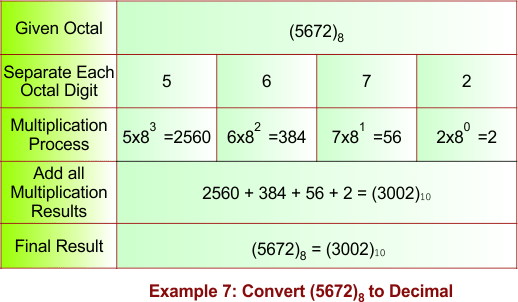
Description:
To convert (5672)₈ into decimal, multiply each digit by its corresponding power of 8, starting from the rightmost digit (8⁰).
(5672)₈ = 5×8³ + 6×8² + 7×8¹ + 2×8⁰
(5672)₈ = 2560 + 384 + 56 + 2
(5672)₈ = (3002)₁₀
Example 8: Convert (70125)₈ to Decimal
Solution:
The following diagram shows the conversion of the octal number (70125)₈ into its equivalent decimal number.
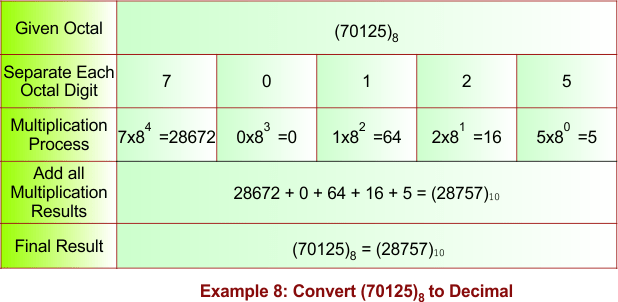
Description:
To convert (70125)₈ into decimal, multiply each digit by its corresponding power of 8, starting from the rightmost digit (8⁰).
(70125)₈ = 7×8⁴ + 0×8³ + 1×8² + 2×8¹ + 5×8⁰
(70125)₈ = 28672 + 0 + 64 + 16 + 5
(70125)₈ = (28757)₁₀
Example 9: Convert (34567)₈ to Decimal
Solution:
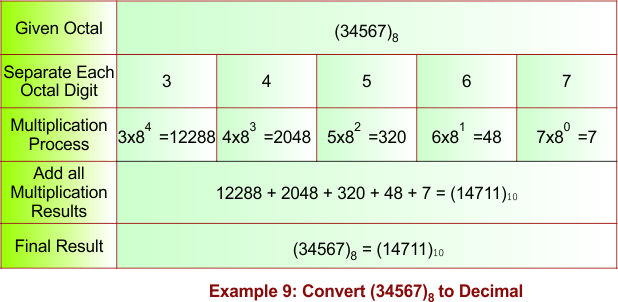
The following diagram shows the conversion of the octal number (34567)₈ into its equivalent decimal number.
Description:
To convert (34567)₈ into decimal, multiply each digit by its corresponding power of 8, starting from the rightmost digit (8⁰).
(34567)₈ = 3×8⁴ + 4×8³ + 5×8² + 6×8¹ + 7×8⁰
(34567)₈ = 12288 + 2048 + 320 + 48 + 7
(34567)₈ = (14711)₁₀
Example 10: Convert (123456)₈ to Decimal
Solution:
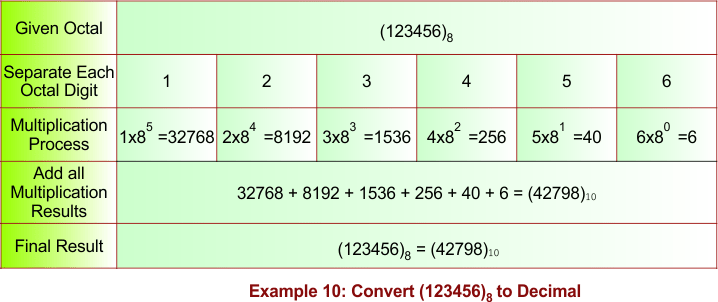
The following diagram shows the conversion of the octal number (123456)₈ into its equivalent decimal number.
Description:
To convert (123456)₈ into decimal, multiply each digit by its corresponding power of 8, starting from the rightmost digit (8⁰).
(123456)₈ = 1×8⁵ + 2×8⁴ + 3×8³ + 4×8² + 5×8¹ + 6×8⁰
(123456)₈ = 32768 + 8192 + 1536 + 256 + 40 + 6
(123456)₈ = (42798)₁₀
Example 11: Convert (654321)₈ to Decimal
Solution:
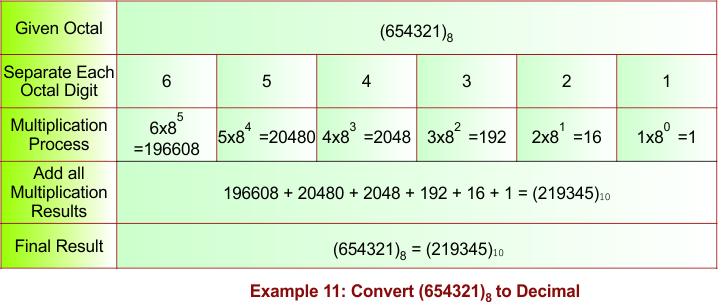
The following diagram shows the conversion of the octal number (654321)₈ into its equivalent decimal number.
Description:
To convert (654321)₈ into decimal, multiply each digit by its corresponding power of 8, starting from the rightmost digit (8⁰).
(654321)₈ = 6×8⁵ + 5×8⁴ + 4×8³ + 3×8² + 2×8¹ + 1×8⁰
(654321)₈ = 196608 + 20480 + 2048 + 192 + 16 + 1
(654321)₈ = (219345)₁₀
Example 12: Convert (7654321)₈ to Decimal
Solution:
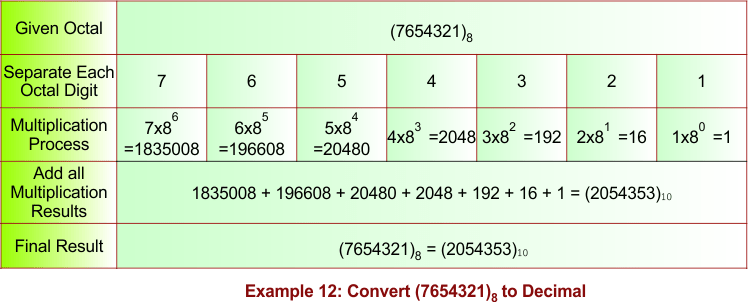
The following diagram shows the conversion of the octal number (7654321)₈ into its equivalent decimal number.
Description:
To convert (7654321)₈ into decimal, multiply each digit by its corresponding power of 8, starting from the rightmost digit (8⁰).
(7654321)₈ = 7×8⁶ + 6×8⁵ + 5×8⁴ + 4×8³ + 3×8² + 2×8¹ + 1×8⁰
(7654321)₈ = 1835008 + 196608 + 20480 + 2048 + 192 + 16 + 1
(7654321)₈ = (2054353)₁₀
Example 13: Convert (1234567)₈ to Decimal
Solution:
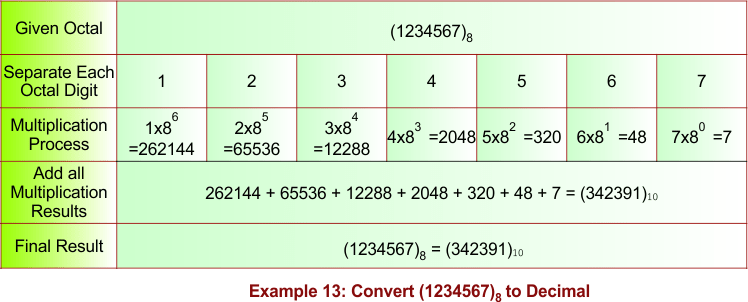
The following diagram shows the conversion of the octal number (1234567)₈ into its equivalent decimal number.
Description:
To convert (1234567)₈ into decimal, multiply each digit by its corresponding power of 8, starting from the rightmost digit (8⁰).
(1234567)₈ = 1×8⁶ + 2×8⁵ + 3×8⁴ + 4×8³ + 5×8² + 6×8¹ + 7×8⁰
(1234567)₈ = 262144 + 65536 + 12288 + 2048 + 320 + 48 + 7
(1234567)₈ = (342391)₁₀
Example 14: Convert (77777777)₈ to Decimal
Solution:
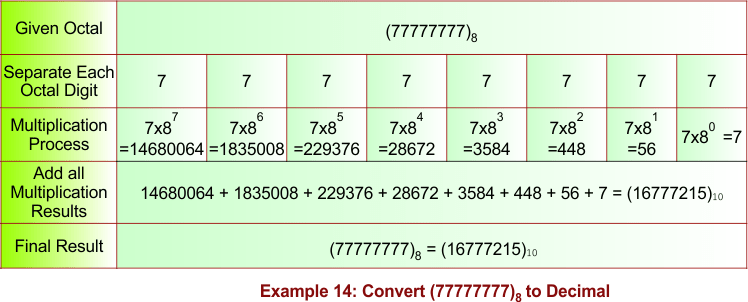
The following diagram shows the conversion of the octal number (77777777)₈ into its equivalent decimal number.
Description:
To convert (77777777)₈ into decimal, multiply each digit by its corresponding power of 8, starting from the rightmost digit (8⁰).
(77777777)₈ = 7×8⁷ + 7×8⁶ + 7×8⁵ + 7×8⁴ + 7×8³ + 7×8² + 7×8¹ + 7×8⁰
(77777777)₈ = 14680064 + 1835008 + 229376 + 28672 + 3584 + 448 + 56 + 7
(77777777)₈ = (16777215)₁₀
Example 15: Convert (1234567012)₈ to Decimal
Solution:
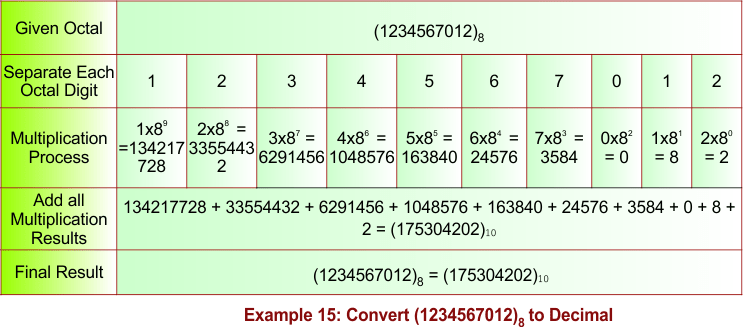
The following diagram shows the conversion of the octal number (1234567012)₈ into its equivalent decimal number.
Description:
To convert (1234567012)₈ into decimal, multiply each digit by its corresponding power of 8, starting from the rightmost digit (8⁰).
(1234567012)₈ = 1×8⁹ + 2×8⁸ + 3×8⁷ + 4×8⁶ + 5×8⁵ + 6×8⁴ + 7×8³ + 0×8² + 1×8¹ + 2×8⁰
(1234567012)₈ = 134217728 + 33554432 + 6291456 + 1048576 + 163840 + 24576 + 3584 + 0 + 2 + 2
(1234567012)₈ = (176304196)₁₀
2. Octal to Decimal Conversion of Fractional Numbers
Octal fractions can also be converted into decimal by using negative powers of 8. This method is important for handling precise values in computing.
- Start from the first digit after the decimal point
- Use powers like 8⁻¹, 8⁻², 8⁻³, …
- Multiply and add the values
Example 1: Convert (17.25)₈ to Decimal
Solution:
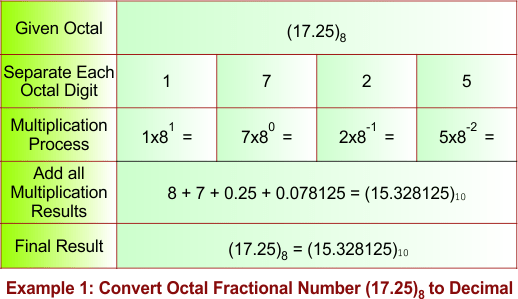
The following diagram shows the conversion of the octal number (17.25)₈ into its equivalent decimal number.
Description:
To convert a fractional octal number into decimal, convert the integer part using powers of 8 (8⁰, 8¹, …) and the fractional part using negative powers of 8 (8⁻¹, 8⁻², …).
(17.25)₈ = 1×8¹ + 7×8⁰ + 2×8⁻¹ + 5×8⁻²
= 8 + 7 + 0.25 + 0.078125
= (15.328125)₁₀
Example 2: Convert (24.13)₈ to Decimal
Solution:
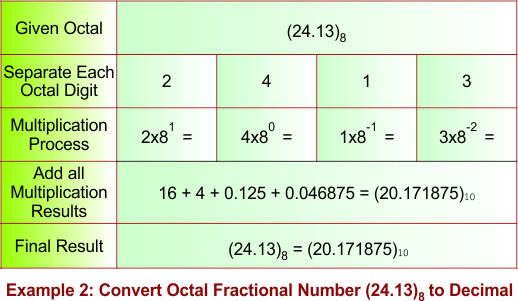
The following diagram shows the conversion of the octal number (24.13)₈ into its equivalent decimal number.
Description:
(24.13)₈ = 2×8¹ + 4×8⁰ + 1×8⁻¹ + 3×8⁻²
= 16 + 4 + 0.125 + 0.046875
= (20.171875)₁₀
Example 3: Convert (105.46)₈ to Decimal
Solution:
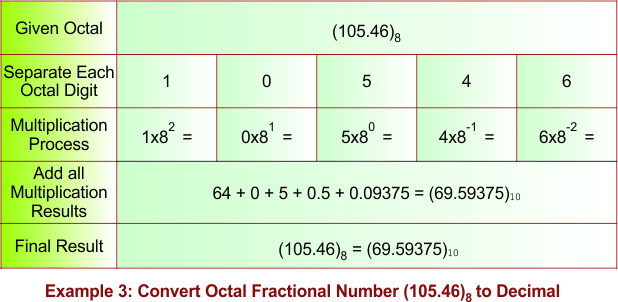
The following diagram shows the conversion of the octal number (105.46)₈ into its equivalent decimal number.
Description:
(105.46)₈ = 1×8² + 0×8¹ + 5×8⁰ + 4×8⁻¹ + 6×8⁻²
= 64 + 0 + 5 + 0.5 + 0.09375
= (69.59375)₁₀
Example 4: Convert (72.307)₈ to Decimal
Solution:
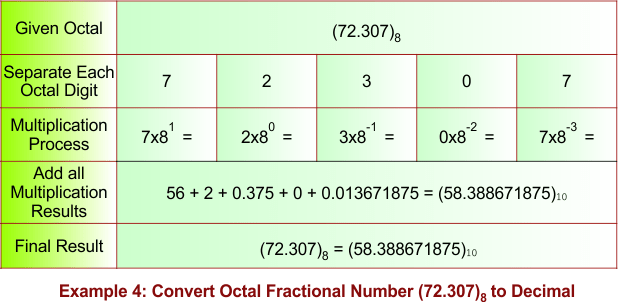
The following diagram shows the conversion of the octal number (72.307)₈ into its equivalent decimal number.
Description:
(72.307)₈ = 7×8¹ + 2×8⁰ + 3×8⁻¹ + 0×8⁻² + 7×8⁻³
= 56 + 2 + 0.375 + 0 + 0.013671875
= (58.388671875)₁₀
Example 5: Convert (356.724)₈ to Decimal
Solution:
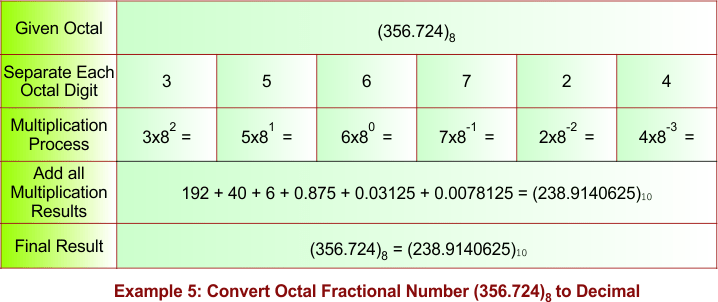
The following diagram shows the conversion of the octal number (356.724)₈ into its equivalent decimal number.
Description:
(356.724)₈ = 3×8² + 5×8¹ + 6×8⁰ + 7×8⁻¹ + 2×8⁻² + 4×8⁻³
= 192 + 40 + 6 + 0.875 + 0.03125 + 0.0078125
= (238.9140625)₁₀