












Decimal to Octal Conversion Examples
Decimal to Octal Conversion Examples are an essential part of number system concepts used in computer science and digital electronics. In this guide, we have explained the two most common methods: the Repeated Division by 8 Method with simple step-by-step examples. These methods help students understand how decimal numbers are converted into octal numbers quickly and accurately.
In this article, we will discuss decimal to octal conversion examples and some examples of the fractional part as well. Let’s start
Repeated Division by 8 Method
This is the most common and fundamental method used to convert decimal numbers into octal form. It involves dividing the number repeatedly by 8 and recording remainders.
Algorithm for Repeated Division by 8 Method
This algorithm clearly defines each step to ensure accuracy and avoid common mistakes during conversion.
- Step 1: Start with the given decimal number N
- Step 2: Divide N by 8
- Step 3: Record the remainder (it will always be between 0 and 7)
- Step 4: Update the quotient obtained from the division
- Step 5: Repeat Steps 2 to 4 until N = 0
- Step 6: Write all recorded remainders in reverse order (from last to first)
- Step 7: The resulting sequence is the octal equivalent
The following diagram explains the entire algorithm of decimal to octal conversion
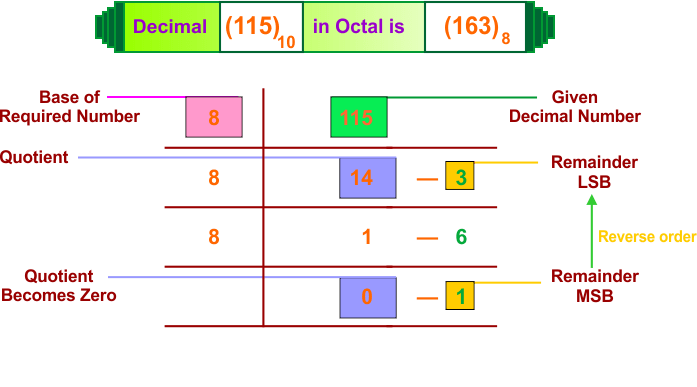
Below are 30 solved examples of decimal-to-octal conversion using the repeated division-by-8 method. Each example follows the same structured format for better understanding.
Example 1: Convert Decimal (10)₁₀ to Octal
Solution
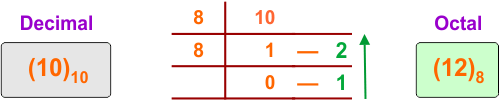
The following diagram shows the conversion of the decimal number (10)₁₀ into its equivalent octal
Description
- 10 is divided by 8, and the quotient is 1 with a remainder of 2.
- 1 is divided by 8, and the quotient is 0 with a remainder of 1.
Now, we write all remainders from bottom to top to get the final octal number. The octal representation of the decimal number (10)₁₀ is (12)₈.
Example 2: Convert Decimal (15)₁₀ to Octal
Solution
The following diagram shows the conversion of the decimal number (15)₁₀ into its equivalent octal

Description
- 15 is divided by 8, and the quotient is 1 with a remainder of 7.
- 1 is divided by 8, and the quotient is 0 with a remainder of 1.
Now, we write all remainders from bottom to top to get the final octal number. The octal representation of the decimal number (15)₁₀ is (17)₈.
Example 3: Convert Decimal (20)₁₀ to Octal
Solution
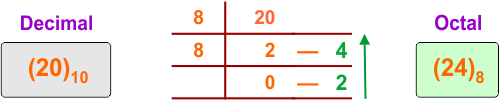
The following diagram shows the conversion of the decimal number (20)₁₀ into its equivalent octal
Description
- 20 is divided by 8, and the quotient is 2 with a remainder of 4.
- 2 is divided by 8, and the quotient is 0 with a remainder of 2.
Now, we write all remainders from bottom to top to get the final octal number. The octal representation of the decimal number (20)₁₀ is (24)₈.
Example 4: Convert Decimal (25)₁₀ to Octal
Solution
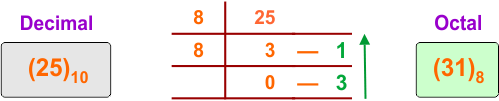
The following diagram shows the conversion of the decimal number (25)₁₀ into its equivalent octal
Description
- 25 is divided by 8, and the quotient is 3 with a remainder of 1.
- 3 is divided by 8, and the quotient is 0 with a remainder of 3.
Now, we write all remainders from bottom to top to get the final octal number. The octal representation of the decimal number (25)₁₀ is (31)₈.
Example 5: Convert Decimal (32)₁₀ to Octal
Solution
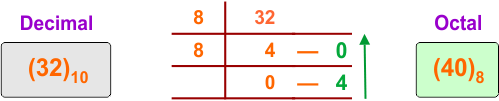
The following diagram shows the conversion of the decimal number (32)₁₀ into its equivalent octal
Description
- 32 is divided by 8, and the quotient is 4 with a remainder of 0.
- 4 is divided by 8, and the quotient is 0 with a remainder of 4.
Now, we write all remainders from bottom to top to get the final octal number. The octal representation of the decimal number (32)₁₀ is (40)₈.
Example 6: Convert Decimal (45)₁₀ to Octal
Solution
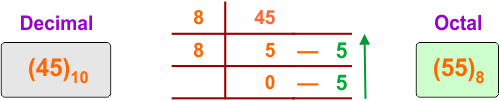
The following diagram shows the conversion of the decimal number (45)₁₀ into its equivalent octal
Description
- 45 is divided by 8, and the quotient is 5 with a remainder of 5.
- 5 is divided by 8, and the quotient is 0 with a remainder of 5.
Now, we write all remainders from bottom to top to get the final octal number. The octal representation of the decimal number (45)₁₀ is (55)₈.
Example 7: Convert Decimal (50)₁₀ to Octal
Solution
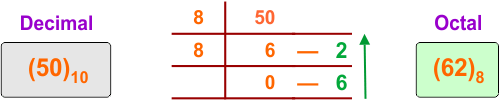
The following diagram shows the conversion of the decimal number (50)₁₀ into its equivalent octal
Description
- 50 is divided by 8, and the quotient is 6 with a remainder of 2.
- 6 is divided by 8, and the quotient is 0 with a remainder of 6.
Now, we write all remainders from bottom to top to get the final octal number. The octal representation of the decimal number (50)₁₀ is (62)₈.
Example 8: Convert Decimal (64)₁₀ to Octal
Solution
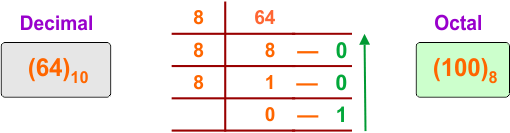
The following diagram shows the conversion of the decimal number (64)₁₀ into its equivalent octal
Description
- 64 is divided by 8, and the quotient is 8 with a remainder of 0.
- 8 is divided by 8, and the quotient is 1 with a remainder of 0.
- 1 is divided by 8, and the quotient is 0 with a remainder of 1.
Now, we write all remainders from bottom to top to get the final octal number. The octal representation of the decimal number (64)₁₀ is (100)₈.
Example 9: Convert Decimal (75)₁₀ to Octal
Solution
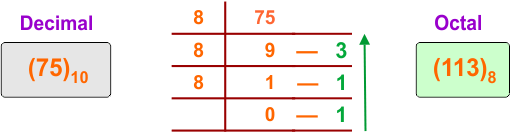
The following diagram shows the conversion of the decimal number (75)₁₀ into its equivalent octal
Description
- 75 is divided by 8, and the quotient is 9 with a remainder of 3.
- 9 is divided by 8, and the quotient is 1 with a remainder of 1.
- 1 is divided by 8, and the quotient is 0 with a remainder of 1.
Now, we write all remainders from bottom to top to get the final octal number. The octal representation of the decimal number (75)₁₀ is (113)₈.
Example 10: Convert Decimal (80)₁₀ to Octal
Solution
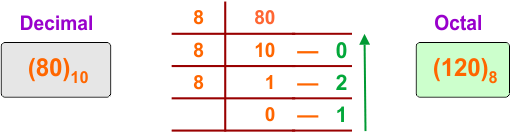
The following diagram shows the conversion of the decimal number (80)₁₀ into its equivalent octal
Description
- 80 is divided by 8, and the quotient is 10 with a remainder of 0.
- 10 is divided by 8, and the quotient is 1 with a remainder of 2.
- 1 is divided by 8, and the quotient is 0 with a remainder of 1.
Now, we write all remainders from bottom to top to get the final octal number. The octal representation of the decimal number (80)₁₀ is (120)₈.
Example 11: Convert Decimal (100)₁₀ to Octal
Solution
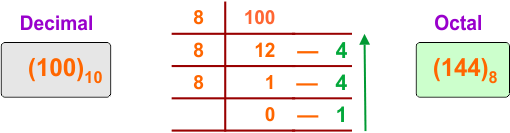
The following diagram shows the conversion of the decimal number (100)₁₀ into its equivalent octal
Description
- 100 is divided by 8, and the quotient is 12 with a remainder of 4.
- 12 is divided by 8, and the quotient is 1 with a remainder of 4.
- 1 is divided by 8, and the quotient is 0 with a remainder of 1.
Now, we write all remainders from bottom to top to get the final octal number. The octal representation of the decimal number (100)₁₀ is (144)₈.
Example 12: Convert Decimal (120)₁₀ to Octal
Solution
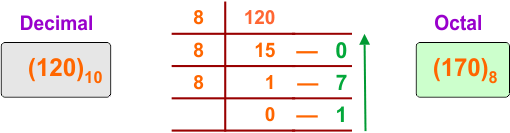
The following diagram shows the conversion of the decimal number (120)₁₀ into its equivalent octal
Description
- 120 is divided by 8, and the quotient is 15 with a remainder of 0.
- 15 is divided by 8, and the quotient is 1 with a remainder of 7.
- 1 is divided by 8, and the quotient is 0 with a remainder of 1.
Now, we write all remainders from bottom to top to get the final octal number. The octal representation of the decimal number (120)₁₀ is (170)₈.
Example 13: Convert Decimal (150)₁₀ to Octal
Solution
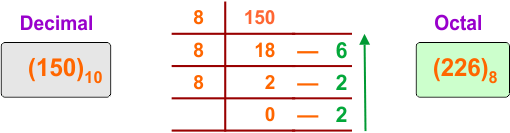
The following diagram shows the conversion of the decimal number (150)₁₀ into its equivalent octal
Description
- 150 is divided by 8, and the quotient is 18 with a remainder of 6.
- 18 is divided by 8, and the quotient is 2 with a remainder of 2.
- 2 is divided by 8, and the quotient is 0 with a remainder of 2.
Now, we write all remainders from bottom to top to get the final octal number. The octal representation of the decimal number (150)₁₀ is (226)₈.
Example 14: Convert Decimal (200)₁₀ to Octal
Solution
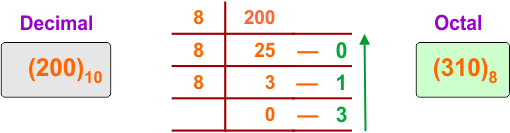
The following diagram shows the conversion of the decimal number (200)₁₀ into its equivalent octal
Description
- 200 is divided by 8, and the quotient is 25 with a remainder of 0.
- 25 is divided by 8, and the quotient is 3 with a remainder of 1.
- 3 is divided by 8, and the quotient is 0 with a remainder of 3.
Now, we write all remainders from bottom to top to get the final octal number. The octal representation of the decimal number (200)₁₀ is (310)₈.
Example 15: Convert Decimal (255)₁₀ to Octal
Solution
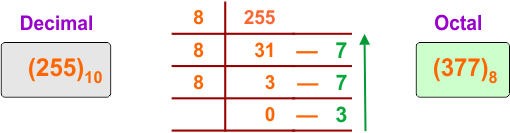
The following diagram shows the conversion of the decimal number (255)₁₀ into its equivalent octal
Description
- 255 is divided by 8, and the quotient is 31 with a remainder of 7.
- 31 is divided by 8, and the quotient is 3 with a remainder of 7.
- 3 is divided by 8, and the quotient is 0 with a remainder of 3.
Now, we write all remainders from bottom to top to get the final octal number. The octal representation of the decimal number (255)₁₀ is (377)₈.
Example 16: Convert Decimal (300)₁₀ to Octal
Solution
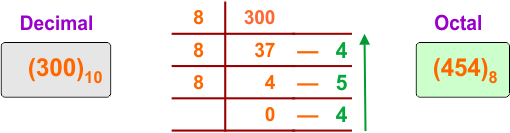
The following diagram shows the conversion of the decimal number (300)₁₀ into its equivalent octal
Description
- 300 is divided by 8, and the quotient is 37 with a remainder of 4.
- 37 is divided by 8, and the quotient is 4 with a remainder of 5.
- 4 is divided by 8, and the quotient is 0 with a remainder of 4.
Now, we write all remainders from bottom to top to get the final octal number. The octal representation of the decimal number (300)₁₀ is (454)₈.
Example 17: Convert Decimal (400)₁₀ to Octal
Solution
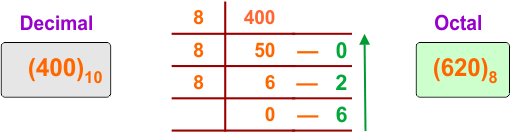
The following diagram shows the conversion of the decimal number (400)₁₀ into its equivalent octal
Description
- 400 is divided by 8, and the quotient is 50 with a remainder of 0.
- 50 is divided by 8, and the quotient is 6 with a remainder of 2.
- 6 is divided by 8, and the quotient is 0 with a remainder of 6.
Now, we write all remainders from bottom to top to get the final octal number. The octal representation of the decimal number (400)₁₀ is (620)₈.
Example 18: Convert Decimal (512)₁₀ to Octal
Solution
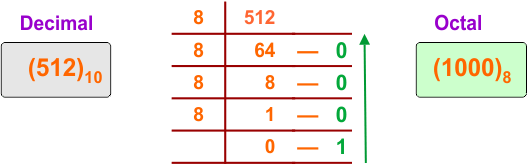
The following diagram shows the conversion of the decimal number (512)₁₀ into its equivalent octal
Description
- 512 is divided by 8, and the quotient is 64 with a remainder of 0.
- 64 is divided by 8, and the quotient is 8 with a remainder of 0.
- 8 is divided by 8, and the quotient is 1 with a remainder of 0.
- 1 is divided by 8, and the quotient is 0 with a remainder of 1.
Now, we write all remainders from bottom to top to get the final octal number. The octal representation of the decimal number (512)₁₀ is (1000)₈.
Example 19: Convert Decimal (750)₁₀ to Octal
Solution
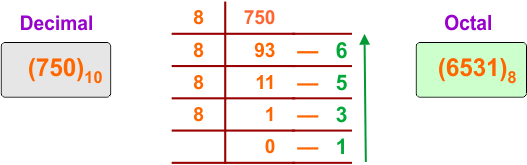
The following diagram shows the conversion of the decimal number (750)₁₀ into its equivalent octal
Description
- 750 is divided by 8, and the quotient is 93 with a remainder of 6.
- 93 is divided by 8, and the quotient is 11 with a remainder of 5.
- 11 is divided by 8, and the quotient is 1 with a remainder of 3.
- 1 is divided by 8, and the quotient is 0 with a remainder of 1.
Now, we write all remainders from bottom to top to get the final octal number. The octal representation of the decimal number (750)₁₀ is (1356)₈.
Example 20: Convert Decimal (1024)₁₀ to Octal
Solution
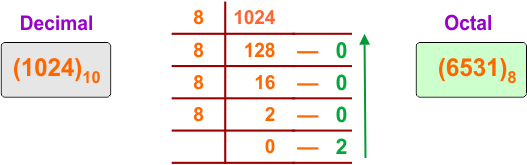
The following diagram shows the conversion of the decimal number (1024)₁₀ into its equivalent octal
Description
- 1024 is divided by 8, and the quotient is 128 with a remainder of 0.
- 128 is divided by 8, and the quotient is 16 with a remainder of 0.
- 16 is divided by 8, and the quotient is 2 with a remainder of 0.
- 2 is divided by 8, and the quotient is 0 with a remainder of 2.
Now, we write all remainders from bottom to top to get the final octal number. The octal representation of the decimal number (1024)₁₀ is (2000)₈.
Example 21: Convert Decimal (1500)₁₀ to Octal
Solution
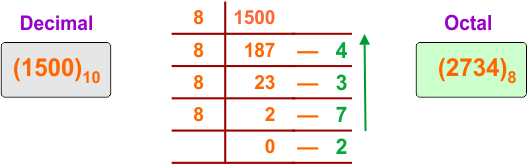
The following diagram shows the conversion of the decimal number (1500)₁₀ into its equivalent octal
Description
- 1500 is divided by 8, and the quotient is 187 with a remainder of 4.
- 187 is divided by 8, and the quotient is 23 with a remainder of 3.
- 23 is divided by 8, and the quotient is 2 with a remainder of 7.
- 2 is divided by 8, and the quotient is 0 with a remainder of 2.
Now, we write all remainders from bottom to top to get the final octal number. The octal representation of the decimal number (1500)₁₀ is (2734)₈.
Example 22: Convert Decimal (5200)₁₀ to Octal
Solution
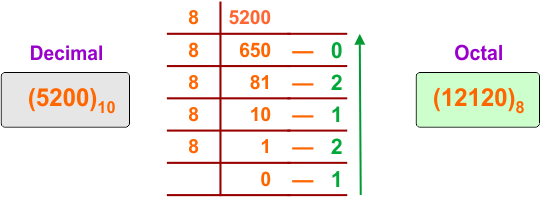
The following diagram shows the conversion of the decimal number (5200)₁₀ into its equivalent octal
Description
- 5200 is divided by 8, and the quotient is 650 with a remainder of 0.
- 650 is divided by 8, and the quotient is 81 with a remainder of 2.
- 81 is divided by 8, and the quotient is 10 with a remainder of 1.
- 10 is divided by 8, and the quotient is 1 with a remainder of 2.
- 1 is divided by 8, and the quotient is 0 with a remainder of 1.
Now, we write all remainders from bottom to top to get the final octal number. The octal representation of the decimal number (5200)₁₀ is (12120)₈.
Example 23: Convert Decimal (10800)₁₀ to Octal
Solution
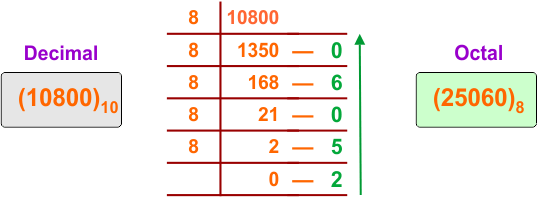
The following diagram shows the conversion of the decimal number (10800)₁₀ into its equivalent octal
Description
- 10800 is divided by 8, and the quotient is 1350 with a remainder of 0.
- 1350 is divided by 8, and the quotient is 168 with a remainder of 6.
- 168 is divided by 8, and the quotient is 21 with a remainder of 0.
- 21 is divided by 8, and the quotient is 2 with a remainder of 5.
- 2 is divided by 8, and the quotient is 0 with a remainder of 2.
Now, we write all remainders from bottom to top to get the final octal number. The octal representation of the decimal number (10800)₁₀ is (25060)₈.
Example 24: Convert Decimal (17189)₁₀ to Octal
Solution
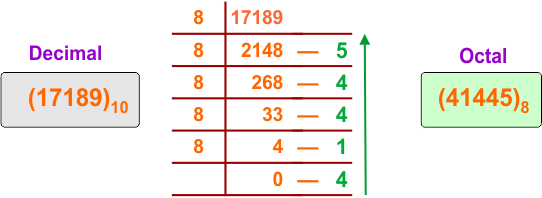
The following diagram shows the conversion of the decimal number (17189)₁₀ into its equivalent octal
Description
- 17189 is divided by 8, and the quotient is 2148 with a remainder of 5.
- 2148 is divided by 8, and the quotient is 268 with a remainder of 4.
- 268 is divided by 8, and the quotient is 33 with a remainder of 4.
- 33 is divided by 8, and the quotient is 4 with a remainder of 1.
- 4 is divided by 8, and the quotient is 0 with a remainder of 4.
Now, we write all remainders from bottom to top to get the final octal number. The octal representation of the decimal number (17189)₁₀ is (41445)₈.
Example 25: Convert Decimal (24688)₁₀ to Octal
Solution
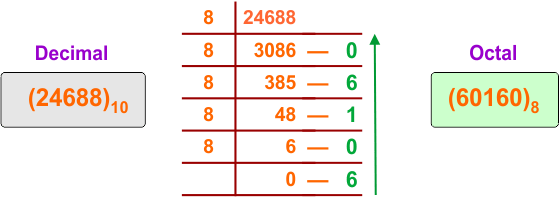
The following diagram shows the conversion of the decimal number (24688)₁₀ into its equivalent octal
Description
- 24688 is divided by 8, and the quotient is 3086 with a remainder of 0.
- 3086 is divided by 8, and the quotient is 385 with a remainder of 6.
- 385 is divided by 8, and the quotient is 48 with a remainder of 1.
- 48 is divided by 8, and the quotient is 6 with a remainder of 0.
- 6 is divided by 8, and the quotient is 0 with a remainder of 6.
Now, we write all remainders from bottom to top to get the final octal number. The octal representation of the decimal number (24688)₁₀ is (60160)₈.
Example 26: Convert Decimal (35474)₁₀ to Octal
Solution
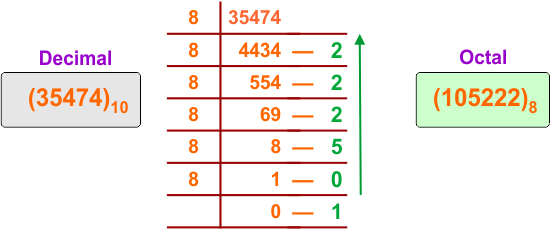
The following diagram shows the conversion of the decimal number (35474)₁₀ into its equivalent octal
Description
- 35474 is divided by 8, and the quotient is 4434 with a remainder of 2.
- 4434 is divided by 8, and the quotient is 554 with a remainder of 2.
- 554 is divided by 8, and the quotient is 69 with a remainder of 2.
- 69 is divided by 8, and the quotient is 8 with a remainder of 5.
- 8 is divided by 8, and the quotient is 1 with a remainder of 0.
- 1 is divided by 8, and the quotient is 0 with a remainder of 1.
Now, we write all remainders from bottom to top to get the final octal number. The octal representation of the decimal number (35474)₁₀ is (105222)₈.
Example 27: Convert Decimal (48000)₁₀ to Octal
Solution
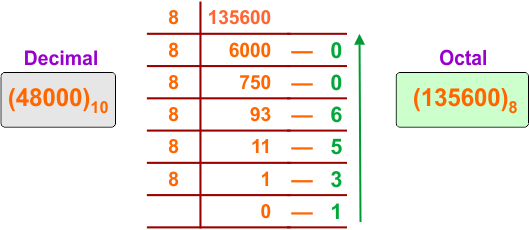
The following diagram shows the conversion of the decimal number (48000)₁₀ into its equivalent octal
Description
- 48000 is divided by 8, and the quotient is 6000 with a remainder of 0.
- 6000 is divided by 8, and the quotient is 750 with a remainder of 0.
- 750 is divided by 8, and the quotient is 93 with a remainder of 6.
- 93 is divided by 8, and the quotient is 11 with a remainder of 5.
- 11 is divided by 8, and the quotient is 1 with a remainder of 3.
- 1 is divided by 8, and the quotient is 0 with a remainder of 1.
Now, we write all remainders from bottom to top to get the final octal number. The octal representation of the decimal number (48000)₁₀ is (135600)₈.
Example 28: Convert Decimal (65535)₁₀ to Octal
Solution
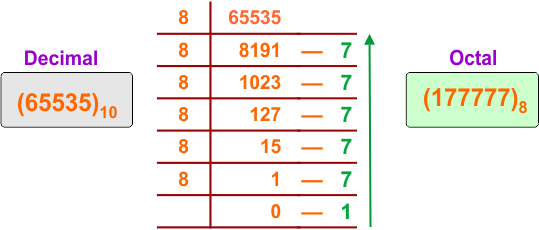
The following diagram shows the conversion of the decimal number (65535)₁₀ into its equivalent octal
Description
- 65535 is divided by 8, and the quotient is 8191 with a remainder of 7.
- 8191 is divided by 8, and the quotient is 1023 with a remainder of 7.
- 1023 is divided by 8, and the quotient is 127 with a remainder of 7.
- 127 is divided by 8, and the quotient is 15 with a remainder of 7.
- 15 is divided by 8, and the quotient is 1 with a remainder of 7.
- 1 is divided by 8, and the quotient is 0 with a remainder of 1.
Now, we write all remainders from bottom to top to get the final octal number. The octal representation of the decimal number (65535)₁₀ is (177777)₈.
Example 29: Convert Decimal (99999)₁₀ to Octal
Solution
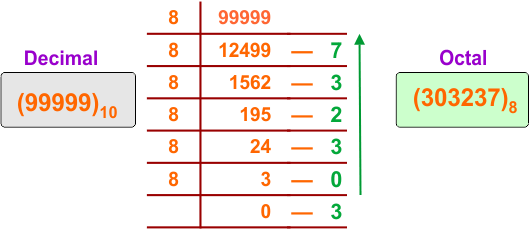
The following diagram shows the conversion of the decimal number (99999)₁₀ into its equivalent octal
Description
- 99999 is divided by 8, and the quotient is 12499 with a remainder of 7.
- 12499 is divided by 8, and the quotient is 1562 with a remainder of 3.
- 1562 is divided by 8, and the quotient is 195 with a remainder of 2.
- 195 is divided by 8, and the quotient is 24 with a remainder of 3.
- 24 is divided by 8, and the quotient is 3 with a remainder of 0.
- 3 is divided by 8, and the quotient is 0 with a remainder of 3.
Now, we write all remainders from bottom to top to get the final octal number. The octal representation of the decimal number (99999)₁₀ is (303237)₈.
Example 30: Convert Decimal (123456)₁₀ to Octal
Solution
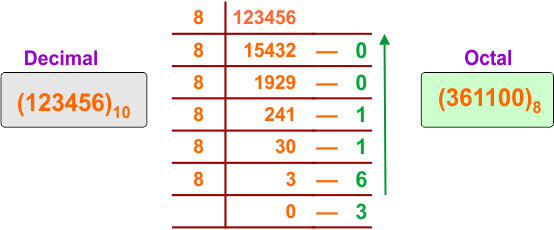
The following diagram shows the conversion of the decimal number (123456)₁₀ into its equivalent octal
Description
- 123456 is divided by 8, and the quotient is 15432 with a remainder of 0.
- 15432 is divided by 8, and the quotient is 1929 with a remainder of 0.
- 1929 is divided by 8, and the quotient is 241 with a remainder of 1.
- 241 is divided by 8, and the quotient is 30 with a remainder of 1.
- 30 is divided by 8, and the quotient is 3 with a remainder of 6.
- 3 is divided by 8, and the quotient is 0 with a remainder of 3.
Now, we write all remainders from bottom to top to get the final octal number. The octal representation of the decimal number (123456)₁₀ is (361100)₈.
Decimal Fraction to Octal Conversion
Decimal fractions (numbers with decimal points) can also be converted into octal form using a multiplication-based method. This is important in computer science when working with base-8 representations of real numbers.
Algorithm for Multiplication by 8 Method (Fractional Part)
This method converts decimal fractions into octal by repeatedly multiplying by 8 and extracting integer parts.
Step 1: Take the decimal fractional number (for example, 0.x)
Step 2: Multiply the fractional number by 8
Step 3: Note the integer part of the result (0 to 7)
Step 4: Keep only the fractional part of the result
Step 5: Repeat Steps 2 to 4 with the new fractional part
Step 6: Continue until the fraction becomes 0 or required precision (3–4 digits) is achieved
Step 7: Write all recorded integer parts in the same order
Example 01: Convert (0.625)₁₀ to Octal
Solution:
The following diagram shows the conversion of the decimal number (0.625)₁₀ into its equivalent octal

Description:
0.625 is multiplied by 8 and the result is 5.0, so the integer part is 5
Octal fraction = 0.5₈
Example 02: Convert (0.375)₁₀ to Octal
Solution:
The following diagram shows the conversion of the decimal number (0.375)₁₀ into its equivalent octal

Description:
0.375 is multiplied by 8 and the result is 3.0, so the integer part is 3
Octal fraction = 0.3₈
Example 03: Convert (0.8125)₁₀ to Octal
Solution:
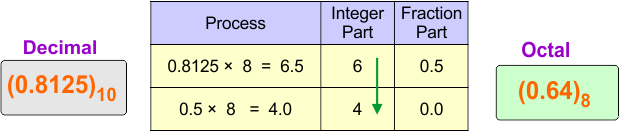
The following diagram shows the conversion of the decimal number (0.8125)₁₀ into its equivalent octal
Description:
0.8125 is multiplied by 8 and the result is 6.5, so the integer part is 6
0.5 is multiplied by 8 and the result is 4.0, so the integer part is 4
Octal fraction = 0.64₈
Example 04: Convert (0.1)₁₀ to Octal (Approximate)
Solution:
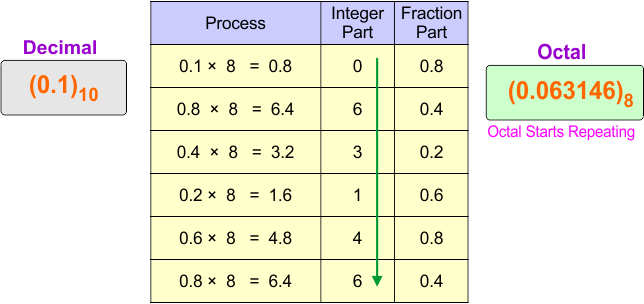
The following diagram shows the conversion of the decimal number (0.1)₁₀ into its equivalent octal
Description:
0.1 is multiplied by 8 and the result is 0.8, so the integer part is 0
0.8 is multiplied by 8 and the result is 6.4, so the integer part is 6
0.4 is multiplied by 8 and the result is 3.2, so the integer part is 3
0.2 is multiplied by 8 and the result is 1.6, so the integer part is 1
0.6 is multiplied by 8 and the result is 4.8, so the integer part is 4
(Octal starts repeating)
Octal fraction ≈ 0.06314₈
Example 05: Convert (0.45)₁₀ to Octal (Approximate up to 4 digits)
Solution:
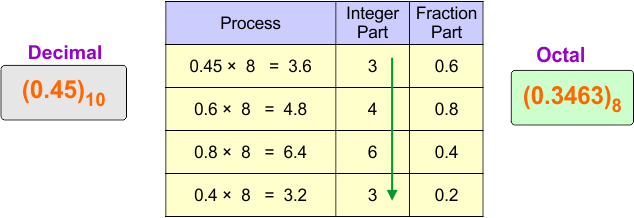
The following diagram shows the conversion of the decimal number (0.45)₁₀ into its equivalent octal
Description:
0.45 is multiplied by 8 and the result is 3.6, so the integer part is 3
0.6 is multiplied by 8 and the result is 4.8, so the integer part is 4
0.8 is multiplied by 8 and the result is 6.4, so the integer part is 6
0.4 is multiplied by 8 and the result is 3.2, so the integer part is 3
Octal fraction ≈ 0.3463₈
Decimal (Integer + Fraction) to Octal Conversion
When a decimal number has both integer and fractional parts, convert each separately.
- Step 01: Convert integer part using division by 8
- Step 02: Convert fractional part using multiplication by 8
- Step 03: Combine both results
Example 01: Convert (16.625)₁₀ to Octal
Solution:
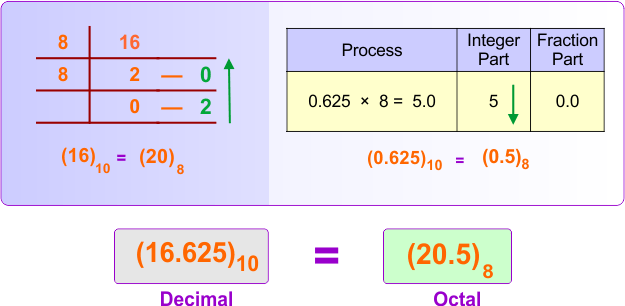
The following diagram shows the conversion of the decimal number (16.625)₁₀ into its equivalent octal
Integer Part Description:
16 is divided by 8 and the quotient is 2 with a remainder of 0
2 is divided by 8 and the quotient is 0 with a remainder of 2
Binary integer part = 20₈
Fraction Part Description:
0.625 is multiplied by 8 and the result is 5.0, so the integer part is 5
Octal fraction = 0.5₈
Final Answer:
(16.625)₁₀ = (20.5)₈
Example 02: Convert (25.375)₁₀ to Octal
Solution:
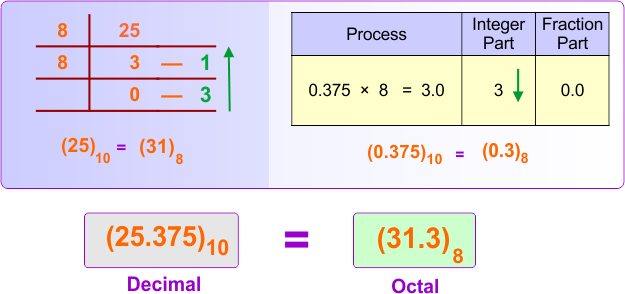
The following diagram shows the conversion of the decimal number (25.375)₁₀ into its equivalent octal
Integer Part Description:
25 is divided by 8 and the quotient is 3 with a remainder of 1
3 is divided by 8 and the quotient is 0 with a remainder of 3
Octal integer part = 31₈
Fraction Part Description:
0.375 is multiplied by 8 and the result is 3.0, so the integer part is 3
Octal fraction = 0.3₈
Final Answer:
(25.375)₁₀ = (31.3)₈
Example 03: Convert (56.8125)₁₀ to Octal
Solution:
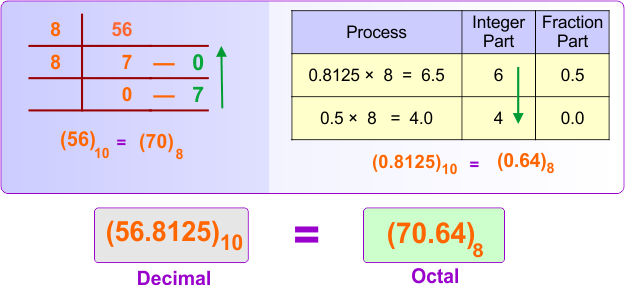
The following diagram shows the conversion of the decimal number (56.8125)₁₀ into its equivalent octal
Integer Part Description:
56 is divided by 8 and the quotient is 7 with a remainder of 0
7 is divided by 8 and the quotient is 0 with a remainder of 7
Octal integer part = 70₈
Fraction Part Description:
0.8125 is multiplied by 8 and the result is 6.5, so the integer part is 6
0.5 is multiplied by 8 and the result is 4.0, so the integer part is 4
Octal fraction = 0.64₈
Final Answer:
(56.8125)₁₀ = (70.64)₈
Example 04: Convert (100.1)₁₀ to Octal (Approximate)
Solution:
The following diagram shows the conversion of the decimal number (100.1)₁₀ into its equivalent octal
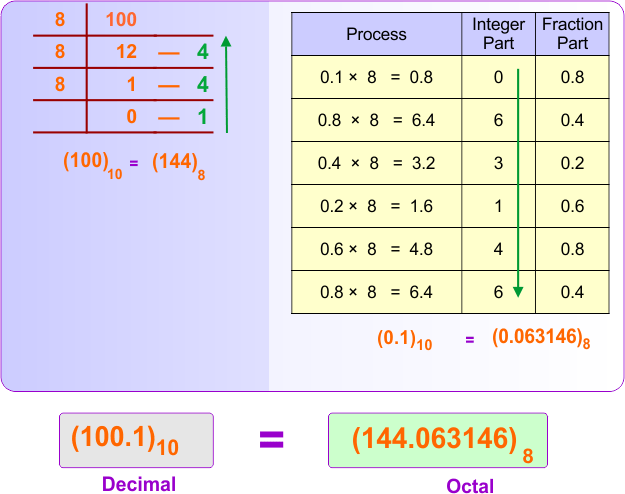
Integer Part Description:
100 is divided by 8 and the quotient is 12 with a remainder of 4
12 is divided by 8 and the quotient is 1 with a remainder of 4
1 is divided by 8 and the quotient is 0 with a remainder of 1
Octal integer part = 144₈
Fraction Part Description:
0.1 is multiplied by 8 and the result is 0.8, so the integer part is 0
0.8 is multiplied by 8 and the result is 6.4, so the integer part is 6
0.4 is multiplied by 8 and the result is 3.2, so the integer part is 3
0.2 is multiplied by 8 and the result is 1.6, so the integer part is 1
Octal fraction ≈ 0.0631₈
Final Answer:
(100.1)₁₀ ≈ (144.0631)₈
Example 05: Convert (255.45)₁₀ to Octal (Approximate up to 4 digits)
Solution:
The following diagram shows the conversion of the decimal number (255.45)₁₀ into its equivalent octal
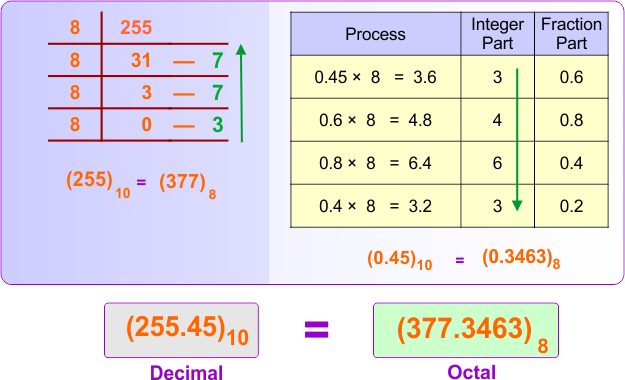
Integer Part Description:
255 is divided by 8 and the quotient is 31 with a remainder of 7
31 is divided by 8 and the quotient is 3 with a remainder of 7
3 is divided by 8 and the quotient is 0 with a remainder of 3
Octal integer part = 377₈
Fraction Part Description:
0.45 is multiplied by 8 and the result is 3.6, so the integer part is 3
0.6 is multiplied by 8 and the result is 4.8, so the integer part is 4
0.8 is multiplied by 8 and the result is 6.4, so the integer part is 6
0.4 is multiplied by 8 and the result is 3.2, so the integer part is 3
Octal fraction ≈ 0.3463₈
Final Answer:
(255.45)₁₀ ≈ (377.3463)₈
This method is widely used in computer systems where base-8 representation is required, especially in low-level computing and digital systems.
Decimal to Octal Conversion Examples for Quick Practice
Practicing different decimal values improves speed and accuracy in conversions. A list of decimal to octal examples is given below.
| Decimal | Octal | Decimal | Octal | Decimal | Octal | Decimal | Octal |
|---|---|---|---|---|---|---|---|
| 0 | 0 | 25 | 31 | 50 | 62 | 75 | 113 |
| 1 | 1 | 26 | 32 | 51 | 63 | 76 | 114 |
| 2 | 2 | 27 | 33 | 52 | 64 | 77 | 115 |
| 3 | 3 | 28 | 34 | 53 | 65 | 78 | 116 |
| 4 | 4 | 29 | 35 | 54 | 66 | 79 | 117 |
| 5 | 5 | 30 | 36 | 55 | 67 | 80 | 120 |
| 6 | 6 | 31 | 37 | 56 | 70 | 81 | 121 |
| 7 | 7 | 32 | 40 | 57 | 71 | 82 | 122 |
| 8 | 10 | 33 | 41 | 58 | 72 | 83 | 123 |
| 9 | 11 | 34 | 42 | 59 | 73 | 84 | 124 |
| 10 | 12 | 35 | 43 | 60 | 74 | 85 | 125 |
| 11 | 13 | 36 | 44 | 61 | 75 | 86 | 126 |
| 12 | 14 | 37 | 45 | 62 | 76 | 87 | 127 |
| 13 | 15 | 38 | 46 | 63 | 77 | 88 | 130 |
| 14 | 16 | 39 | 47 | 64 | 100 | 89 | 131 |
| 15 | 17 | 40 | 50 | 65 | 101 | 90 | 132 |
| 16 | 20 | 41 | 51 | 66 | 102 | 91 | 133 |
| 17 | 21 | 42 | 52 | 67 | 103 | 92 | 134 |
| 18 | 22 | 43 | 53 | 68 | 104 | 93 | 135 |
| 19 | 23 | 44 | 54 | 69 | 105 | 94 | 136 |
| 20 | 24 | 45 | 55 | 70 | 106 | 95 | 137 |
| 21 | 25 | 46 | 56 | 71 | 107 | 96 | 140 |
| 22 | 26 | 47 | 57 | 72 | 110 | 97 | 141 |
| 23 | 27 | 48 | 60 | 73 | 111 | 98 | 142 |
| 24 | 30 | 49 | 61 | 74 | 112 | 99 | 143 |