












Hexadecimal to Octal Conversion Examples
Hexadecimal to octal conversion is an important concept in number systems used in computer science, digital electronics, and programming. It helps transform base-16 numbers into base-8 format, making data easier to interpret in certain computing environments.
In this article, we will discuss hexadecimal to octal conversion examples and some examples of the fractional part as well. Let’s start
What is Hexadecimal to Octal Conversion?
Hexadecimal to octal conversion is the process of converting a base-16 number into its equivalent base-8 number using systematic methods. This conversion is commonly used to simplify binary data representation in different formats.
The main methods for conversion are given below:
1. Direct Method (Using Binary Conversion)
This is the most common and reliable method where hexadecimal numbers are first converted into binary and then into octal.
- Each hexadecimal digit is converted into a 4-bit binary number
- Combine all binary digits
- Group binary digits into sets of 3 (from right)
- Convert each group into octal
2. Indirect Method (Using Decimal Conversion)
In this method, the hexadecimal number is first converted into decimal and then into octal.
- Convert hexadecimal to decimal using powers of 16
- Convert decimal to octal using division by 8
Steps for Hexadecimal to Octal Conversion
Hexadecimal to octal conversion becomes simple when you follow a step-by-step approach. These steps ensure accuracy and clarity.
1. Convert Hexadecimal to Binary
Each hexadecimal digit is replaced by its equivalent 4-bit binary value.
Example:
A → 1010,
F → 1111
2. Group Binary Digits
Binary digits are grouped into sets of 3 starting from the right side.
- Add leading zeros if necessary
3. Convert Binary to Octal
Each group of 3 binary digits is converted into an octal digit.
Example:
111 → 7,
010 → 2
Hexadecimal to Octal Conversion Table
This table helps in understanding the relationship between hexadecimal, binary, and octal numbers.
| Hexadecimal | Binary | Octal |
|---|---|---|
| 0 | 0000 | 0 |
| 1 | 0001 | 1 |
| 2 | 0010 | 2 |
| 3 | 0011 | 3 |
| 4 | 0100 | 4 |
| 5 | 0101 | 5 |
| 6 | 0110 | 6 |
| 7 | 0111 | 7 |
| 8 | 1000 | 10 |
| 9 | 1001 | 11 |
| A | 1010 | 12 |
| B | 1011 | 13 |
| C | 1100 | 14 |
| D | 1101 | 15 |
| E | 1110 | 16 |
| F | 1111 | 17 |
Hexadecimal to Octal Conversion Examples
These examples help students clearly understand the step-by-step process of converting hexadecimal numbers into octal format. The list of solved examples is given below:
1. Example: Convert (3A)₁₆ to Octal
Solution:
The following steps show the conversion of the hexadecimal number (3A)₁₆ into its equivalent octal number.
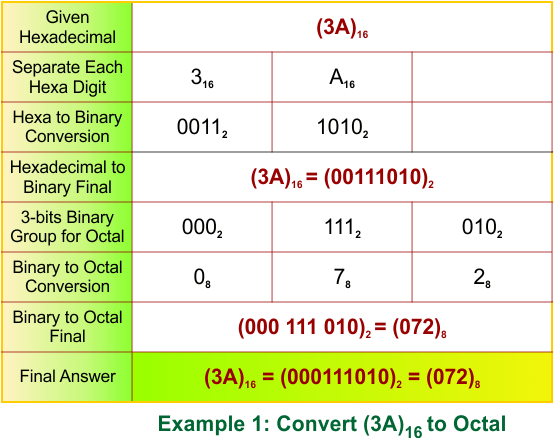
Description:
Step 1: Convert Hexadecimal to Binary
Each hexadecimal digit is converted into its 4-bit binary equivalent:
3₁₆ = 0011₂
A₁₆ = 1010₂
(3A)₁₆ = (00111010)₂
Step 2: Group Binary Digits into 3 Bits
Group the binary number from right to left and add leading zeros if needed:
(00111010)₂ = (000 111 010)₂
Step 3: Convert Each Group to Octal
000₂ = 0₈
111₂ = 7₈
010₂ = 2₈
Final Answer:
(3A)₁₆ = (072)₈
2. Example: Convert (7F)₁₆ to Octal
Solution:
The following steps show the conversion of the hexadecimal number (7F)₁₆ into its equivalent octal number.
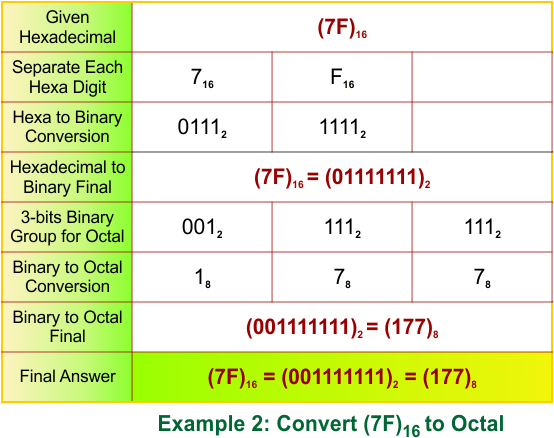
Description:
Step 1: Convert Hexadecimal to Binary
Each hexadecimal digit is converted into its 4-bit binary equivalent:
7₁₆ = 0111₂
F₁₆ = 1111₂
(7F)₁₆ = (01111111)₂
Step 2: Group Binary Digits into 3 Bits
Group the binary number from right to left and add leading zeros if needed:
(01111111)₂ = (001 111 111)₂
Step 3: Convert Each Group to Octal
001₂ = 1₈
111₂ = 7₈
111₂ = 7₈
Final Answer:
(7F)₁₆ = (177)₈
3. Example: Convert (A5)₁₆ to Octal
Solution:
The following steps show the conversion of the hexadecimal number (A5)₁₆ into its equivalent octal number.
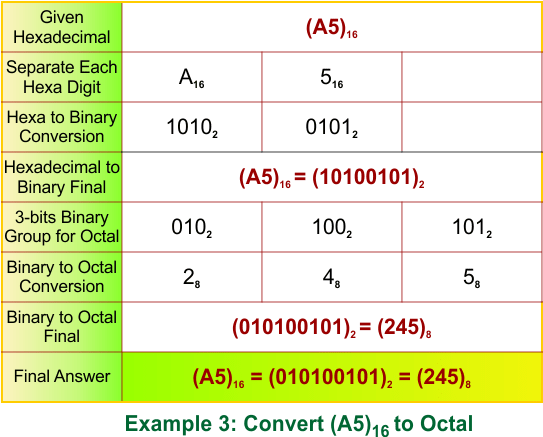
Description:
Step 1: Convert Hexadecimal to Binary
A₁₆ = 1010₂
5₁₆ = 0101₂
( A5 )₁₆ = (10100101)₂
Step 2: Group Binary Digits into 3 Bits
(10100101)₂ = (010 100 101)₂
Step 3: Convert Each Group to Octal
010₂ = 2₈
100₂ = 4₈
101₂ = 5₈
Final Answer:
(A5)₁₆ = (245)₈
4. Example: Convert (2B)₁₆ to Octal
Solution:
The following steps show the conversion of the hexadecimal number (2B)₁₆ into its equivalent octal number.
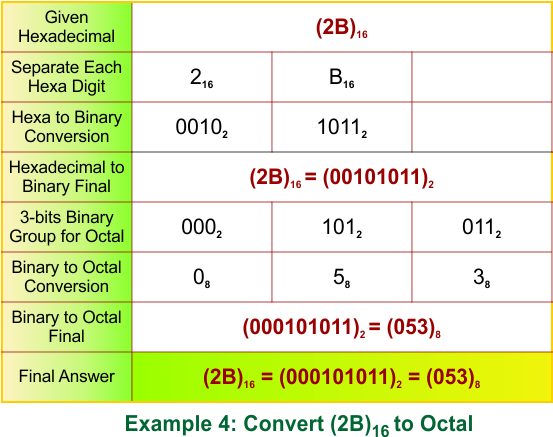
Description:
Step 1: Convert Hexadecimal to Binary
2₁₆ = 0010₂
B₁₆ = 1011₂
(2B)₁₆ = (00101011)₂
Step 2: Group Binary Digits into 3 Bits
(00101011)₂ = (000 101 011)₂
Step 3: Convert Each Group to Octal
000₂ = 0₈
101₂ = 5₈
011₂ = 3₈
Final Answer:
(2B)₁₆ = (053)₈
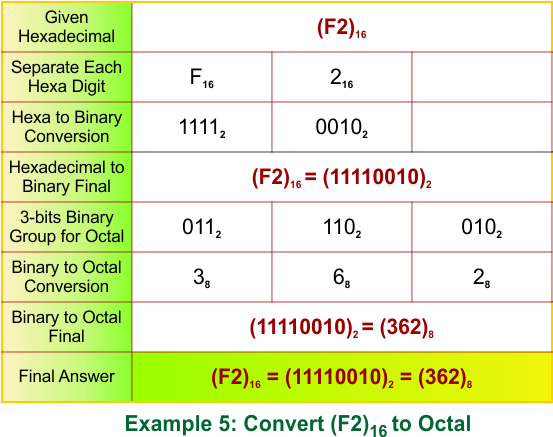
5. Example: Convert (F2)₁₆ to Octal
Solution:
The following steps show the conversion of the hexadecimal number (F2)₁₆ into its equivalent octal number.
Description:
Step 1: Convert Hexadecimal to Binary
F₁₆ = 1111₂
2₁₆ = 0010₂
( F2 )₁₆ = (11110010)₂
Step 2: Group Binary Digits into 3 Bits
(11110010)₂ = (011 110 010)₂
Step 3: Convert Each Group to Octal
011₂ = 3₈
110₂ = 6₈
010₂ = 2₈
Final Answer:
(F2)₁₆ = (362)₈
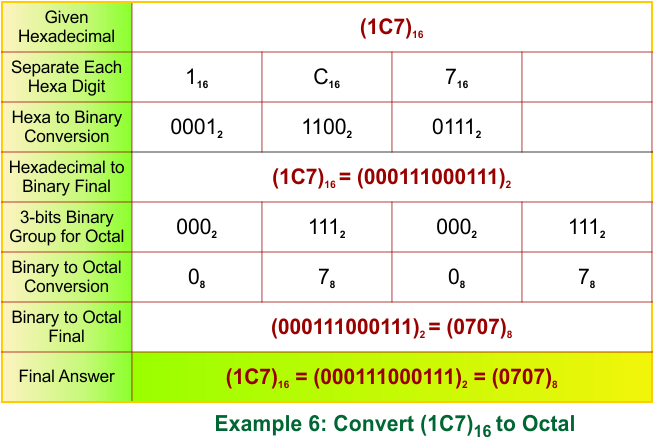
6. Example: Convert (1C7)₁₆ to Octal
Solution:
The following steps show the conversion of the hexadecimal number (1C7)₁₆ into its equivalent octal number.
Description:
Step 1: Convert Hexadecimal to Binary
1₁₆ = 0001₂
C₁₆ = 1100₂
7₁₆ = 0111₂
(1C7)₁₆ = (000111000111)₂
Step 2: Group Binary Digits into 3 Bits
(000111000111)₂ = (000 111 000 111)₂
Step 3: Convert Each Group to Octal
000₂ = 0₈
111₂ = 7₈
000₂ = 0₈
111₂ = 7₈
Final Answer:
(1C7)₁₆ = (0707)₈
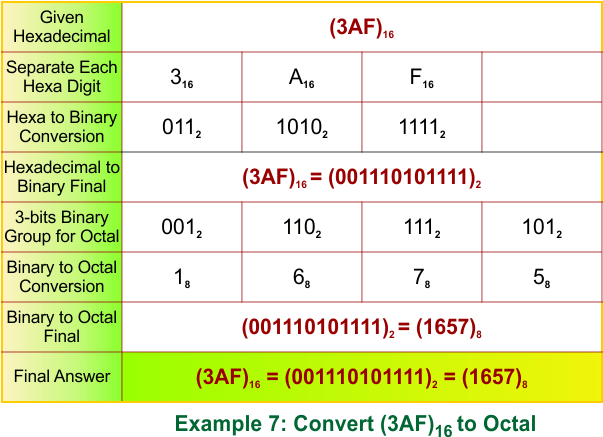
7. Example: Convert (3AF)₁₆ to Octal
Solution:
The following steps show the conversion of the hexadecimal number (3AF)₁₆ into its equivalent octal number.
Description:
Step 1: Convert Hexadecimal to Binary
3₁₆ = 0011₂
A₁₆ = 1010₂
F₁₆ = 1111₂
(3AF)₁₆ = (001110101111)₂
Step 2: Group Binary Digits into 3 Bits
(001110101111)₂ = (001 110 101 111)₂
Step 3: Convert Each Group to Octal
001₂ = 1₈
110₂ = 6₈
101₂ = 5₈
111₂ = 7₈
Final Answer:
(3AF)₁₆ = (1657)₈
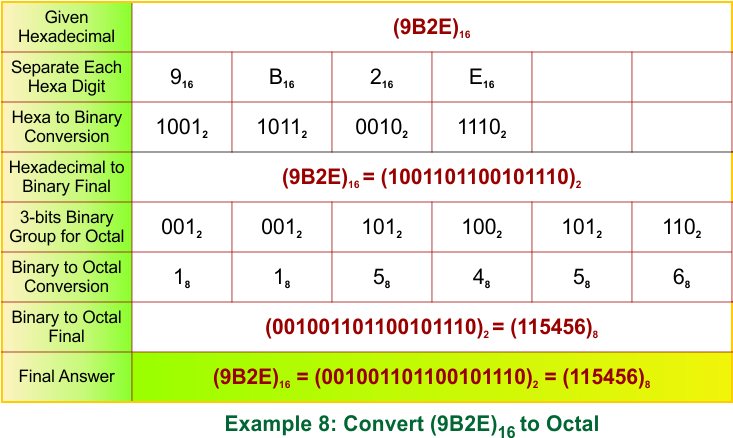
8. Example: Convert (9B2E)₁₆ to Octal
Solution:
The following steps show the conversion of the hexadecimal number (9B2E)₁₆ into its equivalent octal number.
Description:
Step 1: Convert Hexadecimal to Binary
9₁₆ = 1001₂
B₁₆ = 1011₂
2₁₆ = 0010₂
E₁₆ = 1110₂
(9B2E)₁₆ = (1001101100101110)₂
Step 2: Group Binary Digits into 3 Bits
(1001101100101110)₂ = (001 001 101 100 101 110)₂
Step 3: Convert Each Group to Octal
001₂ = 1₈
001₂ = 1₈
101₂ = 5₈
100₂ = 4₈
101₂ = 5₈
110₂ = 6₈
Final Answer:
(9B2E)₁₆ = (115456)₈
9. Example: Convert (4D3A7)₁₆ to Octal
Solution:
The following steps show the conversion of the hexadecimal number (4D3A7)₁₆ into its equivalent octal number.
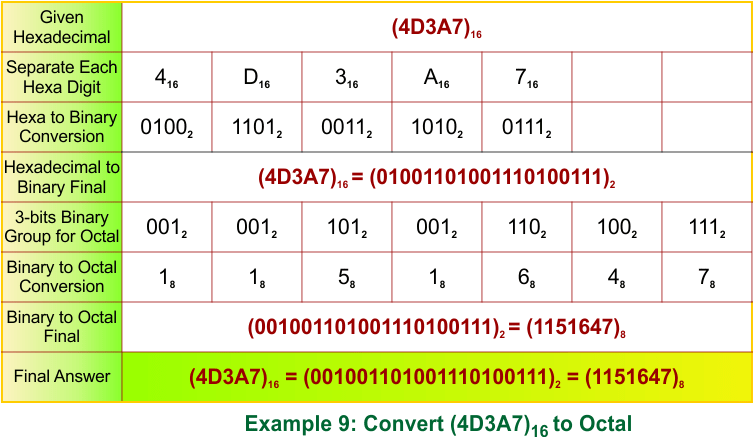
Description:
Step 1: Convert Hexadecimal to Binary
4₁₆ = 0100₂
D₁₆ = 1101₂
3₁₆ = 0011₂
A₁₆ = 1010₂
7₁₆ = 0111₂
(4D3A7)₁₆ = (01001101001110100111)₂
Step 2: Group Binary Digits into 3 Bits
(01001101001110100111)₂
= (001 001 101 001 110 100 111)₂
Step 3: Convert Each Group to Octal
001₂ = 1₈
001₂ = 1₈
101₂ = 5₈
001₂ = 1₈
110₂ = 6₈
100₂ = 4₈
111₂ = 7₈
Final Answer:
(4D3A7)₁₆ = (1151647)₈
10. Example: Convert (1A3F7C)₁₆ to Octal
Solution:
The following steps show the conversion of the hexadecimal number (1A3F7C)₁₆ into its equivalent octal number.
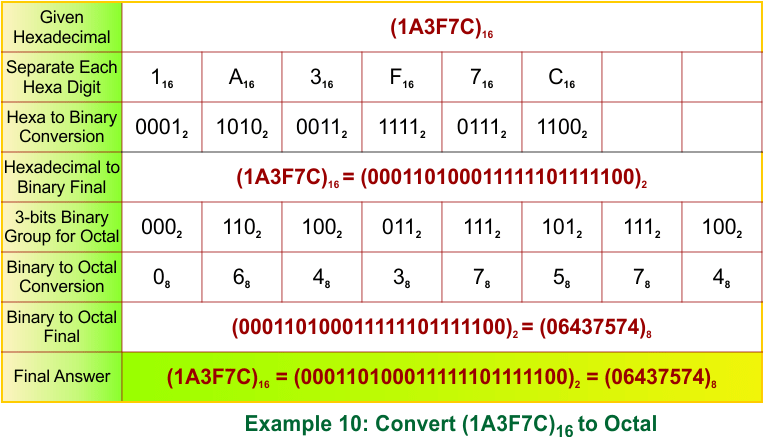
Description:
Step 1: Convert Hexadecimal to Binary
1₁₆ = 0001₂
A₁₆ = 1010₂
3₁₆ = 0011₂
F₁₆ = 1111₂
7₁₆ = 0111₂
C₁₆ = 1100₂
(1A3F7C)₁₆ = (000110100011111101111100)₂
Step 2: Group Binary Digits into 3 Bits
(000110100011111101111100)₂ = (000 110 100 011 111 101 111 100)₂
Step 3: Convert Each Group to Octal
000₂ = 0₈
110₂ = 6₈
100₂ = 4₈
011₂ = 3₈
111₂ = 7₈
101₂ = 5₈
111₂ = 7₈
100₂ = 4₈
Final Answer:
(1A3F7C)₁₆ = (06437574)₈
11. Example: Convert (ABC123)₁₆ to Octal
Solution:
The following steps show the conversion of the hexadecimal number (ABC123)₁₆ into its equivalent octal number.
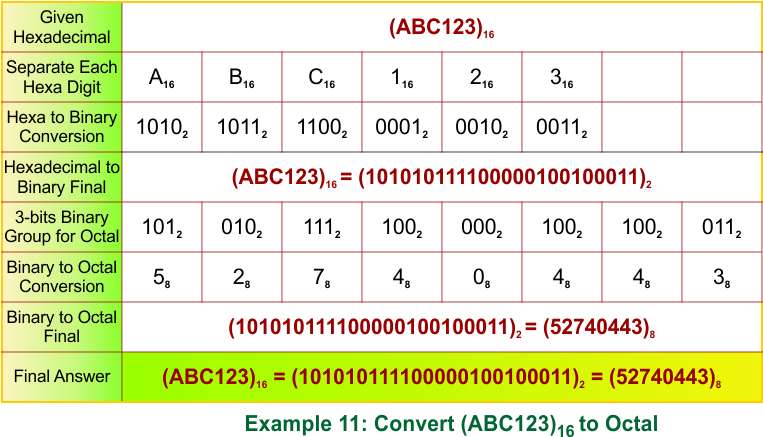
Description:
Step 1: Convert Hexadecimal to Binary
A₁₆ = 1010₂
B₁₆ = 1011₂
C₁₆ = 1100₂
1₁₆ = 0001₂
2₁₆ = 0010₂
3₁₆ = 0011₂
(ABC123)₁₆ = (101010111100000100100011)₂
Step 2: Group Binary Digits into 3 Bits
(101010111100000100100011)₂ = (101 010 111 100 000 100 100 011)₂
Step 3: Convert Each Group to Octal
101₂ = 5₈
010₂ = 2₈
111₂ = 7₈
100₂ = 4₈
000₂ = 0₈
100₂ = 4₈
100₂ = 4₈
011₂ = 3₈
Final Answer:
(ABC123)₁₆ = (52740443)₈
12. Example: Convert (7F2A9B)₁₆ to Octal
Solution:
The following steps show the conversion of the hexadecimal number (7F2A9B)₁₆ into its equivalent octal number.
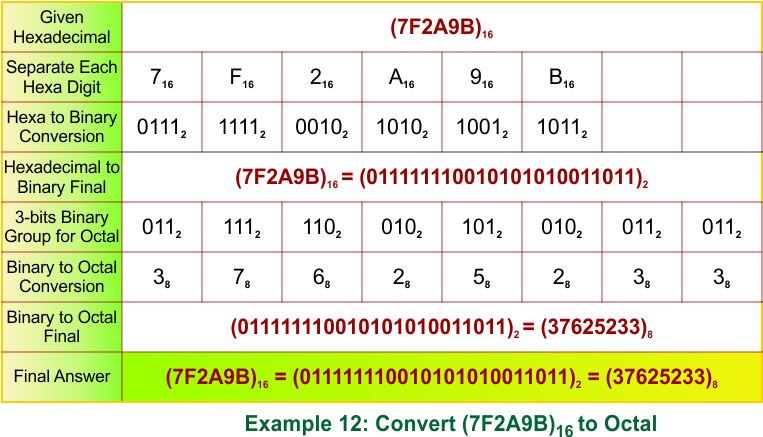
Description:
Step 1: Convert Hexadecimal to Binary
7₁₆ = 0111₂
F₁₆ = 1111₂
2₁₆ = 0010₂
A₁₆ = 1010₂
9₁₆ = 1001₂
B₁₆ = 1011₂
(7F2A9B)₁₆ = (011111110010101010011011)₂
Step 2: Group Binary Digits into 3 Bits
(011111110010101010011011)₂ = (011 111 110 010 101 010 011 011)₂
Step 3: Convert Each Group to Octal
011₂ = 3₈
111₂ = 7₈
110₂ = 6₈
010₂ = 2₈
101₂ = 5₈
010₂ = 2₈
011₂ = 3₈
011₂ = 3₈
Final Answer:
(7F2A9B)₁₆ = (37625233)₈
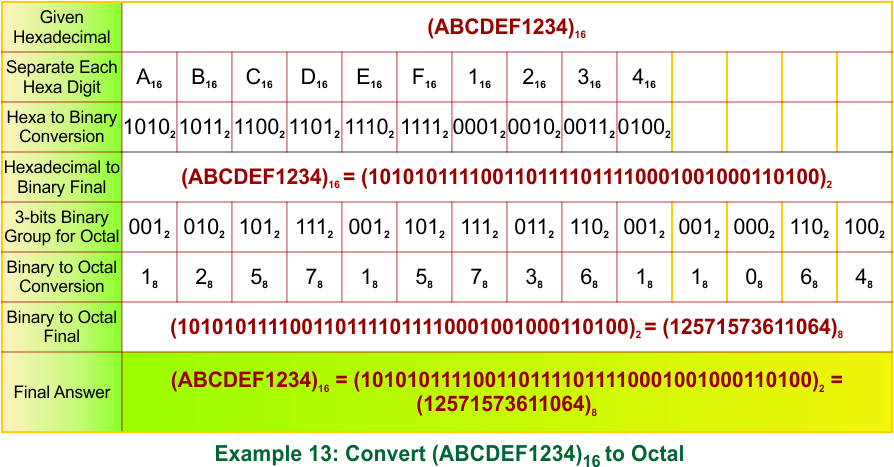
13. Example: Convert (ABCDEF1234)₁₆ to Octal
Solution:
The following steps show the conversion of the hexadecimal number (ABCDEF1234)₁₆ into its equivalent octal number.
Description:
Step 1: Convert Hexadecimal to Binary
A₁₆ = 1010₂
B₁₆ = 1011₂
C₁₆ = 1100₂
D₁₆ = 1101₂
E₁₆ = 1110₂
F₁₆ = 1111₂
1₁₆ = 0001₂
2₁₆ = 0010₂
3₁₆ = 0011₂
4₁₆ = 0100₂
(ABCDEF1234)₁₆ = (1010101111001101111011110001001000110100)₂
Step 2: Group Binary Digits into 3 Bits
(1010101111001101111011110001001000110100)₂
= (001 010 101 111 001 101 111 011 110 001 001 000 110 100)₂
Step 3: Convert Each Group to Octal
001₂ = 1₈
010₂ = 2₈
101₂ = 5₈
111₂ = 7₈
001₂ = 1₈
101₂ = 5₈
111₂ = 7₈
011₂ = 3₈
110₂ = 6₈
001₂ = 1₈
001₂ = 1₈
000₂ = 0₈
110₂ = 6₈
100₂ = 4₈
Final Answer:
(ABCDEF1234)₁₆ = (12571573611064)₈