












OR Gate Truth Table
In Logic Gates, a truth table shows all possible combinations of binary input values (0 and 1) and their corresponding binary outputs. OR Logic Gate is a very basic digital logic gate that produces an output of 1 (HIGH) when at least one input is 1. The output becomes 0 (LOW) in only the case, when all inputs are 0.
The following diagram shows the very basic Boolean Expression, OR Gate Symbol, and OR Gate Truth Table.
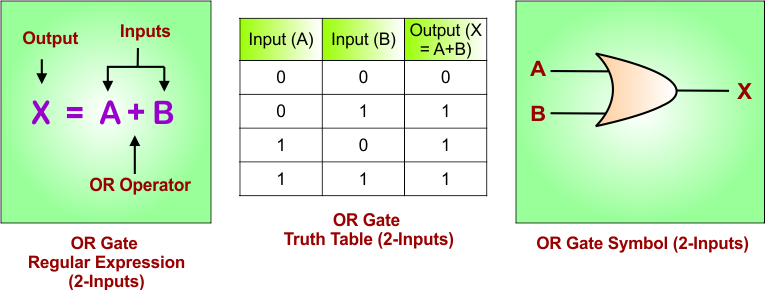
OR Gate Truth Table
Truth tables represent all possible input combinations and their corresponding outputs for a logic gate. OR Gate truth tables for various numbers of inputs are explained below
|
The total possible input combinations in a truth table are calculated using 2ⁿ, where n is the number of inputs. For example:
and so on… |
Let’s explain various truth tables of OR Logic gate for different numbers of inputs
OR Gate Truth Table – 2 Inputs
For 2-input OR Gate, there are 22=4 possible input combinations, explained below.
- Input A Column: First 2 bits = 0, next 2 bits = 1
- Input B Column: Alternates 0 and 1
The truth table of 2 inputs OR Gate with their output is given below
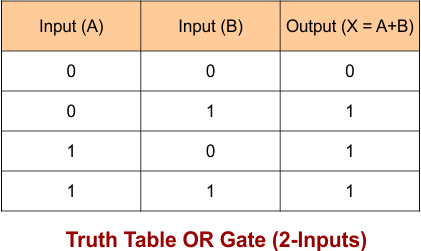
In the above OR gate truth table of 2 inputs
- For A=0 and B = 0, the output (X) will be 0 because neither input is active.
- For A=0 and B = 1, the output (X) will be 1 because the B input is active.
- For A=1 and B = 0, the output (X) will be 1 because the A input is active.
- For A=1 and B =1, the output (X) will be 1 because both inputs are active.
OR Gate Truth Table – 3 Inputs
For 3-input OR Gate, there are 23=8 possible input combinations, explained below.
- Input A Column: First 4 bits = 0, next 4 bits = 1
- Input B Column: First 2 bits = 0, next 2 = 1, next 2 = 0, next 2 = 1
- Input C Column: Alternates 0 and 1
The truth table of 3 inputs OR Gate with their output is given below
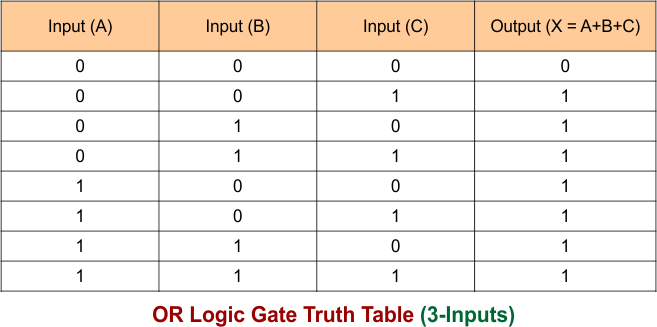
In the above OR gate truth table of 3 inputs
- For A = 0, B = 0, and C = 0, the output (X) will be 0 because no input is active.
- For A=0, B = 0, and C = 1, the output (X) will be 1 because the C input is active.
- For A=0, B = 1, and C = 0, the output (X) will be 1 because the B input is active.
- For A=0, B = 1, and C = 1, the output (X) will be 1 because the B and C inputs are active.
- For A=1, B = 0, and C = 0, the output (X) will be 1 because the A input is active.
- For A=1, B = 0, and C = 1, the output (X) will be 1 because A and C inputs are active.
- For A=1, B = 1, and C = 0, the output (X) will be 1 because A and B inputs are active.
- For A=1, B =1, and C = 1, the output (X) will be 1 because all inputs (A, B,C) are active.
OR Gate Truth Table – 4 Inputs
For 4-input OR Gate, there are 24=16 possible input combinations, explained below.
- Input A Column: First 8 bits = 0, next 8 bits = 1
- Input B Column: First 4 bits = 0, next 4 = 1, next 4 = 0, next 4 = 1
- Input C Column: 2 zeros, 2 ones, repeated
- Input D Column: Alternates 0 and 1
The truth table of 4 inputs OR Gate with their output is given below
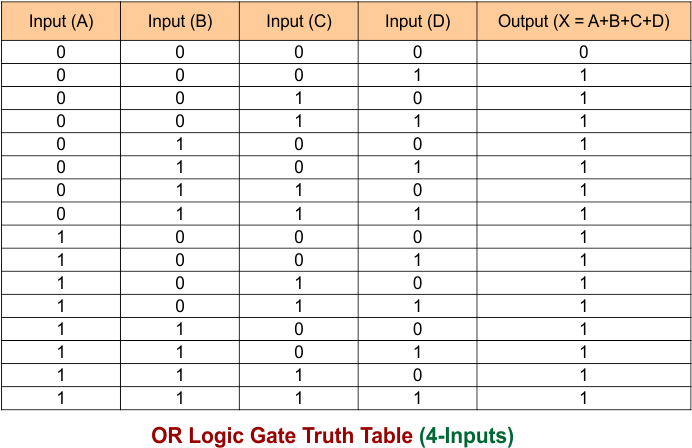
In the above OR gate truth table of 4 inputs
- For A = 0, B = 0, C = 0, and D = 0, the output (X) will be 0 because no input is active.
- For A=0, B = 0, C = 0, and D = 1, the output (X) will be 1 because the D input is active.
- For A=0, B = 0, C = 1, and D = 0, the output (X) will be 1 because the C input is active.
- For A=0, B = 0, C = 1, and D = 1, the output (X) will be 1 because the C and D inputs are active.
- For A=0, B = 1, C = 0, and D = 0, the output (X) will be 1 because the B input is active.
- For A=0, B = 1, C = 0, and D = 1, the output (X) will be 1 because B and D inputs are active.
- For A=0, B = 1, C = 1, and D = 0, the output (X) will be 1 because B and C inputs are active.
- For A=0, B =1, C = 1, and D = 1, the output (X) will be 1 because B, C, and D inputs are active.
- For A = 1, B = 0, C = 0, and D = 0, the output (X) will be 1 because A input is active.
- For A=1, B = 0, C = 0, and D = 1, the output (X) will be 1 because A and D inputs are active.
- For A=1, B = 0, C = 1, and D = 0, the output (X) will be 1 because the A and C inputs are active.
- For A=1, B = 0, C = 1, and D = 1, the output (X) will be 1 because the A, C, and D inputs are active.
- For A=1, B = 1, C = 0, and D = 0, the output (X) will be 1 because the A and B inputs are active.
- For A=1, B = 1, C = 0, and D = 1, the output (X) will be 1 because A, B, and D inputs are active.
- For A=1, B = 1, C = 1, and D = 0, the output (X) will be 1 because A, B, and C inputs are active.
- For A=1, B =1, C = 1, and D = 1, the output (X) will be 1 because all inputs (A, B, C, and D) are active.
OR Gate Truth Table – 5 Inputs
For 5-input OR Gate, there are 25=32 possible input combinations, explained below.
- Input A Column: First 16 bits = 0, next 16 bits = 1
- Input B Column: First 8 bits = 0, next 8 = 1, next 8 = 0, next 8 = 1
- Input C Column: 4 zeros, 4 ones, repeated
- Input D Column: 2 zeros, 2 ones, repeated
- Input E Column: Alternates 0 and 1
The truth table of 5 inputs OR Gate with its output is given below
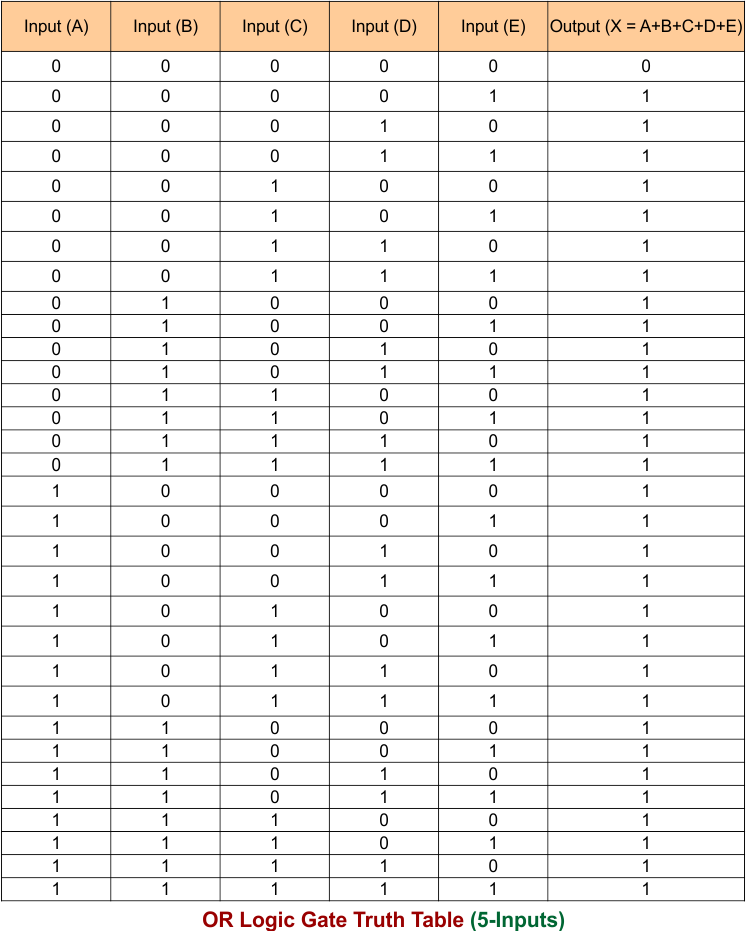
In the above OR gate truth table of 5 inputs
- For A = 0, B = 0, C = 0, D = 0, and E = 0, the output (X) will be 0 because no input is active.
- For A=0, B = 0, C = 0, D = 0, and E = 1, the output (X) will be 1 because one or more inputs are active.
- For A=0, B = 0, C = 0, D = 1, and E = 0, the output (X) will be 1 because one or more inputs are active.
- For A=0, B = 0, C = 0, D = 1, and E = 1, the output (X) will be 1 because one or more inputs are active.
- For A=0, B = 0, C = 1, D = 0, and E = 0, the output (X) will be 1 because one or more inputs are active.
- For A=0, B = 0, C = 1, D = 0, and E = 1, the output (X) will be 1 because one or more inputs are active.
- For A=0, B = 0, C = 1, D = 1, and E = 0, the output (X) will be 1 because one or more inputs are active.
- For A=0, B =0, C = 1, D = 1, and E = 1, the output (X) will be 1 because one or more inputs are active.
- For A =0, B = 1, C = 0, D = 0, and E = 0, the output (X) will be 1 because one or more inputs are active.
- For A=0, B = 1, C = 0, D = 0, and E = 1, the output (X) will be 1 because one or more inputs are active.
- For A=0, B = 1, C = 0, D = 1, and E = 0, the output (X) will be 1 because one or more inputs are active.
- For A=0, B = 1, C = 0, D = 1, and E = 1, the output (X) will be 1 because one or more inputs are active.
- For A=0, B = 1, C = 1, D = 0, and E = 0, the output (X) will be 1 because one or more inputs are active.
- For A=0, B = 1, C = 1, D = 0, and E = 1, the output (X) will be 1 because one or more inputs are active.
- For A=0, B = 1, C = 1, D = 1, and E = 0, the output (X) will be 1 because one or more inputs are active.
- For A=0, B =1, C = 1, D = 1, and E = 1, the output (X) will be 1 because one or more inputs are active.
- For A = 1, B = 0, C = 0, D = 0, and E = 0, the output (X) will be 1 because one or more inputs are active.
- For A=1, B = 0, C = 0, D = 0, and E = 1, the output (X) will be 1 because one or more inputs are active.
- For A=1, B = 0, C = 0, D = 1, and E = 0, the output (X) will be 1 because one or more inputs are active.
- For A=1, B = 0, C = 0, D = 1, and E = 1, the output (X) will be 1 because one or more inputs are active.
- For A=1, B = 0, C = 1, D = 0, and E = 0, the output (X) will be 1 because one or more inputs are active.
- For A=1, B = 0, C = 1, D = 0, and E = 1, the output (X) will be 1 because one or more inputs are active.
- For A=1, B = 0, C = 1, D = 1, and E = 0, the output (X) will be 1 because one or more inputs are active.
- For A=1, B =0, C = 1, D = 1, and E = 1, the output (X) will be 1 because one or more inputs are active.
- For A = 1, B = 1, C = 0, D = 0, and E = 0, the output (X) will be 1 because one or more inputs are active.
- For A=1, B = 1, C = 0, D = 0, and E = 1, the output (X) will be 1 because one or more inputs are active.
- For A=1, B = 1, C = 0, D = 1, and E = 0, the output (X) will be 1 because one or more inputs are active.
- For A=1, B = 1, C = 0, D = 1, and E = 1, the output (X) will be 1 because one or more inputs are active.
- For A=1, B = 1, C = 1, D = 0, and E = 0, the output (X) will be 1 because one or more inputs are active.
- For A=1, B = 1, C = 1, D = 0, and E = 1, the output (X) will be 1 because one or more inputs are active.
- For A=1, B = 1, C = 1, D = 1, and E = 0, the output (X) will be 1 because one or more inputs are active.
- For A=1, B =1, C = 1, D = 1, and E = 1, the output (X) will be 1 because all inputs (A, B, C, and D) are active.