












Binary Division Examples
Binary division is a basic operation used to divide one binary number by another. It works like decimal division but uses only two digits, 0 and 1. In this article, we will learn how to divide binary numbers with simple rules and step-by-step examples, including fractional numbers.
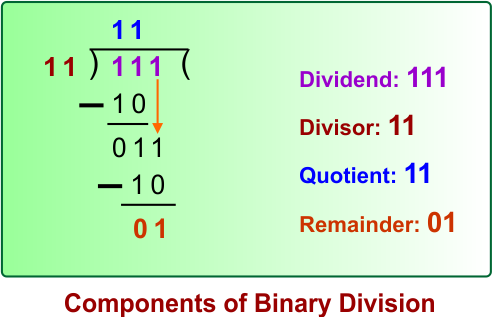
The main components of binary division are given below
- Dividend: The binary number that is being divided.
- Divisor: The binary number used to divide the dividend.
- Quotient: The result obtained after division.
- Remainder: The value left over after completing the division.
The following diagram explains it
Binary Division Rules
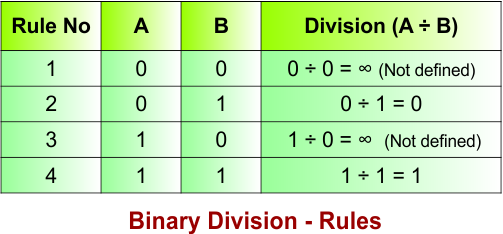
Binary division follows the same basic process as decimal division, but it uses only two digits: 0 and 1. There are four basic rules of binary division. The following diagram shows the binary division rules table
Important Points of Binary Division
- Dividing 0 by 1 gives 0.
- Dividing 1 by 1 gives 1.
- Division by 0 is undefined.
- Binary division uses subtraction and multiplication during the calculation.
- The division process is similar to long division in the decimal number system.
Binary Division Examples
Let’s understand binary division with the following examples.
Example 1: Divide (11)₂ by (11)₂
Let’s divide the binary 11 by 11. The following diagram explains the process
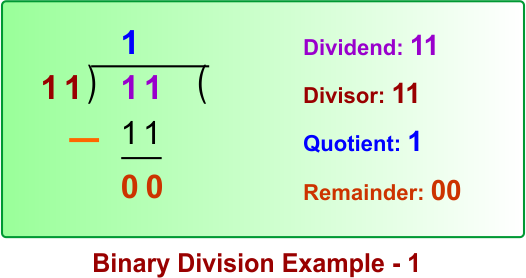
According to the above diagram, Example 1
- Binary value: 11 ÷ 11 = 1
- Quotient = 1
- Remainder = 0
- Decimal proof: 3 ÷ 3 = 1
Example 2: Divide (11)₂ by (10)₂
Let’s divide the binary 11 by 10. The following diagram explains the process
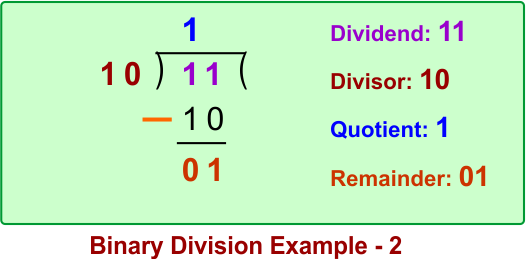
According to the above diagram, Example 2
- Binary value: 11 ÷ 10 = 1
- Quotient = 1
- Remainder = 1
- Decimal proof: 3 ÷ 2 = 1, remainder 1.
Example 3: Divide (111)₂ by (10)₂
Let’s divide the binary 111 by 10. The following diagram explains the process
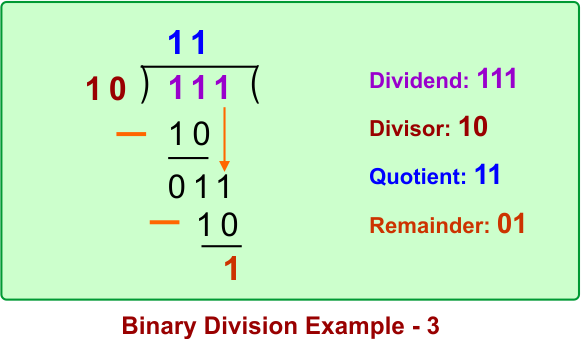
According to the above diagram, Example 3
- Binary value: 111 ÷ 10 = 11
- Quotient = 11
- Remainder = 1
- Decimal proof: 7 ÷ 2 = 3, remainder 1.
Example 4: Divide (11101)₂ by (10)₂
Let’s divide the binary 11101 by 10. The following diagram explains the process
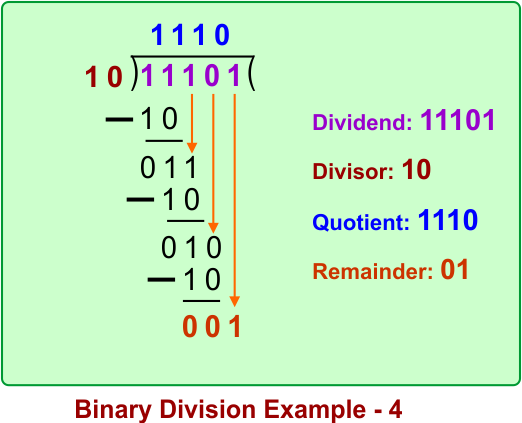
According to the above diagram, Example 4
- Binary value: 11101 ÷ 10 = 1110
- Quotient = 1110
- Remainder = 1
- Decimal proof: 29 ÷ 2 = 14, remainder 1.
Example 5: Divide (1110010)₂ by (10)₂
Let’s divide the binary 1110010 by 10. The following diagram explains the process
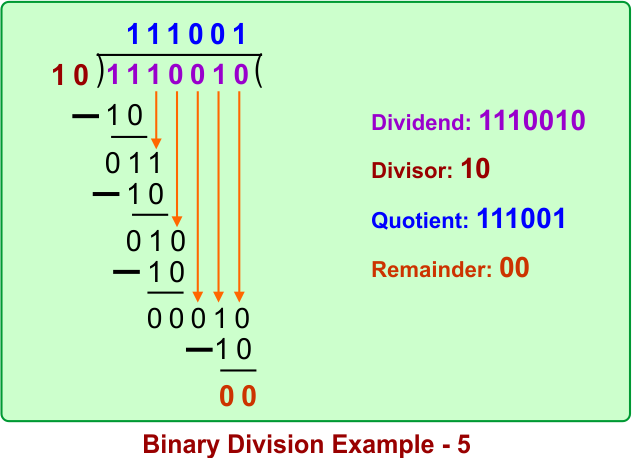
According to the above diagram, Example 5
- Binary value: 1110010 ÷ 10 = 111001
- Quotient = 111001
- Remainder = 0
- Decimal proof: 114 ÷ 2 = 57.
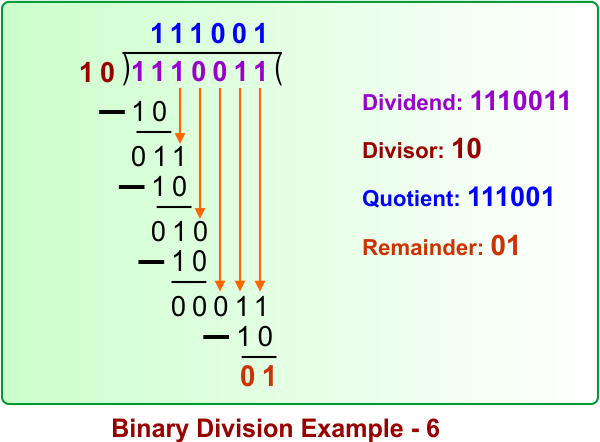
Example 6: Divide (1110011)₂ by (10)₂
Let’s divide the binary 1110011 by 10. The following diagram explains the process
Conclusion
Binary division is an important arithmetic operation used in computer systems and digital electronics. It follows the same general process as decimal long division and uses only the digits 0 and 1. Practicing different binary division examples, including fractional numbers, helps students understand the division process and calculate quotients and remainders accurately.