












2 Variable K-Map Examples
A 2-variable (i.e A, B) Karnaugh Map (K-map) is used to simplify Boolean expressions. It has 4 cells, where each cell represents one possible minterm (i.e., m0) or maxterm (i.e., M0).
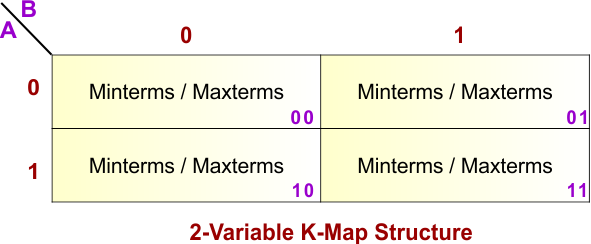
Solving 2 Variable K-Map examples helps students understand how to place minterms and maxterms, group adjacent values, and simplify Boolean expressions using SOP and POS methods.
Minterms and Maxterms in 2 Variable K-Map
Minterms and maxterms represent all possible combinations of two variables (A and B) and are used to simplify Boolean expressions in SOP (Sum of Products) and POS (Product of Sums) forms using a 2 Variable K-Map.
Minterms 2 Variable K-Map – SOP
Minterms of two variables:
- m₀ = 00 = A’B’
- m₁ = 01 = A’B
- m₂ = 10 = AB’
- m₃ = 11 = AB
Example:
F(A,B) = A’B’ + AB’ + AB
- A’B’ = m₀
- AB’ = m₂
- AB = m₃
Therefore: F(A,B) = m₀ + m₂ + m₃ = Σm(0,2,3)
Maxterms 2 Variable K-Map – POS
Maxterms of two variables:
- M₀ = 00 = A + B
- M₁ = 01 = A + B’
- M₂ = 10 = A’ + B
- M₃ = 11 = A’ + B’
Example:
F(A,B) = (A + B)(A’ + B)(A’ + B’)
- (A + B) = M₀
- (A’ + B) = M₂
- (A’ + B’) = M₃
Therefore: F(A,B) = M₀ · M₂ · M₃ = ΠM(0,2,3)
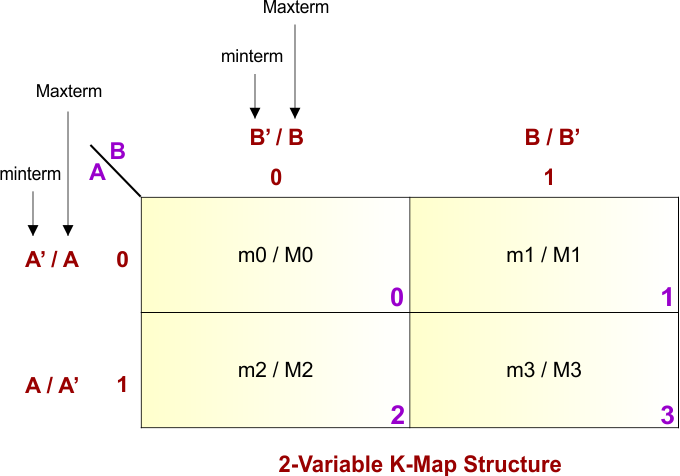
2 Variable K-Map Structure
Here is very descriptive structures of 2 variable K _ MAP which contains 4 cells, each cell represents one possible minterm (i.e. m0) or maxterm (i.e. M0).
Rules for Solving 2 Variable K-Map Examples
Follow these rules when solving 2 Variable K-Map examples:
- Draw a 2 × 2 K-Map containing four cells.
- Identify the given minterms or maxterms.
- For SOP, place 1 in the cells of the given minterms and 0 in the remaining cells.
- For POS, place 0 in the cells of the given maxterms and 1 in the remaining cells.
- Make the largest possible groups of adjacent 1s for SOP or adjacent 0s for POS.
- Groups can contain 1, 2, or 4 cells.
- Diagonal cells cannot be grouped together.
- Write the simplified Boolean expression using the common variables in each group.
The following are common types of questions/ examples asked in exams and assignments about 2 Variable Karnaugh Maps.
2 Variable K-Map Simplification Using Minterms (SOP)
In this section, we will cover different 2 Variable K-Map Simplification Using Minterms (SOP) examples with solutions to understand the simplification process step by step.
2-Variable K-Map Example 1 – SOP (Minterms)
Simplify the Boolean function F(A, B) = Σm(2) using a 2-Variable K-Map.
Solution:
The following diagram completely solves the Example 1 function F(A, B) = Σm(2) in a very descriptive manner
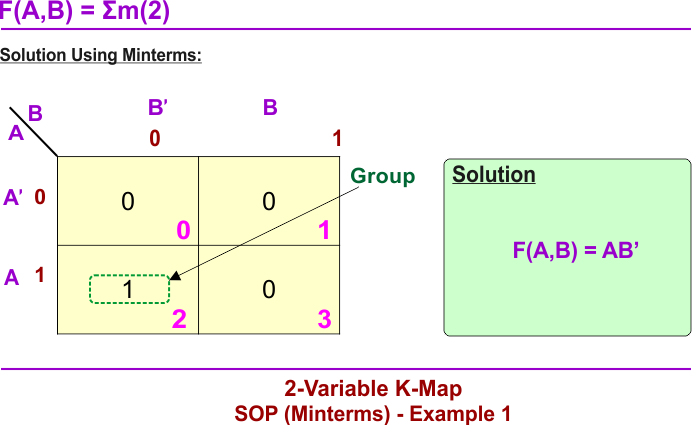
In the above diagram,
There is only a single group that contains “1” in cell 2. The value of cell 2 in terms of variables is AB’. Boolean expression AB’ cannot be further minimized. So, it is the final answer of function F(A, B) = AB’
2-Variable K-Map Example 2 – SOP (Minterms)
Simplify the Boolean function F(A, B) = Σm(2,3) using a 2-Variable K-Map.
Solution:
The following diagram completely solves the Example 2 function F(A, B) = Σm(2,3) in a very descriptive manner
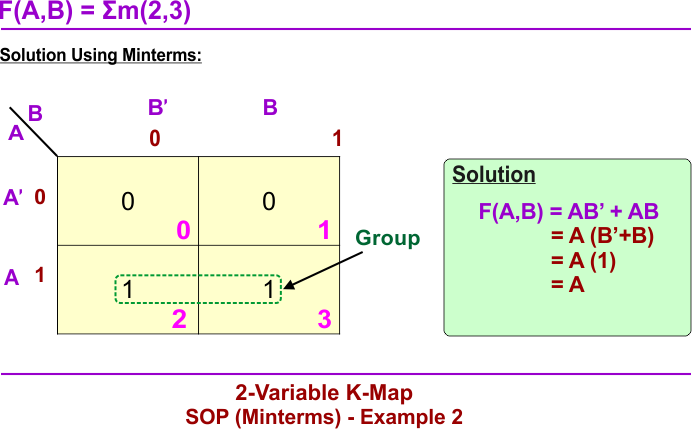
Let’s explain the above diagram
Group
- The value of “A” remains unchanged in the group, so it remains in Function F(A, B)
- The value of “B” changes in the group from B’ to B, so it is removed from Function F (A, B)
- Final result is F (A, B) = A
2-Variable K-Map Example 3 – SOP (Minterms)
Simplify the Boolean function F(A, B) = Σm(0,2,3) using a 2-Variable K-Map.
Solution:
The following diagram completely solves the Example 3 function F(A, B) = Σm(0,2,3) in a very descriptive manner
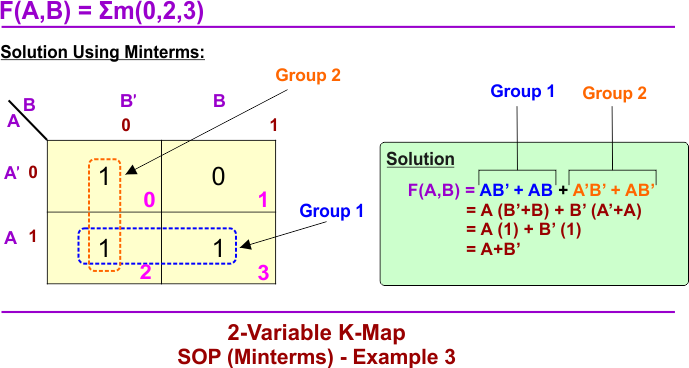
Let’s explain the above diagram
Group 1
- The value of “A” remains unchanged in the group, so it remains in Function F(A, B)
- The value of “B” changes in the group from B’ to B, so it is removed from Function F (A, B)
- Result of group 1 is F (A, B) = A
Group 2
- The value of “B”” remains unchanged in the group, so it remains in Function F(A, B)
- The value of “A” changes in the group from A’ to A, so it is removed from Function F (A, B)
- Result of group 2 is F (A, B) = B’
Final result is F (A, B) = A + B’
2-Variable K-Map Example 4 – SOP (Minterms)
Simplify the Boolean function F(A, B) = Σm(1,2) using a 2-Variable K-Map.
Solution:
The following diagram completely solves the Example 4 function F(A, B) = Σm(1,2) in a very descriptive manner
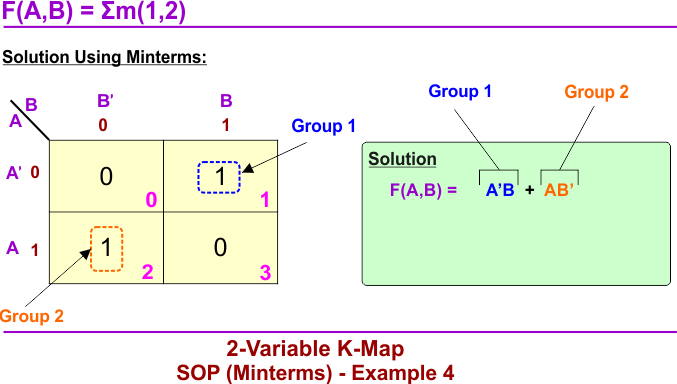
Let’s explain the above diagram
Group 1
- The value of cell 2 in terms of variables is AB’. Boolean expression A’B cannot be further minimized.
- Result of group 1 is F (A, B) = A’B
Group 2
- The value of cell 2 in terms of variables is AB’. Boolean expression AB’ cannot be further minimized.
- Result of group 2 is F (A, B) = AB’
Final result is F (A, B) = A’B + AB’
Note: A group of 3 cells is not possible in a 2 Variable K-Map.
2-Variable K-Map Example 5 – SOP (Minterms)
Simplify the Boolean function F(A, B) = Σm(0,12,3) using a 5-Variable K-Map.
Solution:
The following diagram completely solves the Example 5 function F(A, B) = Σm(0,1,2,3) in a very descriptive manner
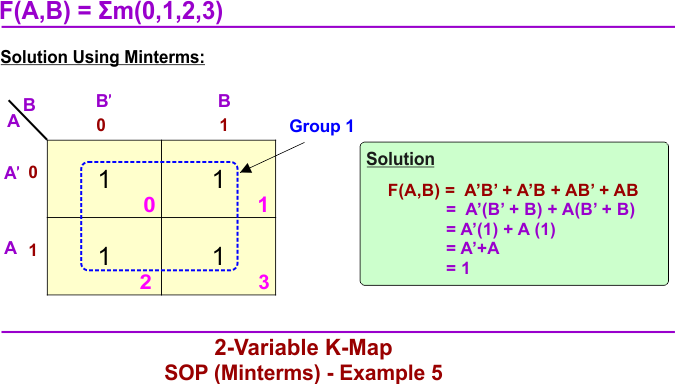
Let’s explain the above diagram
Group
- The value of “A” changes in the group from A’ to A, so it is removed from Function F (A, B)
- The value of “B” changes in the group from B’ to B, so it is removed from Function F (A, B)
- Final result is F (A, B) =1
2 Variable K-Map Simplification Using Maxterms (POS)
In this section, we will cover different 2 Variable K-Map Simplification Using Maxterms (POS) examples with solutions to understand the simplification process step by step.
2-Variable K-Map Example 1 – POS (Maxterms)
Simplify the Boolean function F(A, B) = ΠM(2) using a 2-Variable K-Map.
Solution:
The following diagram completely solves the Example 1 function F(A, B) = ΠM(2) in a very descriptive manner
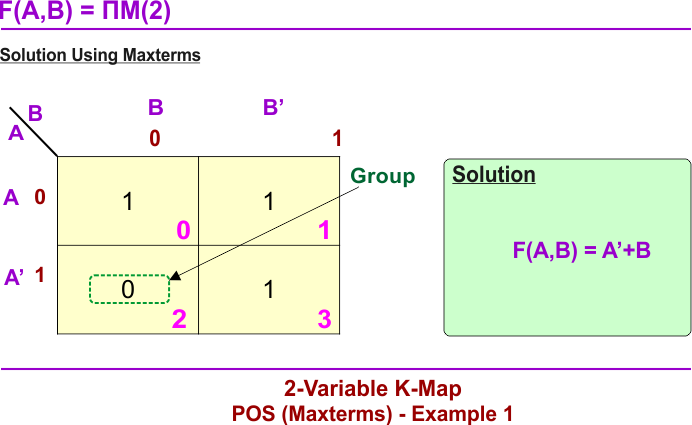
In the above diagram,
There is only a single group that contains “0” in cell 2. The value of cell 2 in terms of variables is (A’ + B). Boolean expression (A’ + B) cannot be further minimized. So, it is the final answer of function F(A, B) = (A’ + B).
2-Variable K-Map Example 2 – POS (Maxterms)
Simplify the Boolean function F(A, B) = ΠM(2,3) using a 2-Variable K-Map.
Solution:
The following diagram completely solves the Example 2 function F(A, B) = ΠM(2,3) in a very descriptive manner
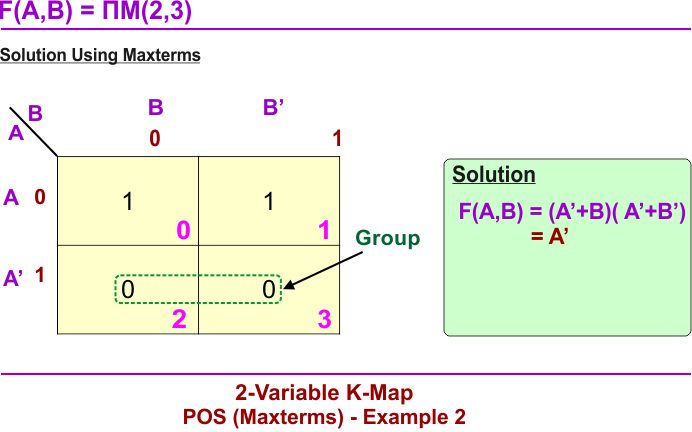
Let’s explain the above diagram
Group
- The value of “A'” remains unchanged in the group, so it remains in Function F(A, B).
- The value of “B” changes in the group from B’ to B, so it is removed from Function F(A, B).
- Final result is F(A, B) = A’
2-Variable K-Map Example 3 – POS (Maxterms)
Simplify the Boolean function F(A, B) = ΠM(0,2,3) using a 2-Variable K-Map.
Solution:
The following diagram completely solves the Example 3 function F(A, B) = ΠM(0,2,3) in a very descriptive manner
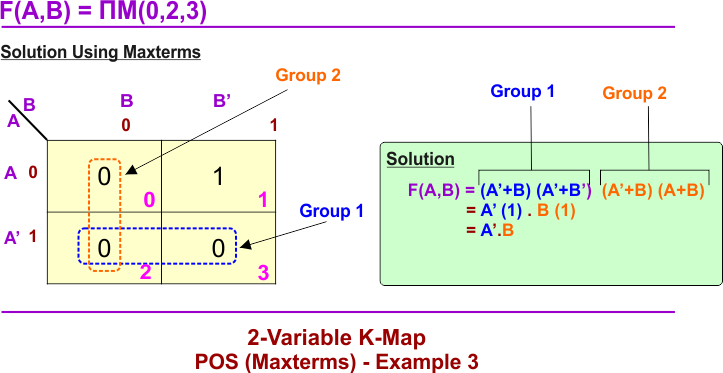
Let’s explain the above diagram.
Group 1
-
The value of “A'” remains unchanged in the group, so it remains in Function F(A, B).
-
The value of “B” changes in the group from B’ to B, so it is removed from Function F(A, B).
-
Result of group 1 is F(A, B) = A’
Group 2
-
The value of “B” remains unchanged in the group, so it remains in Function F(A, B).
-
The value of “A” changes in the group from A’ to A, so it is removed from Function F(A, B).
-
Result of group 2 is F(A, B) = B
Final result is F(A, B) = A’B
2-Variable K-Map Example 4 – POS (Maxterms)
Simplify the Boolean function F(A, B) = ΠM(1,2) using a 2-Variable K-Map.
Solution:
The following diagram completely solves the Example 4 function F(A, B) = ΠM(1,2) in a very descriptive manner
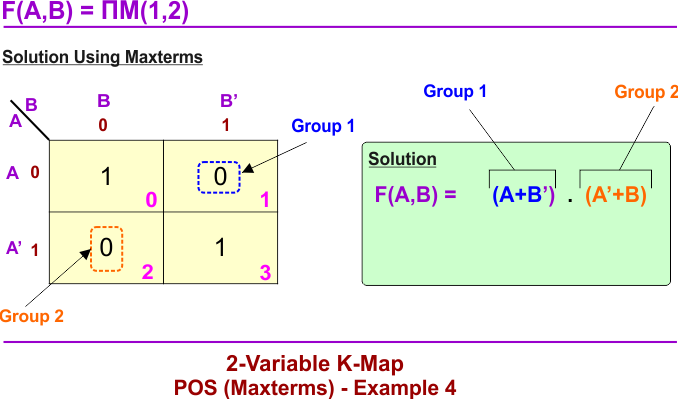
Let’s explain the above diagram.
Group 1
-
The value of cell 1 in terms of variables is (A + B’). Boolean expression (A + B’) cannot be further minimized.
-
Result of group 1 is F(A, B) = (A + B’)
Group 2
-
The value of cell 2 in terms of variables is (A’ + B). Boolean expression (A’ + B) cannot be further minimized.
-
Result of group 2 is F(A, B) = (A’ + B)
Final result is F(A, B) = (A + B’)(A’ + B)
Note: A group of 3 cells is not possible in a 2 Variable K-Map.
2-Variable K-Map Example 5 – POS (Maxterms)
Simplify the Boolean function F(A, B) = ΠM(0,12,3) using a 5-Variable K-Map.
Solution:
The following diagram completely solves the Example 5 function F(A, B) = ΠM(0,1,2,3) in a very descriptive manner
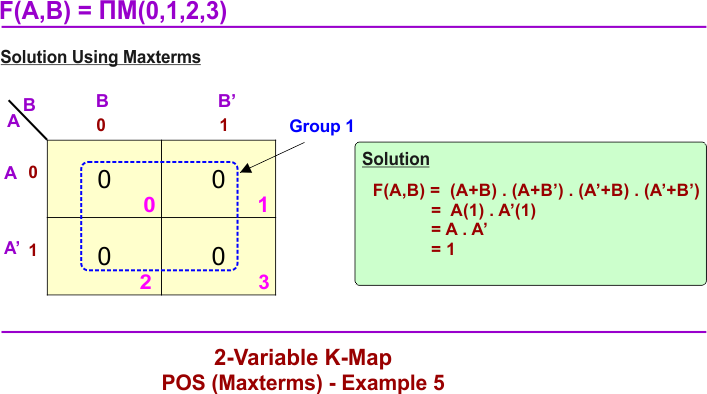
Let’s explain the above diagram.
Group
-
The value of “A” changes in the group from A’ to A, so it is removed from Function F(A, B).
-
The value of “B” changes in the group from B’ to B, so it is removed from Function F(A, B).
-
The final result is F(A, B) = 1.
2 Variables K-Map From a Boolean Expression
A 2-variable K-Map can be used to simplify Boolean expressions in SOP (Sum of Products) and POS (Product of Sums) forms. The following examples show how to convert Boolean expressions into a K-Map and simplify them.
Example 1: SOP (Sum of Products)
The Given Boolean expression is F(A, B) = A’B’ + A’B
- Identify the minterms using the Boolean function F(A, B) = A’B’ + A’B
- Place 1s in the cells where we identify the minterms, and put 0 in the remaining cells.
- Group the adjacent 1s.
The following diagram explains the process
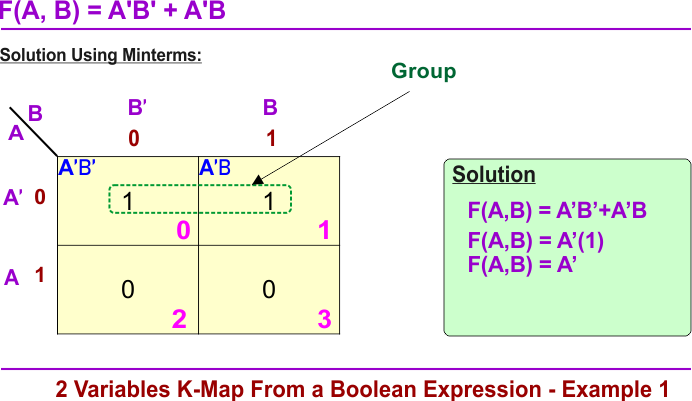
According to the above diagram
- Variable A remains unchanged as A’, while B changes from B’ to B and is eliminated.
- The final result is F(A, B) = A’.
Example 2: POS (Product of Sums)
Given Boolean expression:
F(A, B) = (A + B)(A + B’)
-
Identify the maxterms: M(2, 3).
-
Place 0s in cells 2 and 3 of the 2-variable K-Map.
-
Group the adjacent 0s.
-
Variable A remains unchanged as A, while B changes from B’ to B and is eliminated.
-
Final result is F(A, B) = A.
Example 3: SOP (Sum of Products)
Given Boolean expression:
F(A, B) = AB’ + AB
-
Identify the minterms: m(2, 3).
-
Place 1s in cells 2 and 3 of the 2-variable K-Map.
-
Group the adjacent 1s.
-
Variable A remains unchanged as A, while B changes from B’ to B and is eliminated.
-
Final result is F(A, B) = A.
Example 4: POS (Product of Sums)
Given Boolean expression:
F(A, B) = (A’ + B)(A + B)
-
Identify the maxterms: M(1, 3).
-
Place 0s in cells 1 and 3 of the 2-variable K-Map.
-
Group the adjacent 0s.
-
Variable B remains unchanged as B, while A changes from A’ to A and is eliminated.
-
Final result is F(A, B) = B.
4. K-Map From a Truth Table
-
Given: A truth table containing inputs A, B, and output F.
-
Task: Draw the K-Map and obtain the simplified Boolean expression.
5. K-Map From a Logic Circuit
-
Given: A logic circuit containing AND, OR, and NOT gates.
-
Task: Write its Boolean function, construct the K-Map, and simplify it.
6. K-Map With Don’t Care Conditions
-
Given: (F(A,B)=\igma m(1,2)+d(3)\)
-
Task: Use the don’t-care condition to obtain the simplest Boolean expression.
7. Find the Missing Minterms
-
Given: A partially completed K-Map.
-
Task: Identify the missing minterms and complete the Boolean function.
8. Draw and Complete a K-Map
-
Given: A Boolean function in SOP or POS form.
-
Task: Draw the 2 Variable K-Map and fill all four cells correctly.