












Identity Law in Boolean Algebra
According to the Identity Law in Boolean Algebra, combining a Boolean variable with its identity value does not change the variable’s value. The identity value is different in AND and OR operations.
- The identity value for the AND operation is 1
- The identity value for the OR operation is 0
Identity laws are fundamental laws used to simplify Boolean expressions and digital logic circuits.
Types of Identity Laws
There are two types of identity laws in Boolean algebra
1. AND Identity Law
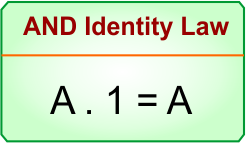
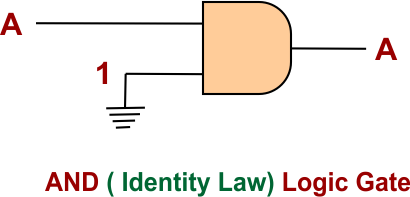
The identity value for the AND operation is 1. When any variable is ANDed with “1”, then the result remains the same variable. The following diagram of the AND identity law explains it.
Let’s explain the diagram
A · 1 = A. It means that1 does not change the value of A.
- If A = 0 then 0 · 1 = 0
- If A = 1 then1 · 1 = 1
Therefore, A · 1 = A because the value of A remains the same whether A is 0 or 1. It is called AND identity Law
2. OR Identity Law
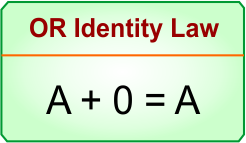
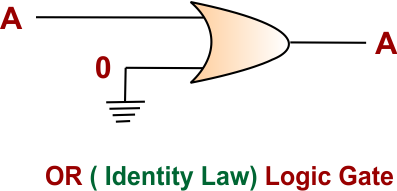
The identity value for the OR operation is 0. When any variable is OR with “0”, then the result remains the same variable. The following diagram of the OR identity law explains it.
Let’s explain the diagram
A + 0 = A. It means that0 does not change the value of A.
- If A = 0 then 0 + 0 = 0
- If A = 1 then1 + 0 = 1
Therefore, A + 0 = A because the value of A remains the same whether A is 0 or 1. It is called OR identity Law
Identity Law Truth Table
Let’s explain the truth table of AND and OR operations in Boolean algebra
AND Identity Law Truth Table
In an AND operation, 1 acts as the identity value. When A is ANDed with 1, the result is always the same as A. The following diagram shows the truth table of AND identity law
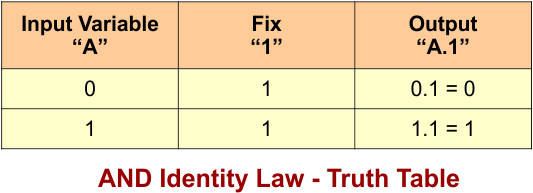
So, A · 1 = A because 1 does not change A’s value.
OR Identity Law Truth Table
In an OR operation, 0 acts as the identity value. When A is ORed with 0, the result is always the same as A. The following diagram shows the truth table of OR identity law
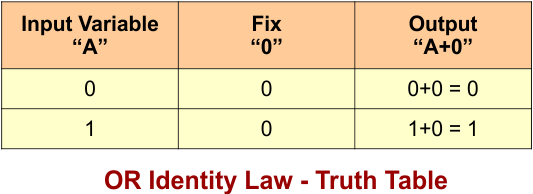
So, A + 0 = A because 0 does not change the value of A.
Identity Law Logic Gates
Let’s explain the logic gates of the identity law in Boolean algebra
AND Identity law – Logic Gate
OR Identity law – Logic Gate
Identity Law – Circuit switches
Let’s explain the logic gates of the circuit switches in Boolean algebra. The Identity Law can be represented using circuit switches to show how an identity value does not change the input.
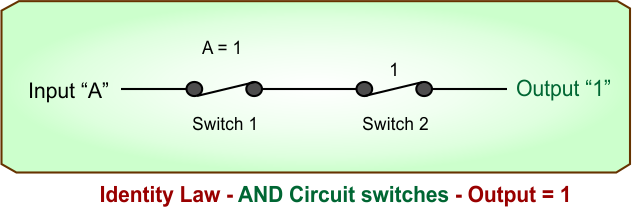
AND Identity law – Circuit switches
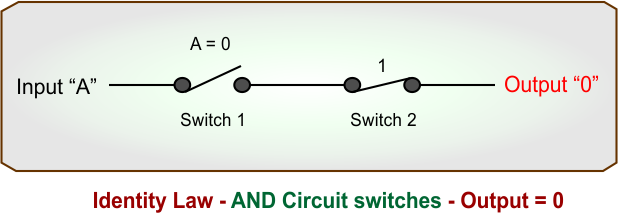
Switch 2 represents 1 and remains closed, so it does not affect the circuit, giving A . 1 = A. Switch 1 can be either 0 or 1, and passes directly to the output without being changed.
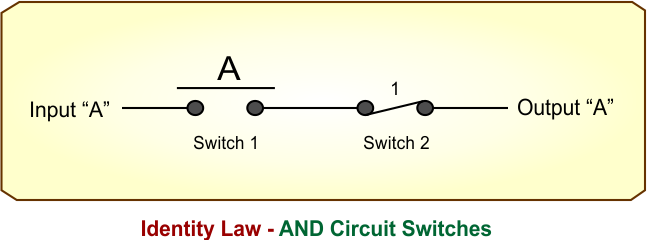
Case 01: When A = 0, the output becomes 0
Case 02: When A = 1, the output becomes 1
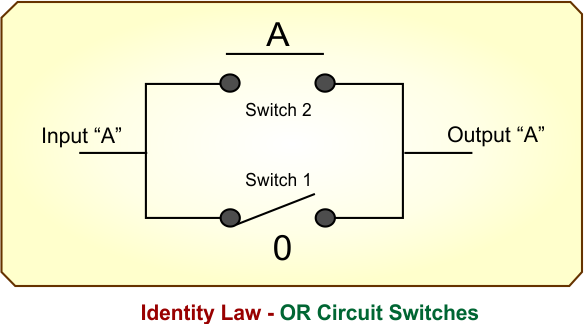
OR Identity law – Circuit switches
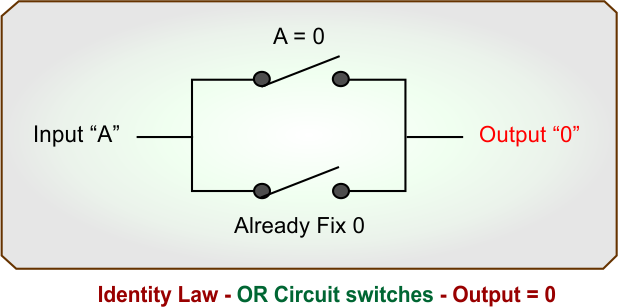
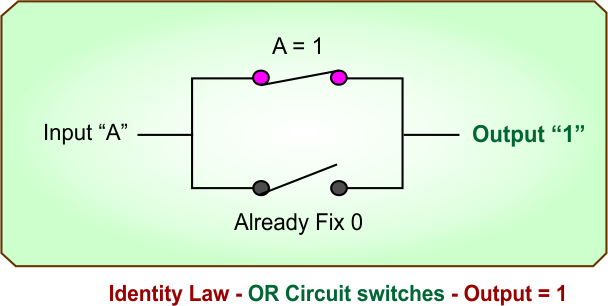
Switch 1 represents 0 and remains open, so it does not affect the circuit, giving A + 0 = A. Switch 2 can be either 0 or 1, and passes directly to the output without being changed.
Case 01: When A = 0, the output becomes 0
Case 02: When A = 1, the output becomes 1
Identity Law in Boolean Simplification
The Identity Law is commonly used to remove unnecessary constants from Boolean expressions. Let’s explain some examples
Identity Law Example 1: AB · 1 + C
The Identity Law X · 1 = X removes 1 without changing AB.
- AB · 1 + C = AB + C
Identity Law Example 2: A + B + 0
The Identity Law X + 0 = X removes 0 without changing the expression.
- A + B + 0 = A + B
Identity Law Example 3: ABC · 1 + D
Using X · 1 = X, the 1 is removed from the AND operation.
- ABC · 1 + D = ABC + D
Identity Law Example 4: AB + CD · 1 + E + 0
Apply the Identity Law to CD · 1 and E + 0.
- AB + CD · 1 + E + 0 = AB + CD + E
Identity Law Example 5: ABC · 1 + DE + F + 0
Apply X · 1 = X to ABC · 1 and X + 0 = X to F + 0.
- ABC · 1 + DE + F + 0 = ABC + DE + F
Identity Law vs Null/Domination Law
Identity Law and Null/Domination laws are sometimes confused
Identity Law: The identity value does not change the original variable.
- A · 1 = A
- A + 0 = A
Null/Domination Law: The dominating value determines the output regardless of the variable.
- A · 0 = 0
- A + 1 = 1
| Law | Expression | Result |
|---|---|---|
| AND Identity | A · 1 = A |
Variable remains unchanged |
| OR Identity | A + 0 = A |
Variable remains unchanged |
| AND Null | A · 0 = 0 |
0 dominates |
| OR Null | A + 1 = 1 |
1 dominates |
In the next lecture, we will see the Null/Domination law