












Idempotent Law in Boolean Algebra
According to the Idempotent Law in Boolean Algebra, combining a Boolean variable with itself does not change the value of the variable. The same variable can be used more than once with the same Boolean operation, and the result remains the original variable.
There are two Idempotent Laws in Boolean Algebra:
- AND Idempotent Law: A · A = A
- OR Idempotent Law: A + A = A
Idempotent laws are fundamental laws used to simplify Boolean expressions and digital logic circuits.
Types of Idempotent Laws
There are two types of Idempotent Laws in Boolean Algebra:
- AND Idempotent Law
- OR Idempotent Law
1. AND Idempotent Law
According to the AND Idempotent Law, when a Boolean variable is ANDed with itself, the result remains the same variable. The Boolean expression for the AND Idempotent Law is:
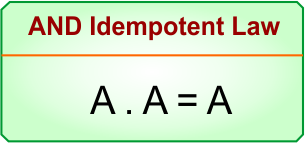
Let’s explain the AND Idempotent Law.
A · A = A. It means that ANDing A with itself does not change the value of A.
- If A = 0 then 0 · 0 = 0
- If A = 1 then 1 · 1 = 1
Therefore, A · A = A because the output remains the same whether A is 0 or 1. It is called the AND Idempotent Law.
2. OR Idempotent Law
According to the OR Idempotent Law, when a Boolean variable is ORed with itself, the result remains the same variable. The Boolean expression for the OR Idempotent Law is:
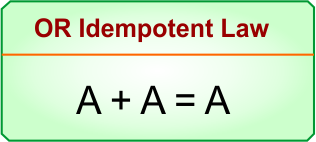
Let’s explain the OR Idempotent Law.
A + A = A. It means that ORing A with itself does not change the value of A.
- If A = 0 then 0 + 0 = 0
- If A = 1 then 1 + 1 = 1
Therefore, A + A = A because the output remains the same whether A is 0 or 1. It is called the OR Idempotent Law.
Idempotent Law Truth Table
Let’s explain the truth tables of AND and OR Idempotent Laws in Boolean Algebra.
AND Idempotent Law Truth Table
In an AND operation, a Boolean variable is ANDed with itself. The output is always the same as the input A.
The following truth table shows the AND Idempotent Law.
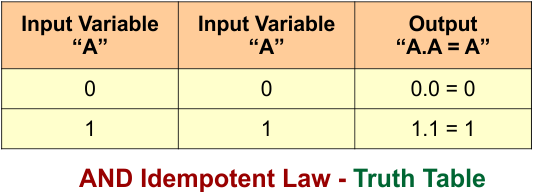
So, A · A = A because ANDing A with itself does not change its value.
OR Idempotent Law Truth Table
In an OR operation, a Boolean variable is ORed with itself. The output is always the same as the input A.
The following truth table shows the OR Idempotent Law.
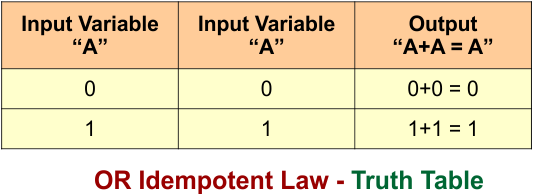
So, A + A = A because ORing A with itself does not change the value of A.
Idempotent Law Logic Gates
Let’s explain the logic gates of the Idempotent Law in Boolean Algebra.
AND Idempotent Law – Logic Gate
In the AND Idempotent Law, the same input A is connected to both inputs of an AND gate.
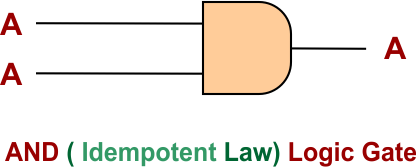
The Boolean expression is:
A · A = A
Since both inputs have the same value, the output remains equal to A.
- When A = 0, the output is 0.
- When A = 1, the output is 1.
OR Idempotent Law – Logic Gate
In the OR Idempotent Law, the same input A is connected to both inputs of an OR gate.
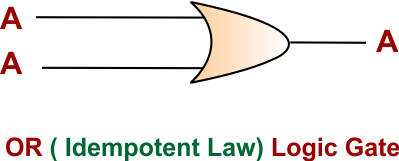
The Boolean expression is:
A + A = A
Since both inputs have the same value, the output remains equal to A.
- When A = 0, the output is 0.
- When A = 1, the output is 1.
Idempotent Law – Circuit Switches
Let’s explain the Idempotent Law using circuit switches. The same input is applied to both inputs of an AND or OR operation.
AND Idempotent Law – Circuit Switches
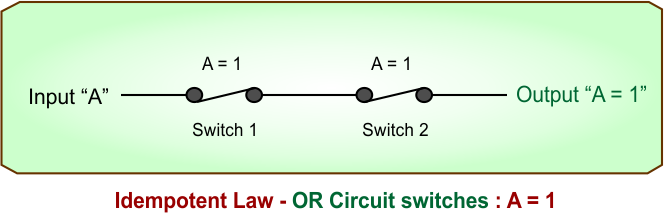
For the AND Idempotent Law, the same input A is represented by both switches.
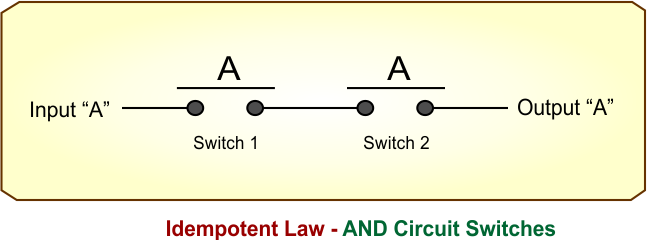
When A = 0, both switches are open, so the output is 0.
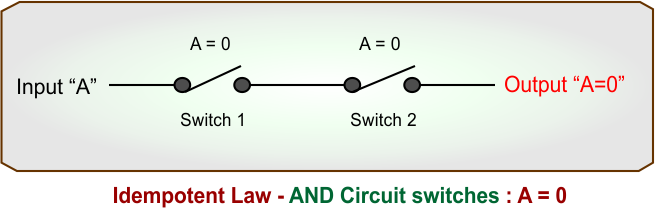
When A = 1, both switches are closed, so the output is 1.
OR Idempotent Law – Circuit Switches
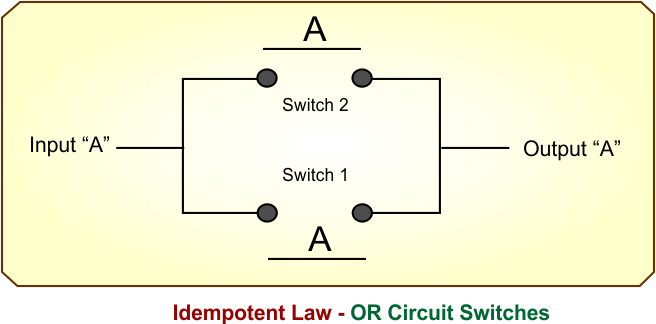
For the OR Idempotent Law, the same input A is represented by both switches.
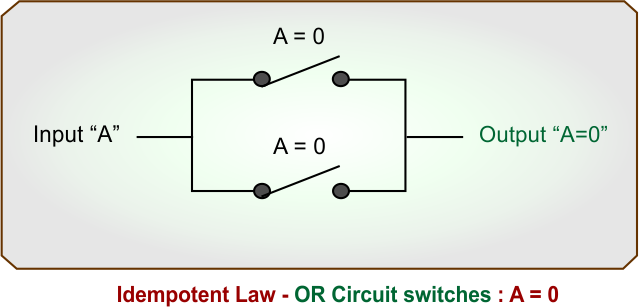
When A = 0, both switches remain open, so the output is 0.
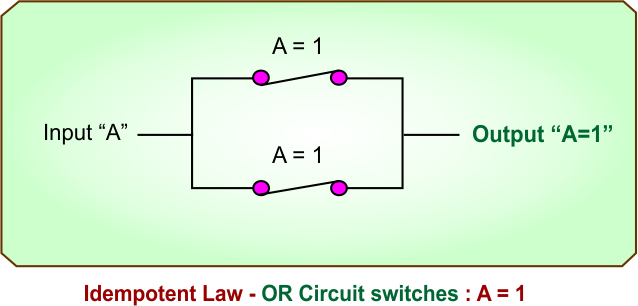
When A = 1, both switches are closed, so the output is 1.
Idempotent Law in Boolean Simplification
The Idempotent Law is commonly used to remove repeated variables from Boolean expressions. It simplifies an expression without changing its output.
Let’s explain some examples.
Idempotent Law Example 1: A · A + B
The Idempotent Law X · X = X removes the repeated A.
A · A + B = A + B
Idempotent Law Example 2: A + A + B
The Idempotent Law X + X = X removes the repeated A.
A + A + B = A + B
Idempotent Law Example 3: AB · AB + C
Using the Idempotent Law X · X = X, the repeated AB is removed.
AB · AB + C = AB + C
Idempotent Law Example 4: A + BC + BC
Apply the Idempotent Law X + X = X to the repeated BC.
A + BC + BC = A + BC
Idempotent Law Example 5: AB + AB · C + D
Using the Idempotent Law on the repeated AB term:
AB + AB · C + D
However, the Idempotent Law alone cannot remove AB from this expression because the two occurrences of AB are not directly combined using the same operation.
Therefore, no Idempotent Law simplification is applied to the complete expression.
Idempotent Law vs Identity Law
Idempotent Law and Identity Law are sometimes confused because both can simplify Boolean expressions. However, they work in different ways.
Idempotent Law: Combining a variable with itself gives the same variable.
A · A = A
A + A = A
Identity Law: Combining a variable with the identity value leaves the variable unchanged.
A · 1 = A
A + 0 = A
| Law | Expression | Result |
|---|---|---|
| AND Idempotent | A · A = A | Repeated variable is removed |
| OR Idempotent | A + A = A | Repeated variable is removed |
| AND Identity | A · 1 = A | 1 does not change A |
| OR Identity | A + 0 = A | 0 does not change A |
In the next lecture, we will see the Complement Law in Boolean Algebra.