












Binary to Hexadecimal Conversion Examples
Binary to hexadecimal conversion is an essential concept in number systems used in computer science, programming, and digital electronics. It allows long binary numbers to be represented in a shorter and more readable base-16 form. This is especially useful in memory addressing, machine-level programming, and debugging.
In this article, we will discuss binary to hexadecimal conversion examples and some examples of the fractional part as well. Let’s start
Understanding Binary to Hexadecimal Conversion
Binary to hexadecimal conversion is efficient because each group of 4 binary bits corresponds directly to one hexadecimal digit.
1. What is Binary Number System?
The binary number system is a base-2 number system used internally by computers.
- Base: 2
- Digits: 0 and 1
- Each position represents powers of 2
2. What is Hexadecimal Number System?
The hexadecimal number system is a base-16 number system.
- Base: 16
- Digits: 0–9 and A–F
- (A = 10, B = 11, C = 12, D = 13, E = 14, F = 15)
- Each position represents powers of 16
3. Relationship Between Binary and Hexadecimal
Binary and hexadecimal are closely related because:
1 hexadecimal digit = 4 binary bits
So, binary numbers are grouped into sets of 4 bits for conversion.
Binary to Hexadecimal Conversion Methods
There are two main methods for converting binary to hexadecimal:
1. Binary to Hexadecimal Conversion using Grouping Method (standard table)
In this method, binary digits are grouped into sets of 4 bits (from right to left), and each group is converted into its hexadecimal equivalent.
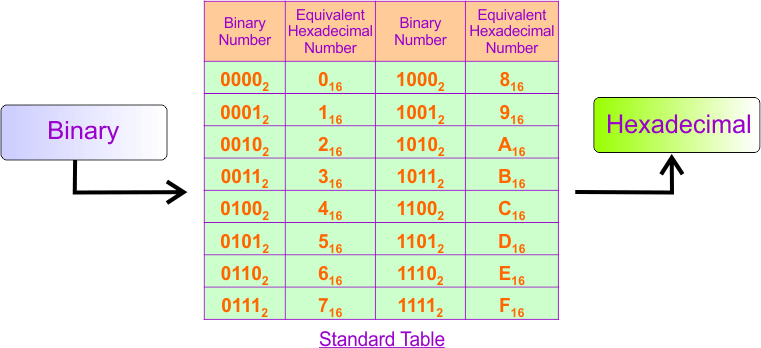
2. Binary to Hexadecimal Conversion using Decimal Method
In this method, the binary number is first converted into decimal, and then the decimal number is converted into hexadecimal.

1. Binary to Hexadecimal Conversion using Standard Table
The binary to hexadecimal conversion table helps students quickly convert binary numbers into their hexadecimal equivalents by grouping bits. This method is widely used because it simplifies long binary numbers.
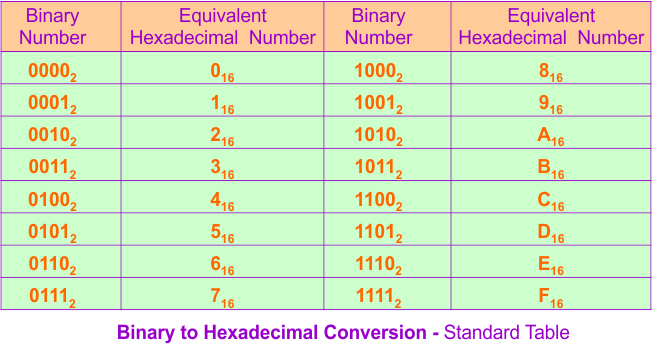
Algorithm for Binary to Hexadecimal Conversion using a Standard Table
Step 1: Write the Given Binary Number
Start by writing the binary number clearly.
Example: (10110110)₂
Step 2: Group Binary Digits into Sets of 4 (from Right to Left)
Divide the binary number into groups of four digits starting from the right side.
10110110 → 1011 0110
If necessary, add leading zeros:
11011 → 0001 1011
Step 3: Convert Each Group into Hexadecimal
Use the standard table:
1011₂ = B₁₆
0110₂ = 6₁₆
Step 4: Combine All Hexadecimal Digits
Write all digits together:
(10110110)₂ = (B6)₁₆
Binary to Hexadecimal Conversion Examples
Examples are the best way to understand binary to hexadecimal conversion in a practical and exam-oriented manner. Below are solved examples with step-by-step explanations.
Example 1: Convert (101101)₂ to Hexadecimal
Solution:
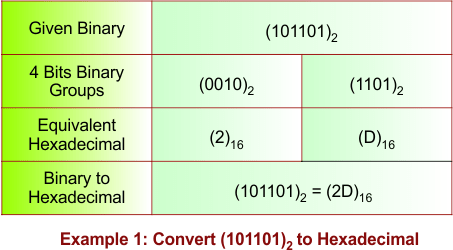
The following diagram shows the conversion of the binary number (101101)₂ into its equivalent hexadecimal.
Description:
By grouping the binary digits into sets of four from right to left and replacing each group with its corresponding hexadecimal equivalent using the standard table, we get the hexadecimal of (101101)₂
The hexadecimal of 0010₂ is 2₁₆
The hexadecimal of 1101₂ is D₁₆
By joining all the hexadecimal digits together to form the final hexadecimal number. So, the final result is:
(101101)₂ = 2D₁₆
Example 2: Convert (111010)₂ to Hexadecimal
Solution:
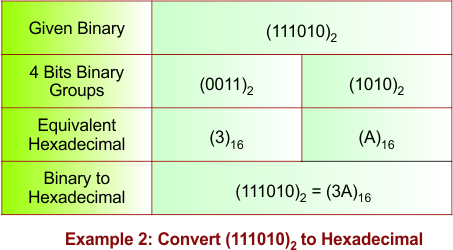
The following diagram shows the conversion of the binary number (111010)₂ into its equivalent hexadecimal.
Description:
Grouping into 4 bits: 0011 1010
The hexadecimal of 0011₂ is 3₁₆
The hexadecimal of 1010₂ is A₁₆
Final result:
(111010)₂ = 3A₁₆
Example 3: Convert (11001101)₂ to Hexadecimal
Solution:
The following diagram shows the conversion of the binary number (11001101)₂ into its equivalent hexadecimal.
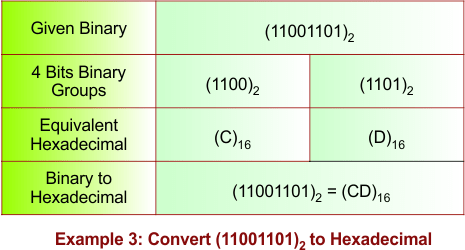
Description:
Grouping: 1100 1101
The hexadecimal of 1100₂ is C₁₆
The hexadecimal of 1101₂ is D₁₆
Final result:
(11001101)₂ = CD₁₆
Example 4: Convert (10111110)₂ to Hexadecimal
Solution:
The following diagram shows the conversion of the binary number (10111110)₂ into its equivalent hexadecimal.
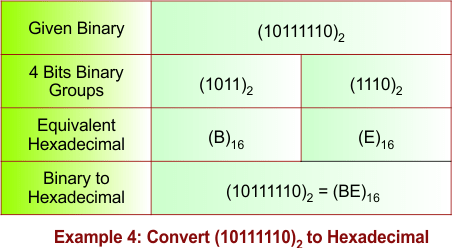
Description:
Grouping: 1011 1110
The hexadecimal of 1011₂ is B₁₆
The hexadecimal of 1110₂ is E₁₆
Final result:
(10111110)₂ = BE₁₆
Example 5: Convert (100110111)₂ to Hexadecimal
Solution:
The following diagram shows the conversion of the binary number (100110111)₂ into its equivalent hexadecimal.
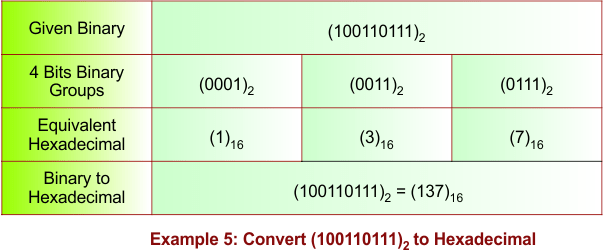
Description:
Grouping: 0001 0011 0111
The hexadecimal of 0001₂ is 1₁₆
The hexadecimal of 0011₂ is 3₁₆
The hexadecimal of 0111₂ is 7₁₆
Final result:
(100110111)₂ = 137₁₆
Example 6: Convert (11111111)₂ to Hexadecimal
Solution:
The following diagram shows the conversion of the binary number (11111111)₂ into its equivalent hexadecimal.
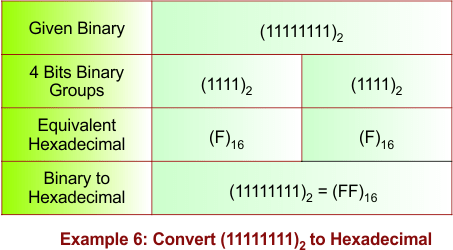
Description:
Grouping: 1111 1111
The hexadecimal of 1111₂ is F₁₆
The hexadecimal of 1111₂ is F₁₆
Final result:
(11111111)₂ = FF₁₆
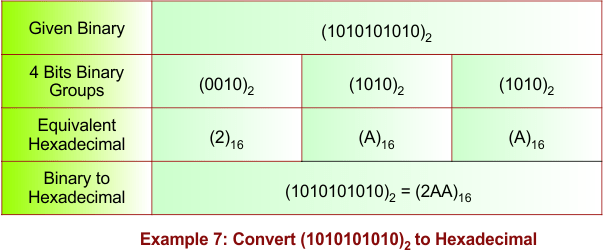
Example 7: Convert (1010101010)₂ to Hexadecimal
Solution:
The following diagram shows the conversion of the binary number (1010101010)₂ into its equivalent hexadecimal.
Description:
Grouping: 0010 1010 1010
The hexadecimal of 0010₂ is 2₁₆
The hexadecimal of 1010₂ is A₁₆
The hexadecimal of 1010₂ is A₁₆
Final result:
(1010101010)₂ = 2AA₁₆
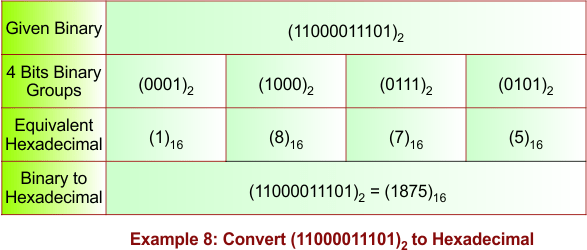
Example 8: Convert (11000011101)₂ to Hexadecimal
Solution:
The following diagram shows the conversion of the binary number (11000011101)₂ into its equivalent hexadecimal.
Description:
Grouping: 0001 1000 0111 01 → adjust → 0001 1000 0111 0101
The hexadecimal of 0001₂ is 1₁₆
The hexadecimal of 1000₂ is 8₁₆
The hexadecimal of 0111₂ is 7₁₆
The hexadecimal of 0101₂ is 5₁₆
Final result:
(11000011101)₂ = 1875₁₆
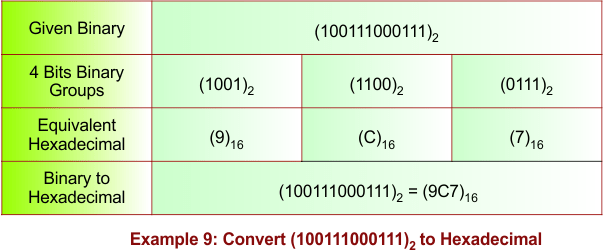
Example 9: Convert (100111000111)₂ to Hexadecimal
Solution:
The following diagram shows the conversion of the binary number (100111000111)₂ into its equivalent hexadecimal.
Description:
Grouping: 1001 1100 0111
The hexadecimal of 1001₂ is 9₁₆
The hexadecimal of 1100₂ is C₁₆
The hexadecimal of 0111₂ is 7₁₆
Final result:
(100111000111)₂ = 9C7₁₆
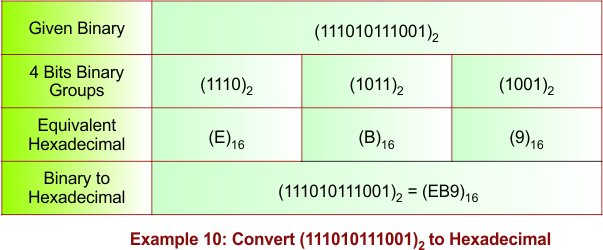
Example 10: Convert (111010111001)₂ to Hexadecimal
Solution:
The following diagram shows the conversion of the binary number (111010111001)₂ into its equivalent hexadecimal.
Description:
Grouping: 1110 1011 1001
The hexadecimal of 1110₂ is E₁₆
The hexadecimal of 1011₂ is B₁₆
The hexadecimal of 1001₂ is 9₁₆
Final result:
(111010111001)₂ = EB9₁₆
Example 11: Convert (1011011110011010)₂ to Hexadecimal
Solution:
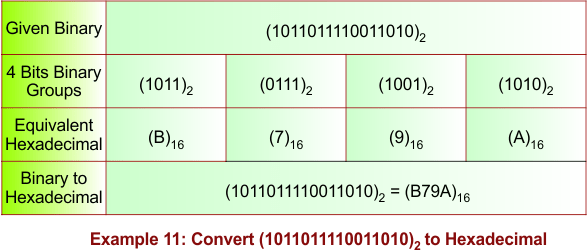
The following diagram shows the conversion of the binary number (1011011110011010)₂ into its equivalent hexadecimal.
Description:
By grouping the binary digits into sets of four from right to left and replacing each group with its corresponding hexadecimal equivalent using the standard table, we get the hexadecimal of (1011011110011010)₂
Grouping: 1011 0111 1001 1010
The hexadecimal of 1011₂ is B₁₆
The hexadecimal of 0111₂ is 7₁₆
The hexadecimal of 1001₂ is 9₁₆
The hexadecimal of 1010₂ is A₁₆
By joining all the hexadecimal digits together to form the final hexadecimal number. So, the final result is:
(1011011110011010)₂ = B79A₁₆
Example 12: Convert (11001011101101001)₂ to Hexadecimal
Solution:
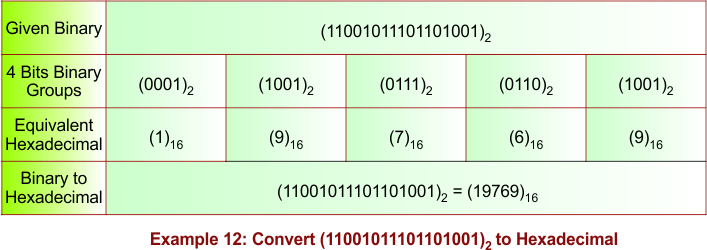
The following diagram shows the conversion of the binary number (11001011101101001)₂ into its equivalent hexadecimal.
Description:
Grouping: 0001 1001 0111 0110 1001
The hexadecimal of 0001₂ is 1₁₆
The hexadecimal of 1001₂ is 9₁₆
The hexadecimal of 0111₂ is 7₁₆
The hexadecimal of 0110₂ is 6₁₆
The hexadecimal of 1001₂ is 9₁₆
By joining all the hexadecimal digits together to form the final hexadecimal number. So, the final result is:
(11001011101101001)₂ = 19769₁₆
Example 13: Convert (1111001110101101)₂ to Hexadecimal
Solution:
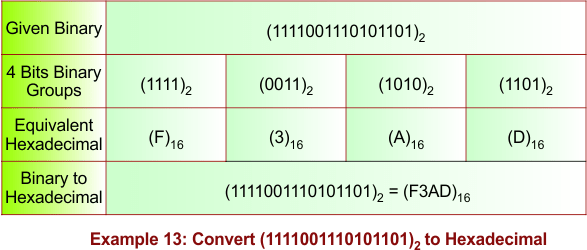
The following diagram shows the conversion of the binary number (1111001110101101)₂ into its equivalent hexadecimal.
Description:
Grouping: 1111 0011 1010 1101
The hexadecimal of 1111₂ is F₁₆
The hexadecimal of 0011₂ is 3₁₆
The hexadecimal of 1010₂ is A₁₆
The hexadecimal of 1101₂ is D₁₆
By joining all the hexadecimal digits together to form the final hexadecimal number. So, the final result is:
(1111001110101101)₂ = F3AD₁₆
Example 14: Convert (100111000101101011)₂ to Hexadecimal
Solution:
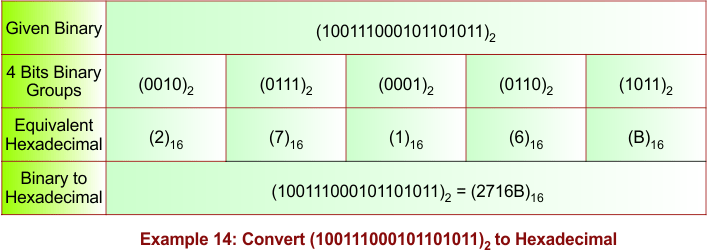
The following diagram shows the conversion of the binary number (100111000101101011)₂ into its equivalent hexadecimal.
Description:
Grouping: 0010 0111 0001 0110 1011
The hexadecimal of 0010₂ is 2₁₆
The hexadecimal of 0111₂ is 7₁₆
The hexadecimal of 0001₂ is 1₁₆
The hexadecimal of 0110₂ is 6₁₆
The hexadecimal of 1011₂ is B₁₆
By joining all the hexadecimal digits together to form the final hexadecimal number. So, the final result is:
(100111000101101011)₂ = 2716B₁₆
Example 15: Convert (10101111001011100101)₂ to Hexadecimal
Solution:
The following diagram shows the conversion of the binary number (10101111001011100101)₂ into its equivalent hexadecimal.
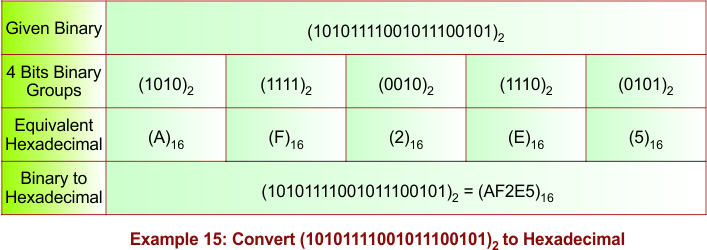
Description:
Grouping: 1010 1111 0010 1110 0101
The hexadecimal of 1010₂ is A₁₆
The hexadecimal of 1111₂ is F₁₆
The hexadecimal of 0010₂ is 2₁₆
The hexadecimal of 1110₂ is E₁₆
The hexadecimal of 0101₂ is 5₁₆
By joining all the hexadecimal digits together to form the final hexadecimal number. So, the final result is:
(10101111001011100101)₂ = AF2E5₁₆
2. Binary to Hexadecimal Conversion (Using Decimal Number System)
This method converts a binary number into hexadecimal in two main steps:
Step 1: Convert Binary to Decimal
- Write the given binary number
- Start from the rightmost digit
- Multiply each digit by powers of 2
- Rightmost digit → × 2⁰
- Next digit → × 2¹
- Next → × 2² and so on
- Add all the results
- The sum is your decimal number
For Fractional Part (if present)
Digits after the decimal use negative powers of 2:
- First digit → × 2⁻¹
- Next digit → × 2⁻²
- Next → × 2⁻³
Step 2: Convert Decimal to Hexadecimal
- Take the decimal number
- Divide it by 16
- Write down the remainder
- Repeat division until quotient becomes 0
- Write remainders in reverse order
This gives the hexadecimal result
Fractional Part (if present)
- Multiply the fractional part by 16
- Write the integer part (0–15 → 0–9, A–F)
- Keep the fractional part only
- Repeat until fraction becomes 0 or required accuracy is reached
- Write digits in the same order
Example 01: Convert (101010.0011)₂ to Hexadecimal
Step 1: Convert Binary to Decimal
Integer Part (101010)₂ Conversion
(101010)₂ = 1×2⁵ + 0×2⁴ + 1×2³ + 0×2² + 1×2¹ + 0×2⁰
= 32 + 0 + 8 + 0 + 2 + 0
= (42)₁₀
Fractional Part (.0011)₂ Conversion
(0.0011)₂ = 0×2⁻¹ + 0×2⁻² + 1×2⁻³ + 1×2⁻⁴
= 0 + 0 + 1/8 + 1/16
= (0.1875)₁₀
Combine
(101010.0011)₂ = (42.1875)₁₀
Step 2: Convert Decimal to Hexadecimal
Integer Part (42)₁₀
42 ÷ 16 = 2 remainder 10 (A)
2 ÷ 16 = 0 remainder 2
→ (42)₁₀ = (2A)₁₆
Fractional Part (0.1875)₁₀
0.1875 × 16 = 3.0 → 3
→ (0.1875)₁₀ = (.3)₁₆
Final Answer
(101010.0011)₂ = (42.1875)₁₀ = (2A.3)₁₆
Example 02: Convert (110011.101)₂ to Hexadecimal
Step 1: Binary to Decimal
(110011)₂ = 32 + 16 + 0 + 0 + 2 + 1 = (51)₁₀
(0.101)₂ = 1/2 + 0 + 1/8 = (0.625)₁₀
→ (110011.101)₂ = (51.625)₁₀
Step 2: Decimal to Hexadecimal
Integer Part
51 ÷ 16 = 3 remainder 3
3 ÷ 16 = 0 remainder 3
→ (51)₁₀ = (33)₁₆
Fractional Part
0.625 × 16 = 10.0 → A
→ (0.625)₁₀ = (.A)₁₆
Final Answer
(110011.101)₂ = (51.625)₁₀ = (33.A)₁₆
Example 03: Convert (1011011.011)₂ to Hexadecimal
Step 1: Binary to Decimal
(1011011)₂ = 64 + 0 + 16 + 8 + 0 + 2 + 1 = (91)₁₀
(0.011)₂ = 0 + 1/4 + 1/8 = (0.375)₁₀
→ (1011011.011)₂ = (91.375)₁₀
Step 2: Decimal to Hexadecimal
Integer Part
91 ÷ 16 = 5 remainder 11 (B)
5 ÷ 16 = 0 remainder 5
→ (91)₁₀ = (5B)₁₆
Fractional Part
0.375 × 16 = 6.0 → 6
→ (0.375)₁₀ = (.6)₁₆
Final Answer
(1011011.011)₂ = (91.375)₁₀ = (5B.6)₁₆
Example 04: Convert (111010.1101)₂ to Hexadecimal
Step 1: Binary to Decimal
(111010)₂ = 32 + 16 + 8 + 0 + 2 + 0 = (58)₁₀
(0.1101)₂ = 1/2 + 1/4 + 0 + 1/16 = (0.8125)₁₀
→ (111010.1101)₂ = (58.8125)₁₀
Step 2: Decimal to Hexadecimal
Integer Part
58 ÷ 16 = 3 remainder 10 (A)
3 ÷ 16 = 0 remainder 3
→ (58)₁₀ = (3A)₁₆
Fractional Part
0.8125 × 16 = 13.0 → D
→ (0.8125)₁₀ = (.D)₁₆
Final Answer
(111010.1101)₂ = (58.8125)₁₀ = (3A.D)₁₆
Example 05: Convert (1001110.1011)₂ to Hexadecimal
Step 1: Binary to Decimal
(1001110)₂ = 64 + 0 + 0 + 8 + 4 + 2 + 0 = (78)₁₀
(0.1011)₂ = 1/2 + 0 + 1/8 + 1/16 = (0.6875)₁₀
→ (1001110.1011)₂ = (78.6875)₁₀
Step 2: Decimal to Hexadecimal
Integer Part
78 ÷ 16 = 4 remainder 14 (E)
4 ÷ 16 = 0 remainder 4
→ (78)₁₀ = (4E)₁₆
Fractional Part
0.6875 × 16 = 11.0 → B
→ (0.6875)₁₀ = (.B)₁₆
Final Answer
(1001110.1011)₂ = (78.6875)₁₀ = (4E.B)₁₆