












Null Law in Boolean Algebra
According to the Null Law in Boolean Algebra, combining a Boolean variable with a dominating value always produces the dominating value. The dominating value is different for AND and OR operations.
- The dominating value for the AND operation is 0
- The dominating value for the OR operation is 1
Null Law is also called the Domination Law because the value 0 or 1 dominates the result regardless of the value of the Boolean variable.
Types of Null Laws
There are two types of Null Laws in Boolean algebra:
1. AND Null Law
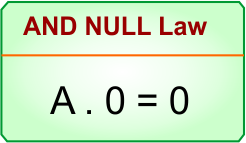
The dominating value for the AND operation is 0. When any variable is ANDed with 0, the result is always 0. The following diagram of the AND Null Law explains it.
Let’s explain the diagram.
A · 0 = 0. It means that 0 determines the output regardless of the value of A.
- If A = 0, then
0 · 0 = 0 - If A = 1, then
1 · 0 = 0
Therefore, A · 0 = 0 because the output is always 0 whether A is 0 or 1. It is called the AND Null Law.
2. OR Null Law
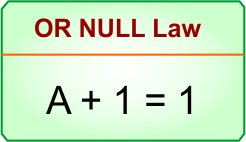
The dominating value for the OR operation is 1. When any variable is ORed with 1, the result is always 1. The following diagram of the OR Null Law explains it.
Let’s explain the diagram.
A + 1 = 1. It means that 1 determines the output regardless of the value of A.
- If A = 0, then
0 + 1 = 1 - If A = 1, then
1 + 1 = 1
Therefore, A + 1 = 1 because the output is always 1 whether A is 0 or 1. It is called the OR Null Law.
Null Law Truth Table
Let’s explain the truth tables of AND and OR Null Laws in Boolean algebra.
AND Null Law Truth Table
In an AND operation, 0 acts as the dominating value. When A is ANDed with 0, the result is always 0. The following diagram shows the truth table of the AND Null Law.
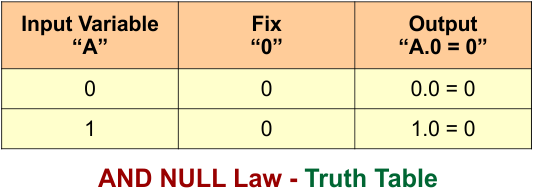
So, A · 0 = 0 because 0 dominates the AND operation.
OR Null Law Truth Table
In an OR operation, 1 acts as the dominating value. When A is ORed with 1, the result is always 1. The following diagram shows the truth table of the OR Null Law.
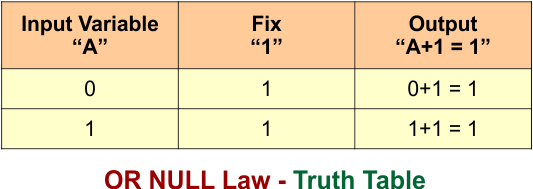
So, A + 1 = 1 because 1 dominates the OR operation.
Null Law Logic Gates
Let’s explain the logic gates of the Null Law in Boolean algebra.
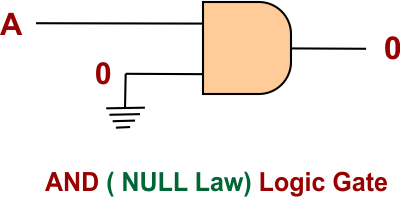
AND Null Law – Logic Gate
The AND gate has one input connected to 0. Since an AND operation with 0 always produces 0, the output remains 0 regardless of the value of A.
A · 0 = 0
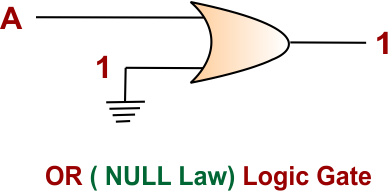
OR Null Law – Logic Gate
The OR gate has one input connected to 1. Since an OR operation with 1 always produces 1, the output remains 1 regardless of the value of A.
A + 1 = 1
Null Law – Circuit Switches
The Null Law can also be represented using circuit switches. These circuits show how the dominating value determines the output regardless of the other input.
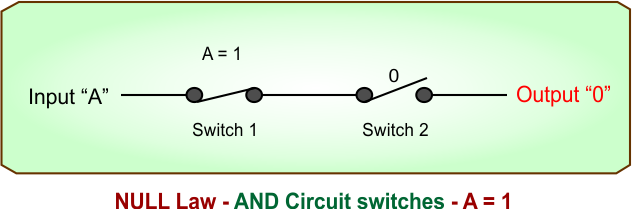
AND Null Law – Circuit Switches
Switch 2 represents 0 and remains open. In a series circuit, an open switch prevents current from passing through the circuit, giving A · 0 = 0.
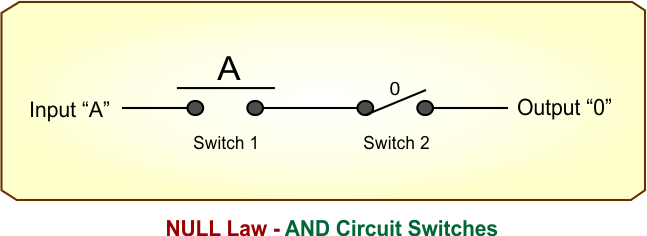
Case 01: When A = 0, the output is 0.
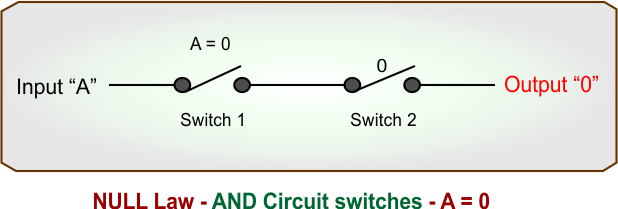
Case 02: When A = 1, the output is still 0 because the other switch represents 0.
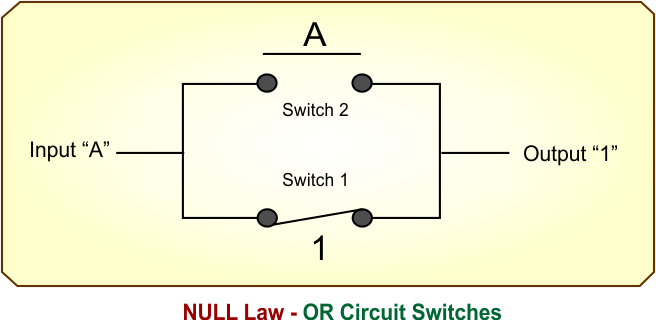
OR Null Law – Circuit Switches
Switch 2 represents 1 and remains closed. In a parallel circuit, a closed switch provides a path for current, giving A + 1 = 1.
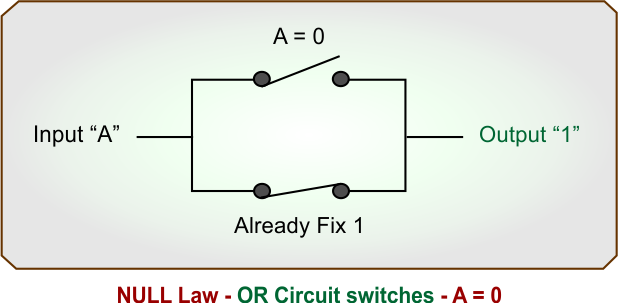
Case 01: When A = 0, the output is 1 because the other switch represents 1.
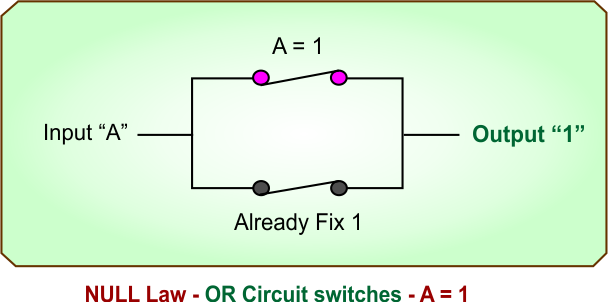
Case 02: When A = 1, the output is still 1.
Null Law in Boolean Simplification
The Null Law is commonly used to simplify Boolean expressions by replacing an expression containing a dominating value with that value.
Null Law Example 1: AB · 0 + C
The Null Law X · 0 = 0 changes AB · 0 to 0.
AB · 0 + C = 0 + C= C
Null Law Example 2: A + B + 1
The Null Law X + 1 = 1 makes the complete OR expression equal to 1.
A + B + 1 = 1
Null Law Example 3: ABC · 0 + D
Using X · 0 = 0, the ABC · 0 term becomes 0.
ABC · 0 + D = 0 + D= D
Null Law Example 4: AB + CD · 0 + E
Apply the Null Law to CD · 0.
AB + CD · 0 + E= AB + 0 + E= AB + E
Null Law Example 5: ABC + DE + F + 1
Apply the Null Law X + 1 = 1.
ABC + DE + F + 1 = 1
Null Law vs Identity Law
Null Law and Identity Law are sometimes confused because both involve constants in Boolean expressions.
Identity Law: The identity value does not change the original variable.
A · 1 = AA + 0 = A
Null/Domination Law: The dominating value determines the output regardless of the variable.
A · 0 = 0A + 1 = 1
| Law | Expression | Result |
|---|---|---|
| AND Identity | A · 1 = A |
Variable remains unchanged |
| OR Identity | A + 0 = A |
Variable remains unchanged |
| AND Null | A · 0 = 0 |
0 dominates |
| OR Null | A + 1 = 1 |
1 dominates |
The main difference is that the Identity Law keeps the original variable unchanged, while the Null Law replaces the expression with the dominating value.
In the next lecture, we will see the Idempotent Law in Boolean Algebra.