












AND Gate Truth Table for 2, 3, 4, 5 Inputs
An AND gate is a digital logic gate that produces a HIGH (1) output only when all inputs are HIGH (1). The output remains LOW (0) if any one or more inputs are LOW (0).
The AND gate truth table shows how the output changes for different input combinations in 2, 3, 4, and 5-input AND gates. Let’s explain the truth tables of AND gates with different numbers of inputs.
Truth Tables of AND Gate for Various Inputs
The following table shows the number of inputs and possible combinations for AND gates with different numbers of inputs:
| AND Gate | Number of Inputs | Possible Combinations |
|---|---|---|
| 2-Input AND | 2 | 4 |
| 3-Input AND | 3 | 8 |
| 4-Input AND | 4 | 16 |
| 5-Input AND | 5 | 32 |
AND Gate Truth Table for 2 Inputs
The following diagram shows the AND Gate Truth Table for 2 Inputs.
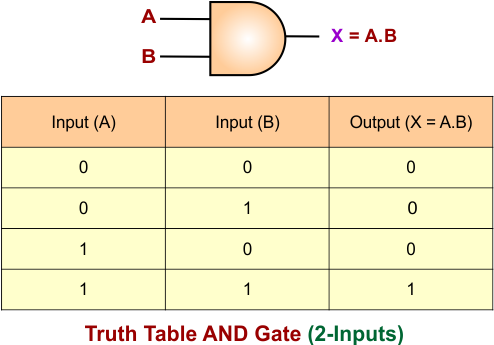
Let’s explain the truth table of a 2-input AND logic gate.
- A = 0, B = 0: Both inputs are LOW, so the output is 0 (LOW).
- A = 0, B = 1: Input A is LOW, so the output remains 0 (LOW).
- A = 1, B = 0: Input B is LOW, so the output remains 0 (LOW).
- A = 1, B = 1: Both inputs are HIGH, so the output becomes 1 (HIGH).
AND Gate Truth Table for 3 Inputs
The following diagram shows the AND Gate Truth Table for 3 Inputs.
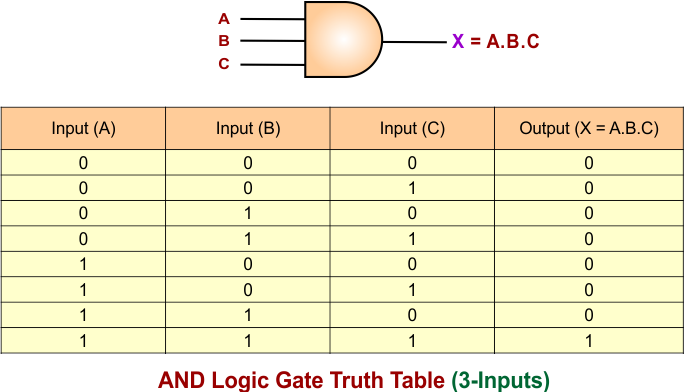
Let’s explain the truth table of a 3-input AND logic gate.
- A = 0, B = 0, C = 0: All inputs are LOW, so the output is 0 (LOW).
- A = 0, B = 0, C = 1: A and B are LOW, so the output is 0 (LOW).
- A = 0, B = 1, C = 0: A and C are LOW, so the output is 0 (LOW).
- A = 0, B = 1, C = 1: Input A is LOW, so the output is 0 (LOW).
- A = 1, B = 0, C = 0: B and C are LOW, so the output is 0 (LOW).
- A = 1, B = 0, C = 1: Input B is LOW, so the output is 0 (LOW).
- A = 1, B = 1, C = 0: Input C is LOW, so the output is 0 (LOW).
- A = 1, B = 1, C = 1: All inputs are HIGH, so the output becomes 1 (HIGH).
AND Gate Truth Table for 4 Inputs
The following diagram shows the AND Gate Truth Table for 4 Inputs.
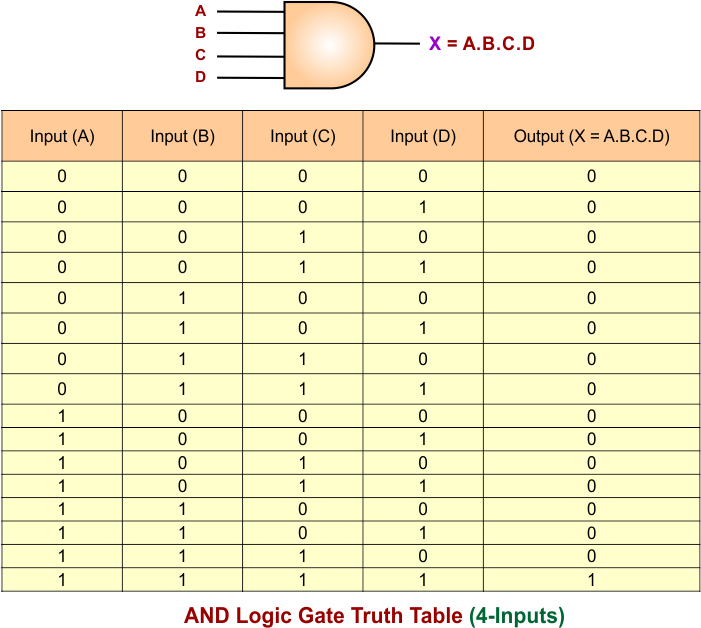
Let’s explain the truth table of a 4-input AND logic gate.
- A = 0, B = 0, C = 0, D = 0: All inputs are LOW, so the output is 0 (LOW).
- A = 0, B = 0, C = 0, D = 1: A, B, and C are LOW, so the output is 0 (LOW).
- A = 0, B = 0, C = 1, D = 0: A, B, and D are LOW, so the output is 0 (LOW).
- A = 0, B = 0, C = 1, D = 1: A and B are LOW, so the output is 0 (LOW).
- A = 0, B = 1, C = 0, D = 0: A, C, and D are LOW, so the output is 0 (LOW).
- A = 0, B = 1, C = 0, D = 1: A and C are LOW, so the output is 0 (LOW).
- A = 0, B = 1, C = 1, D = 0: A and D are LOW, so the output is 0 (LOW).
- A = 0, B = 1, C = 1, D = 1: Input A is LOW, so the output is 0 (LOW).
- A = 1, B = 0, C = 0, D = 0: B, C, and D are LOW, so the output is 0 (LOW).
- A = 1, B = 0, C = 0, D = 1: B and C are LOW, so the output is 0 (LOW).
- A = 1, B = 0, C = 1, D = 0: B and D are LOW, so the output is 0 (LOW).
- A = 1, B = 0, C = 1, D = 1: Input B is LOW, so the output is 0 (LOW).
- A = 1, B = 1, C = 0, D = 0: C and D are LOW, so the output is 0 (LOW).
- A = 1, B = 1, C = 0, D = 1: Input C is LOW, so the output is 0 (LOW).
- A = 1, B = 1, C = 1, D = 0: Input D is LOW, so the output is 0 (LOW).
- A = 1, B = 1, C = 1, D = 1: All inputs are HIGH, so the output becomes 1 (HIGH).
AND Gate Truth Table for 5 Inputs
The following diagram shows the AND Gate Truth Table for 5 Inputs.
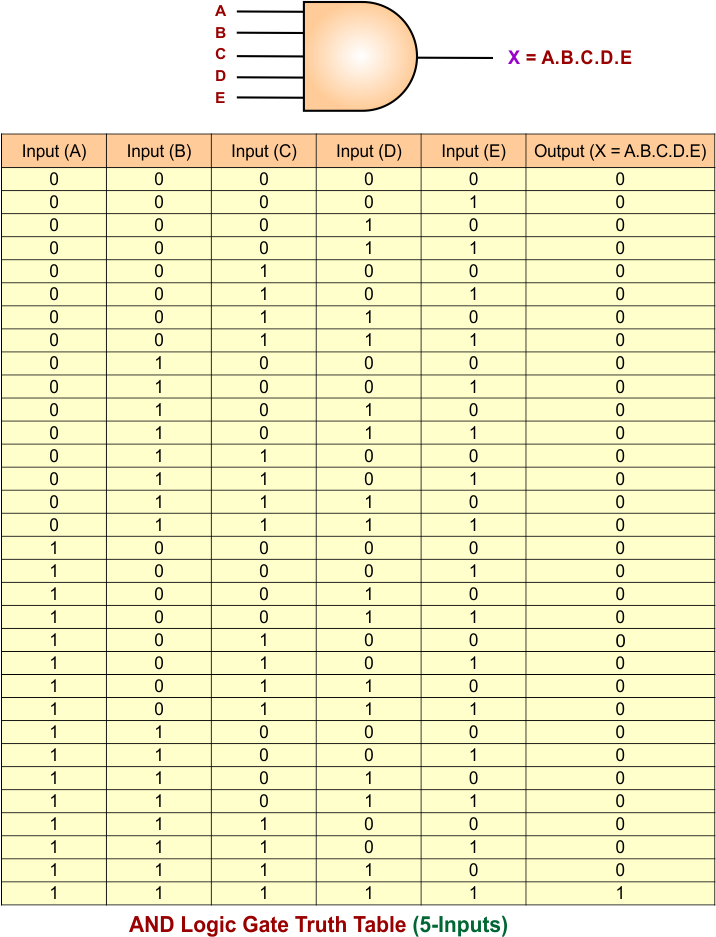
Let’s explain the truth table of a 5-input AND logic gate.
- A = 0, B = 0, C = 0, D = 0, E = 0: All inputs are LOW, so the output is 0 (LOW).
- A = 0, B = 0, C = 0, D = 0, E = 1: A, B, C, and D are LOW, so the output is 0 (LOW).
- A = 0, B = 0, C = 0, D = 1, E = 0: A, B, C, and E are LOW, so the output is 0 (LOW).
- A = 0, B = 0, C = 0, D = 1, E = 1: A, B, and C are LOW, so the output is 0 (LOW).
- A = 0, B = 0, C = 1, D = 0, E = 0: A, B, D, and E are LOW, so the output is 0 (LOW).
- A = 0, B = 0, C = 1, D = 0, E = 1: A, B, and D are LOW, so the output is 0 (LOW).
- A = 0, B = 0, C = 1, D = 1, E = 0: A, B, and E are LOW, so the output is 0 (LOW).
- A = 0, B = 0, C = 1, D = 1, E = 1: A and B are LOW, so the output is 0 (LOW).
- A = 0, B = 1, C = 0, D = 0, E = 0: A, C, D, and E are LOW, so the output is 0 (LOW).
- A = 0, B = 1, C = 0, D = 0, E = 1: A, C, and D are LOW, so the output is 0 (LOW).
- A = 0, B = 1, C = 0, D = 1, E = 0: A, C, and E are LOW, so the output is 0 (LOW).
- A = 0, B = 1, C = 0, D = 1, E = 1: A and C are LOW, so the output is 0 (LOW).
- A = 0, B = 1, C = 1, D = 0, E = 0: A, D, and E are LOW, so the output is 0 (LOW).
- A = 0, B = 1, C = 1, D = 0, E = 1: A and D are LOW, so the output is 0 (LOW).
- A = 0, B = 1, C = 1, D = 1, E = 0: A and E are LOW, so the output is 0 (LOW).
- A = 0, B = 1, C = 1, D = 1, E = 1: Input A is LOW, so the output is 0 (LOW).
- A = 1, B = 0, C = 0, D = 0, E = 0: B, C, D, and E are LOW, so the output is 0 (LOW).
- A = 1, B = 0, C = 0, D = 0, E = 1: B, C, and D are LOW, so the output is 0 (LOW).
- A = 1, B = 0, C = 0, D = 1, E = 0: B, C, and E are LOW, so the output is 0 (LOW).
- A = 1, B = 0, C = 0, D = 1, E = 1: B and C are LOW, so the output is 0 (LOW).
- A = 1, B = 0, C = 1, D = 0, E = 0: B, D, and E are LOW, so the output is 0 (LOW).
- A = 1, B = 0, C = 1, D = 0, E = 1: B and D are LOW, so the output is 0 (LOW).
- A = 1, B = 0, C = 1, D = 1, E = 0: B and E are LOW, so the output is 0 (LOW).
- A = 1, B = 0, C = 1, D = 1, E = 1: Input B is LOW, so the output is 0 (LOW).
- A = 1, B = 1, C = 0, D = 0, E = 0: C, D, and E are LOW, so the output is 0 (LOW).
- A = 1, B = 1, C = 0, D = 0, E = 1: C and D are LOW, so the output is 0 (LOW).
- A = 1, B = 1, C = 0, D = 1, E = 0: C and E are LOW, so the output is 0 (LOW).
- A = 1, B = 1, C = 0, D = 1, E = 1: Input C is LOW, so the output is 0 (LOW).
- A = 1, B = 1, C = 1, D = 0, E = 0: D and E are LOW, so the output is 0 (LOW).
- A = 1, B = 1, C = 1, D = 0, E = 1: Input D is LOW, so the output is 0 (LOW).
- A = 1, B = 1, C = 1, D = 1, E = 0: Input E is LOW, so the output is 0 (LOW).
- A = 1, B = 1, C = 1, D = 1, E = 1: All inputs are HIGH, so the output becomes 1 (HIGH).