












Binary Operation
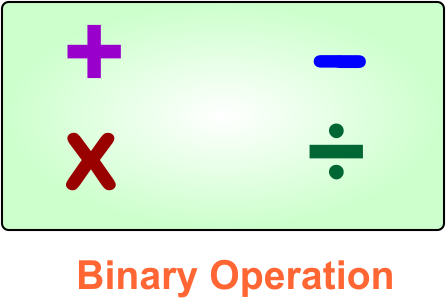
Binary operations are mathematical operations that are performed over binary digits (0.1). There are various computer calculations that are done through binary operations. There are four main types of binary operations (addition, subtraction, multiplication, and division), as shown in the following diagram
Let’s explain each type of binary operation with definitions, rules, and examples
1. Binary Addition
Binary addition is an arithmetic operation used to add two binary numbers. It follows simple rules based on the digits 0 and 1. When adding 1 and 1, the sum is 0 with a carry of 1 to the next column.
Rules of Binary Addition
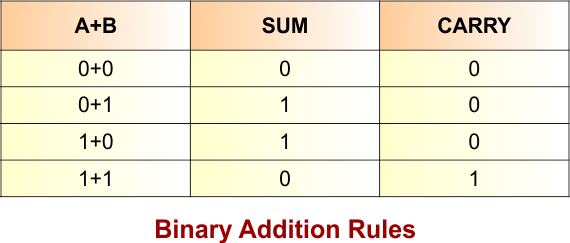
Binary addition follows four basic rules using the digits 0 and 1. The Key point is that when adding 1 + 1, write 0 and carry 1 to the next column. The following diagram shows the entire rules
In the above diagram
- A and B: The two binary input bits.
- Sum: The result of adding A and B.
- Carry: The bit passed to the next column when 1 + 1 = 10.
Let’s explain some examples of binary addition
Binary Addition Example – 1
Add 1101₂ and 0111₂ by starting from the rightmost bit and carrying 1 whenever the sum is 2.
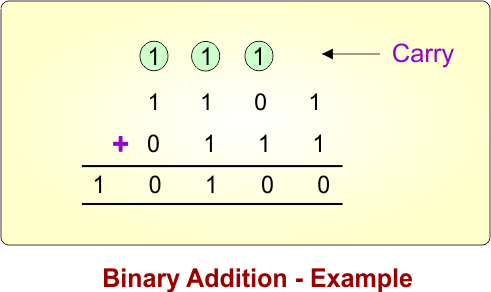
- Convert to decimal: 1101₂ = 13 and 0111₂ = 7.
- Add the decimal numbers: 13 + 7 = 20.
- Convert 20 to binary: 20 = 10100₂.
Therefore, 1101₂ + 0111₂ = 10100₂, which is equal to 13 + 7 = 20 in decimal.
Binary Addition with Fractions – Example 2
Binary addition can also be used to add binary fractions. Align the binary points and add the digits from right to left, carrying when necessary.
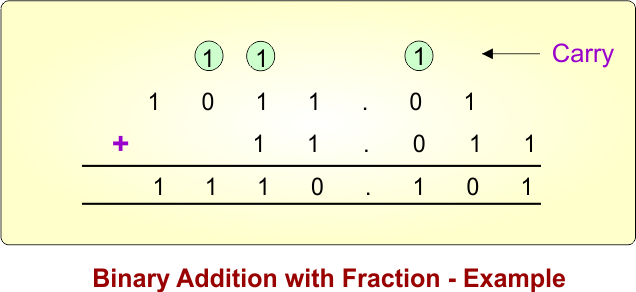
Let’s explain the above diagram, where the binary addition shown in the image is 1011.01₂ + 11.011₂ = 1110.101₂.
- Convert to decimal: 1011.01₂ = 11.25 and 11.011₂ = 3.375.
- Add the decimal numbers: 11.25 + 3.375 = 14.625.
- Convert 14.625 to binary: 14.625 = 1110.101₂.
Therefore, 1011.01₂ + 11.011₂ = 1110.101₂, which is equal to 11.25 + 3.375 = 14.625 in decimal.
2. Binary Subtraction
Binary subtraction is an arithmetic operation used to find the difference between two binary numbers. It follows simple rules based on the digits 0 and 1. When subtracting 1 from 0, borrow 1 from the next column to perform the subtraction.
Rules of Binary Subtraction
Binary subtraction follows four basic rules using the digits 0 and 1. The key point is that when subtracting 1 from 0, borrow 1 from the next column. The following table shows the basic rules.
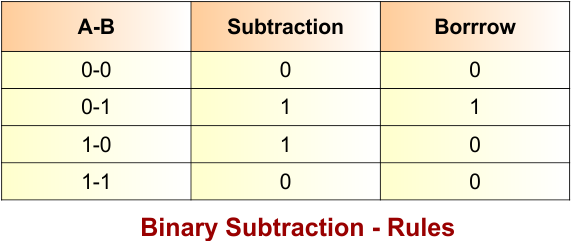
In the above diagram
- 0 − 0 = 0: Subtracting 0 from 0 gives 0, with no borrow.
- 0 − 1 = 1: We borrow 1 from the next column, so the result is 1 with a borrow of 1.
- 1 − 0 = 1: Subtracting 0 from 1 gives 1, with no borrow.
- 1 − 1 = 0: Subtracting 1 from 1 gives 0, with no borrow.
Remember: In binary subtraction, borrowing is required when we subtract 1 from 0.
Binary Subtraction Example – 1
Subtract 011₂ from 101₂ by starting from the rightmost bit and borrowing when necessary.
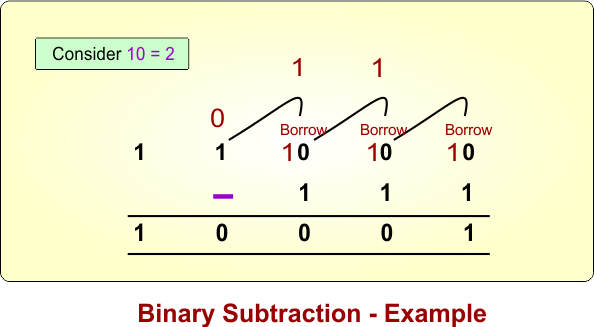
The image shows binary subtraction with borrowing. When subtracting 1 from 0, borrow 1 from the next column. In binary, the borrowed value is 10₂, which equals 2 in decimal.
- Step 1: (0-1) requires borrowing, so (102 – 1 = 1).
- Step 2: If the next bit is 0, borrow from the next available 1. The borrowed 1 becomes 0, and the 0 receiving the borrow becomes
10₂. - Step 3: Continue borrowing as needed until all columns are subtracted.
Result: The final answer shown is 10001₂.
|
Important: Convert to decimal: 11000₂ = 24 and 111₂ = 7. Subtract: 24 − 7 = 17. Convert 17 to binary: 10001₂. Therefore, 11000₂ − 111₂ = 10001₂, which equals 17 in decimal. |
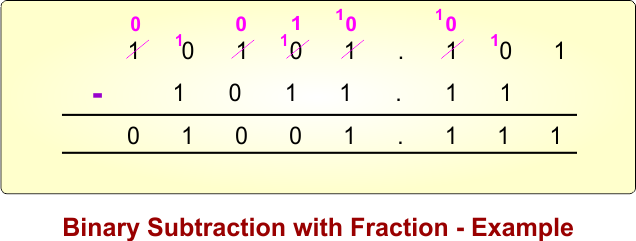
Binary Subtraction with Fractions – Example 2
Binary subtraction can also be used to subtract binary fractions. Align the binary points and subtract the digits from right to left, borrowing when necessary.
3. Binary Multiplication
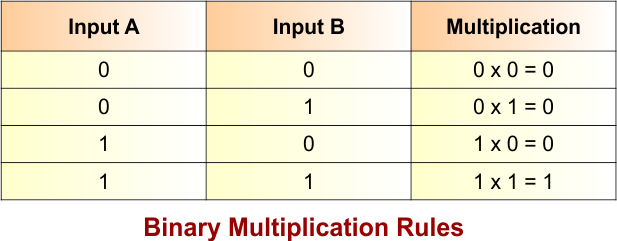
Binary multiplication is an arithmetic operation used to multiply two binary numbers. It follows simple rules based on the digits 0 and 1. Multiplying any binary digit by 0 gives 0, while multiplying 1 by 1 gives 1.
Rules of Binary Multiplication
Binary multiplication follows four basic rules using the digits 0 and 1. The following table shows the rules.
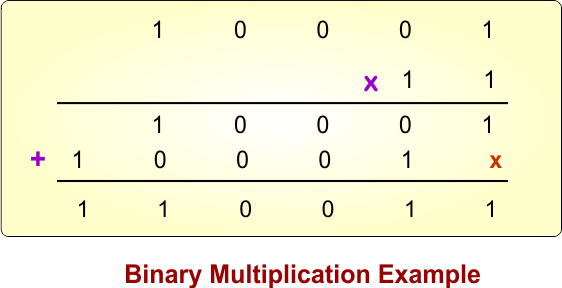
Binary Multiplication Example
Here is a simple example of binary multiplication example
4. Binary Division
Binary division is an arithmetic operation used to divide one binary number by another. It follows the same basic long-division method used in decimal arithmetic, but it uses only the digits 0 and 1.
Rules of Binary Division
Binary division follows four basic rules based on the digits 0 and 1. The following table shows the basic rules.
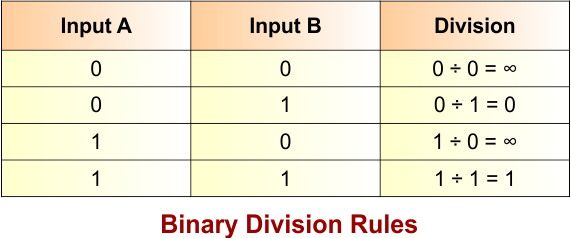
Key point: Division by 0 is undefined, just as in decimal arithmetic.
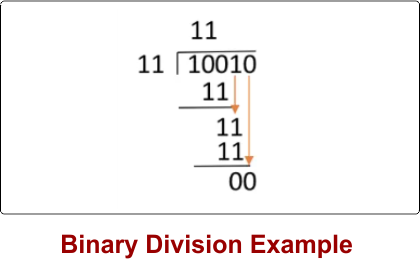
Binary Division Example
Here is a simple example of binary division example
Binary Division with Fractions – Example 2
Binary division can also be used to divide binary numbers containing fractional parts. The division follows the same basic process as whole-number division.
Example: Divide 1.1₂ by 10₂.
1.1₂ ÷ 10₂ = 0.11₂Step-by-step explanation:
- Convert the numbers to decimal to verify the result: 1.1₂ = 1.5 and 10₂ = 2.
- Divide 1.5 by 2 to get 0.75.
- Convert 0.75 to binary: 0.75 = 0.11₂.
Therefore, 1.1₂ ÷ 10₂ = 0.11₂. In decimal, 1.5 ÷ 2 = 0.75, so the result is correct.