












Distributive Law in Boolean Algebra
According to the Distributive Law in Boolean Algebra, one Boolean operation can be distributed over another operation without changing the result. The Distributive Law applies to both AND and OR operations.
- In the AND operation, AND can be distributed over OR.
- In the OR operation, OR can be distributed over AND.
Distributive laws are fundamental laws used to simplify Boolean expressions and understand the behavior of digital logic circuits.
Types of Distributive Laws
There are two types of Distributive Laws in Boolean algebra:
1. AND Distributive Law
The Distributive Law for the AND operation states that AND can be distributed over an OR expression. It can be expressed as:
A · (B + C) = (A · B) + (A · C)
The following diagram of the AND Distributive Law explains it.
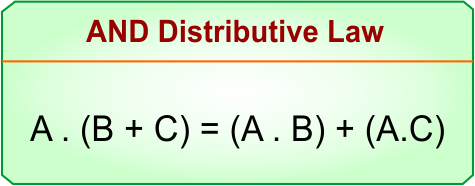
Let’s explain the diagram.
A · (B + C) = (A · B) + (A · C). It means that A is ANDed with the OR operation of B and C, which gives the same output as ANDing A separately with B and C and then ORing the results.
- If A = 1, B = 0, and C = 1, then 1 · (0 + 1) = 1 and (1 · 0) + (1 · 1) = 1.
- If A = 0, B = 1, and C = 1, then 0 · (1 + 1) = 0 and (0 · 1) + (0 · 1) = 0.
Therefore, A · (B + C) = (A · B) + (A · C) because both expressions produce the same output. It is called the AND Distributive Law.
2. OR Distributive Law
The Distributive Law for the OR operation states that OR can be distributed over an AND expression. It can be expressed as:
A + (B · C) = (A + B) · (A + C)
The following diagram of the OR Distributive Law explains it.
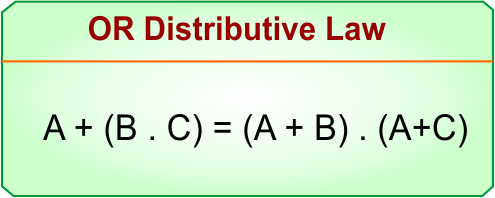
Let’s explain the diagram.
A + (B · C) = (A + B) · (A + C). It means that A is ORed with the AND operation of B and C, which gives the same output as ORing A separately with B and C and then ANDing the results.
- If A = 0, B = 1, and C = 1, then 0 + (1 · 1) = 1 and (0 + 1) · (0 + 1) = 1.
- If A = 1, B = 0, and C = 1, then 1 + (0 · 1) = 1 and (1 + 0) · (1 + 1) = 1.
Therefore, A + (B · C) = (A + B) · (A + C) because both expressions produce the same output. It is called the OR Distributive Law.
Distributive Law Truth Table
Let’s explain the truth table of AND and OR Distributive Laws in Boolean algebra.
AND Distributive Law Truth Table
In the AND Distributive Law, AND is distributed over OR without changing the output. The following diagram shows the truth table of the AND Distributive Law.
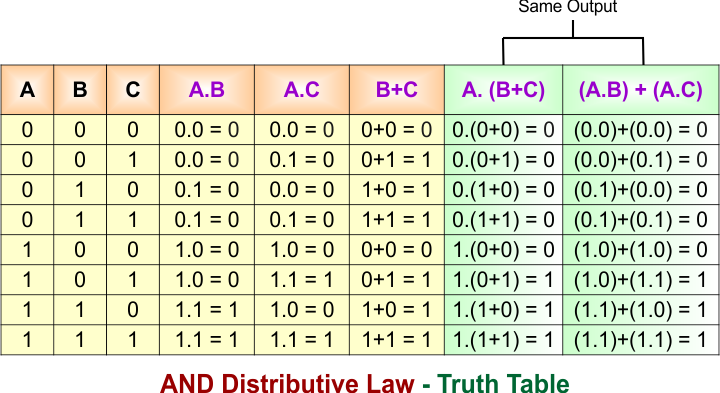
So, A · (B + C) = (A · B) + (A · C) because both expressions produce the same output for every combination of A, B, and C.
OR Distributive Law Truth Table
In the OR Distributive Law, OR is distributed over AND without changing the output. The following diagram shows the truth table of the OR Distributive Law.
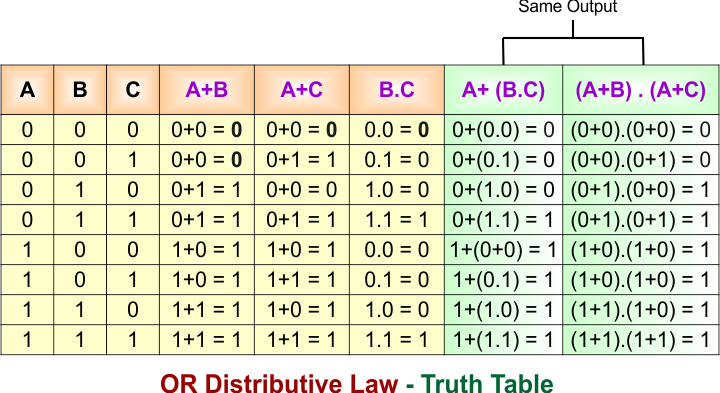
So, A + (B · C) = (A + B) · (A + C) because both expressions produce the same output for every combination of A, B, and C.
Distributive Law Logic Gates
Let’s explain the logic gates of the Distributive Law in Boolean algebra.
AND Distributive Law – Logic Gate
In the AND Distributive Law, the AND operation is distributed over the OR operation. The following diagram shows the AND Distributive Law using logic gates.
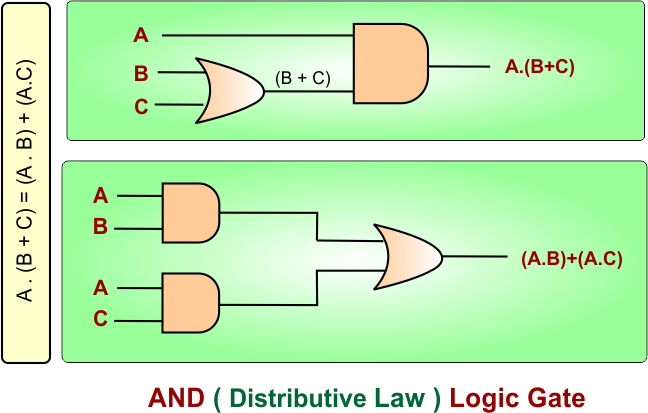
The first circuit represents A · (B + C), while the second circuit represents (A · B) + (A · C). Both circuits produce the same output.
OR Distributive Law – Logic Gate
In the OR Distributive Law, the OR operation is distributed over the AND operation. The following diagram shows the OR Distributive Law using logic gates.
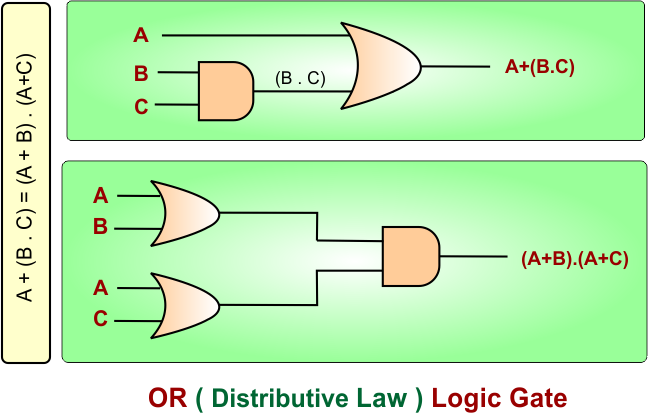
The first circuit represents A + (B · C), while the second circuit represents (A + B) · (A + C). Both circuits produce the same output.
Distributive Law in Boolean Simplification
The Distributive Law is commonly used to expand or factor Boolean expressions without changing their value. Let’s explain some examples.
Distributive Law Example 1: A · (B + C)
The AND Distributive Law allows us to distribute A over B and C.
- A · (B + C) = AB + AC
Distributive Law Example 2: A + (B · C)
The OR Distributive Law allows us to distribute A over B and C.
- A + B.C = (A + B).(A + C)
Distributive Law Example 3: A(B + C + D)
The AND operation can be distributed over multiple OR terms.
- A(B + C + D) = AB + AC + AD
Distributive Law Example 4: A + B(C + D)
The Distributive Law can be applied to the AND expression inside the OR expression.
- A + B(C + D) = A + BC + BD