












Binary Subtraction Examples
Binary subtraction examples help explain how to subtract binary numbers using the digits 0 and 1. Binary subtraction follows four basic rules, and if the top bit is smaller than the bottom bit, we borrow 1 from the next bit.
Binary Subtraction Rules
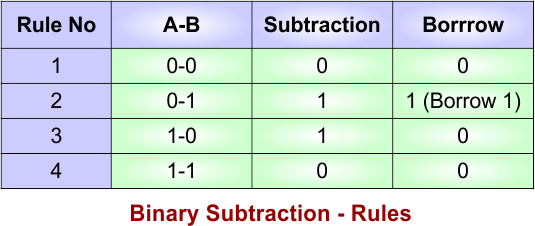
Binary subtraction has four basic rules. The following table shows the subtraction result and borrow for each combination of binary digits. The following diagram explains all binary subtraction rules
Let’s explain all rules
- Rule 1 (0 − 0 = 0): Subtracting 0 from 0 gives a result of 0 with no borrow.
- Rule 2 (0 − 1 = 1): Since 0 is smaller than 1, we borrow 1 from the next higher bit. The result is 1, and the borrow is 1.
- Rule 3 (1 − 0 = 1): Subtracting 0 from 1 gives a result of 1 with no borrow.
- Rule 4 (1 − 1 = 0): Subtracting 1 from 1 gives a result of 0 with no borrow.
Note: Binary subtraction starts from the rightmost bit (LSB) and proceeds from right to left. When a borrow is required, it is taken from the next higher bit.
Binary Subtraction Examples
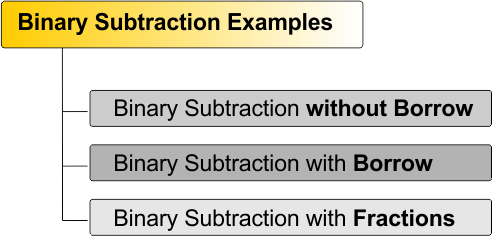
The main types of binary subtraction examples include subtraction without borrowing, subtraction with borrowing, and subtraction involving binary fractions. The three major categories of binary subtraction are given in the following diagram
Let’s solve binary subtraction examples from each category.
1. Binary Subtraction Without Borrowing Examples
Binary subtraction without borrowing occurs when each bit can be subtracted without borrowing from the next available bit.
Binary Subtraction Without Borrowing – Example 1
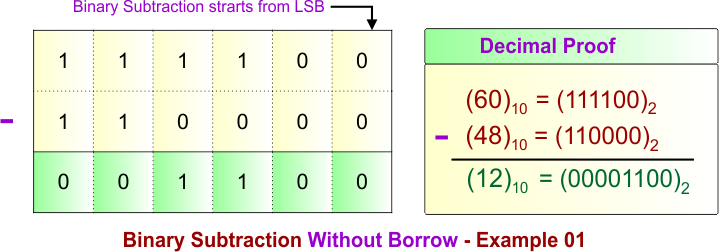
Binary subtraction of 111100-110000 is shown in the following diagram.
According to the above diagram
- First Bit (LSB): 0 − 0 = 0
- Second Bit: 0 − 0 = 0
- Third Bit: 1 − 0 = 1
- 4th Bit: 1 − 0 = 1
- 5th Bit: 1 − 1 = 0
- 6th Bit (MSB): 1 − 1 = 0
Result in Binary: 111100₂ -110000₂ = 001100₂
Binary Subtraction Without Borrowing – Example 2
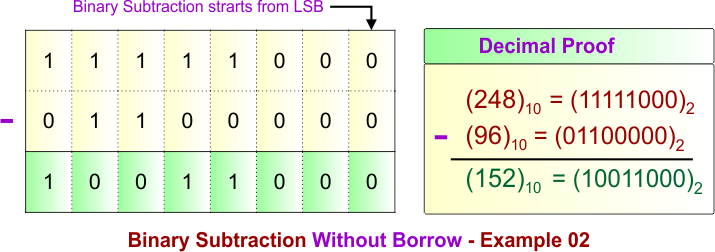
Binary subtraction of 11111000-01100000 is shown in the following diagram.
According to the above diagram:
- First Bit (LSB): 0 − 0 = 0
- Second Bit: 0 − 0 = 0
- Third Bit: 0 − 0 = 0
- 4th Bit: 1 − 0 = 1
- 5th Bit: 1 − 0 = 1
- 6th Bit: 1 − 1 = 0
- 7th Bit: 1 − 1 = 0
- 8th Bit (MSB): 1 − 0 = 1
Result in Binary: 11111000₂ − 01100000₂ = 10011000₂
2. Binary Subtraction With Borrowing Examples
Binary subtraction with borrowing occurs when a 1 must be subtracted from 0. Borrow from the next available 1 on the left to complete the subtraction.
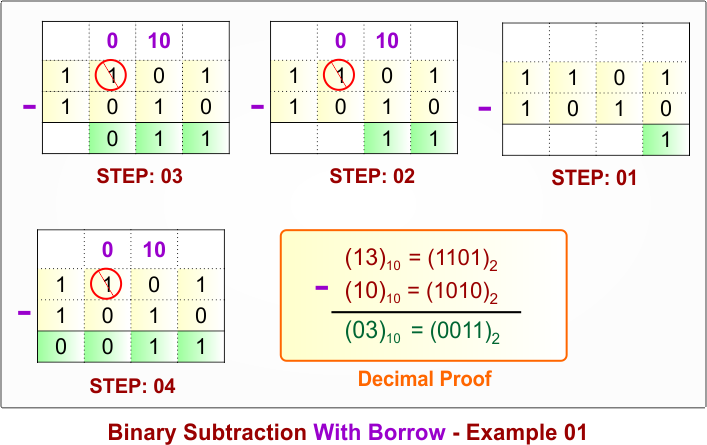
Binary Subtraction With Borrowing – Example 1
The following diagram shows binary subtraction 1101 – 1010 with borrowing.
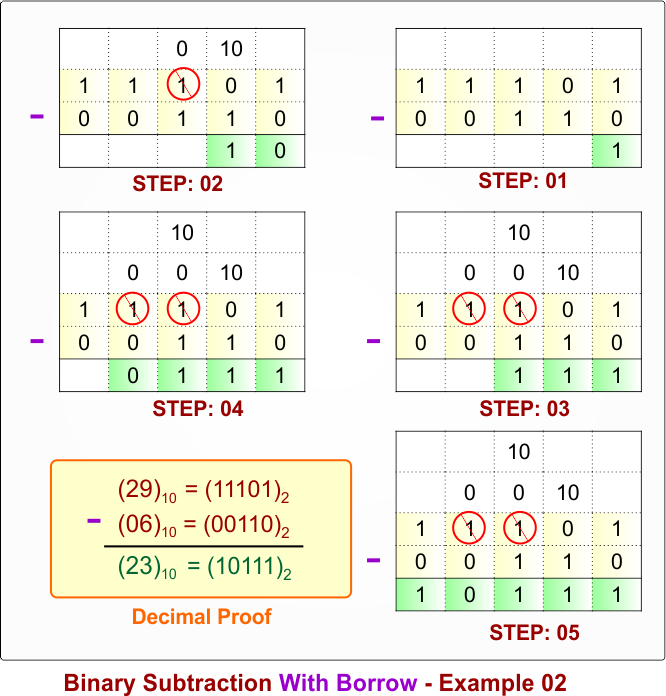
Binary Subtraction With Borrowing – Example 2
The following diagram shows binary subtraction 11101 – 00110 with borrowing.
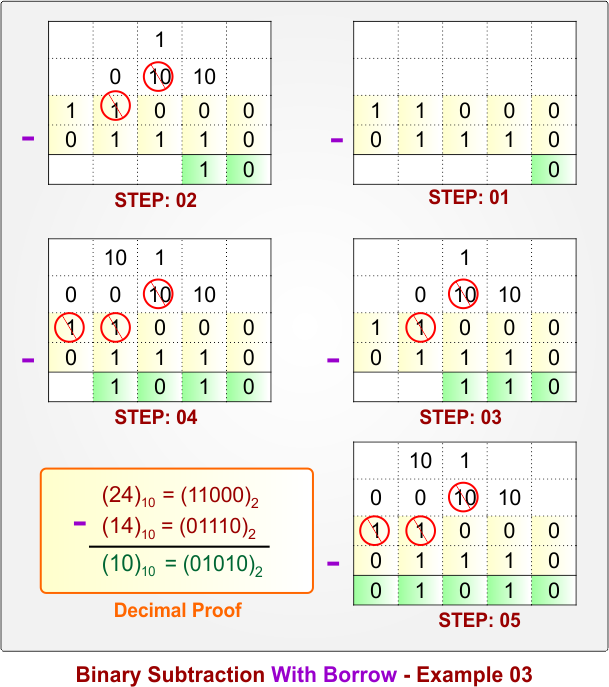
Binary Subtraction With Borrowing – Example 3
The following diagram shows binary subtraction 11000 – 0110 with borrowing.
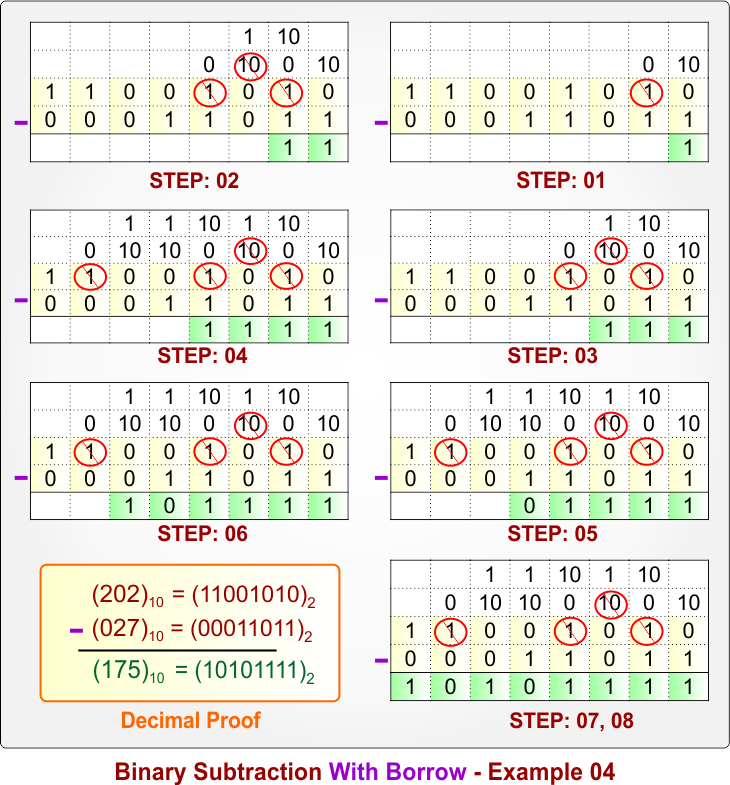
Binary Subtraction With Borrowing – Example 4
The following diagram shows binary subtraction 11001010 – 00011011 with borrowing.
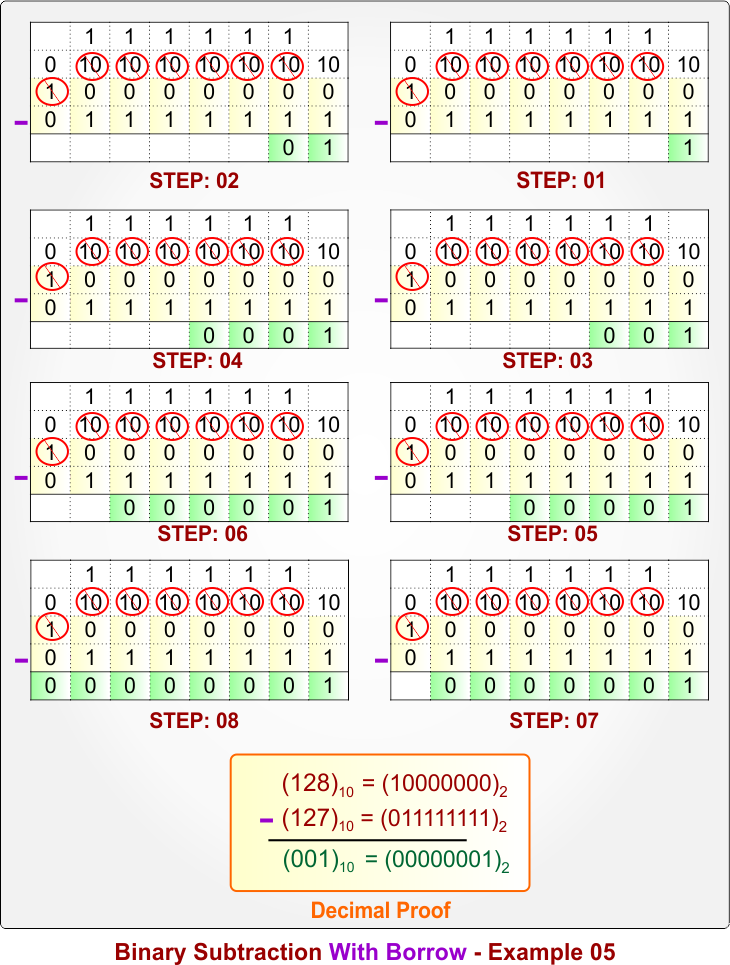
Binary Subtraction With Borrowing – Example 5
The following diagram shows binary subtraction 10000000 – 01111111 with borrowing.
3. Binary Subtraction With Fractions
Binary subtraction with fractions involves subtracting binary numbers that contain fractional parts separated by a binary point. Align the binary points before subtracting, and use borrowing when required.
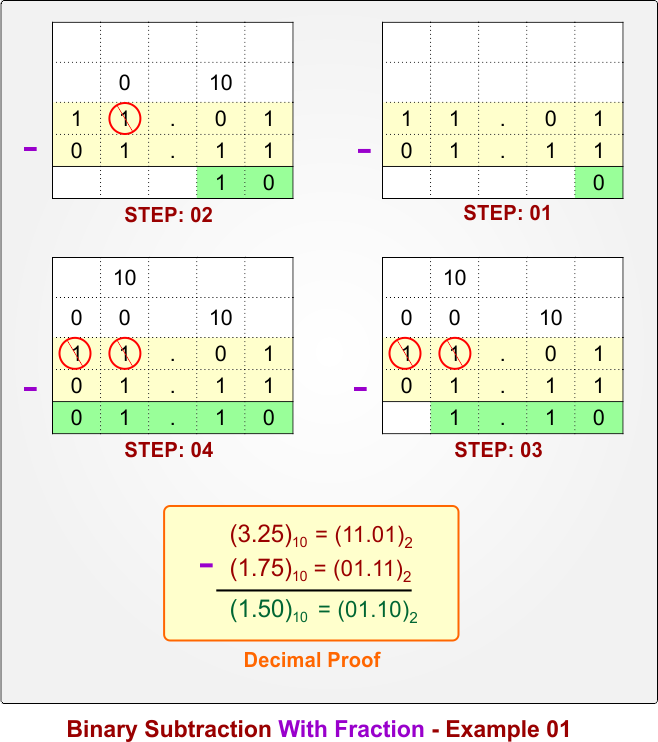
Binary Subtraction With Fractions – Example 1
The following diagram shows binary subtraction 11.01 – 01.11 with borrowing and fractions.
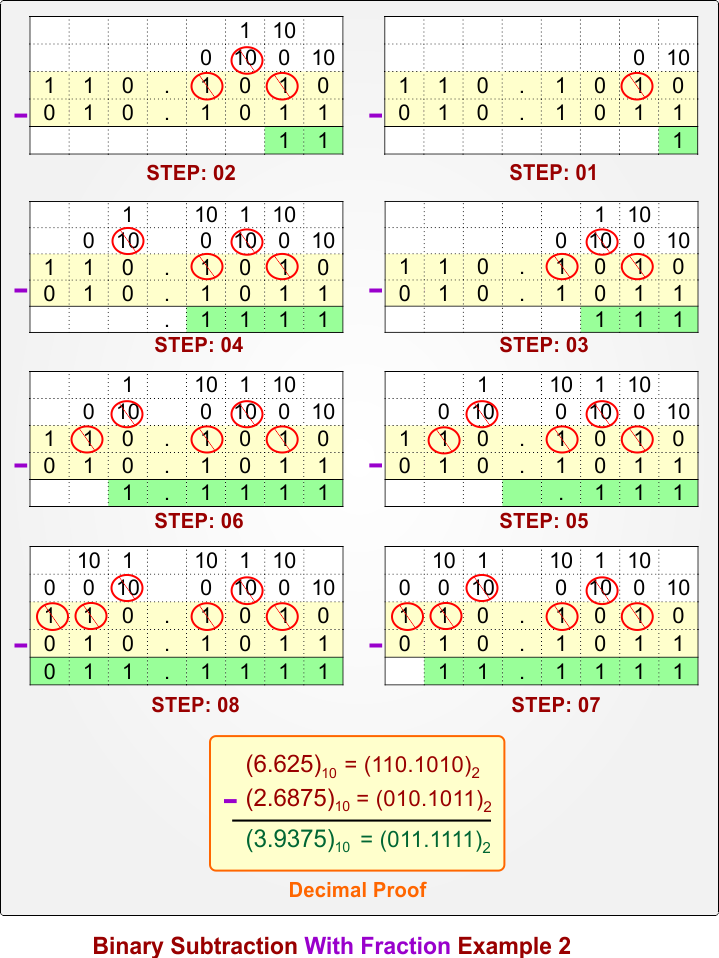
Binary Subtraction With Fractions – Example 2
The following diagram shows binary subtraction 110.1010 – 010.1011 with borrowing and fractions.
Binary Subtraction Summary Table
The following table includes binary subtraction examples without borrowing, with borrowing, and with fractions.
| Binary Subtraction Example | Example Type | Decimal Subtraction |
|---|---|---|
| 1111 − 0011 = 1100 | Without Borrowing | 15 − 3 = 12 |
| 10101 − 01010 = 01011 | Without Borrowing | 21 − 10 = 11 |
| 101101 − 010010 = 011011 | Without Borrowing | 45 − 18 = 27 |
| 1101 − 1011 = 0010 | With Borrowing | 13 − 11 = 2 |
| 11101 − 10111 = 00110 | With Borrowing | 29 − 23 = 6 |
| 11001010 − 10011011 = 00101111 | With Borrowing | 202 − 155 = 47 |
| 110.1010 − 100.1011 = 001.1111 | Fraction | 6.625 − 4.6875 = 1.9375 |
| 101.1100 − 011.0100 = 010.1000 | Fraction | 5.75 − 3.25 = 2.5 |
| 1011.101 − 0110.011 = 0101.010 | Fraction | 11.625 − 6.375 = 5.25 |
Conclusion
Binary subtraction is performed from right to left, starting with the least significant bit (LSB). When subtracting 1 from 0, borrowing is required from the next available bit. Practicing binary subtraction examples with and without borrowing, as well as fractional binary numbers, helps build a clear understanding of binary arithmetic.