












Binary Subtraction Rules
Binary subtraction rules explain how to subtract binary digits (0 and 1) to obtain a binary result. Binary subtraction is a basic arithmetic binary operation in the binary number system and is used by computers to perform calculations. There are four basic binary subtraction rules, including subtraction with borrowing.
Note: Binary subtraction starts from the LSB (Least Significant Bit), which is the rightmost bit, and proceeds from right to left, just like decimal subtraction.
Binary Subtraction Rules
There are four basic rules of binary subtraction, which are shown in the following diagram
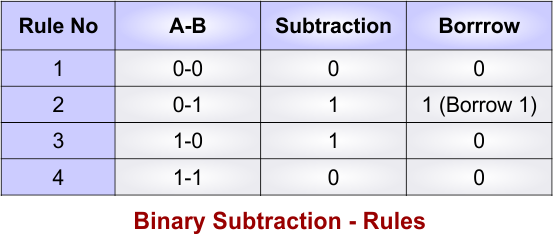
Let’s explain the above diagram
- 0 − 0 = 0: Subtracting zero from zero gives zero.
- 0 − 1 = 1 (Borrow 1): Subtracting one from zero requires borrowing from the next available bit. The calculation becomes 10 − 1 = 1 in binary.
- 1 − 0 = 1: Subtracting zero from one gives one.
- 1 − 1 = 0: Subtracting one from one gives zero.
Binary Subtraction Rules Examples
Let’s understand binary subtraction rules with simple examples.
Example 1: Binary Subtraction Without Borrowing
Let’s explain the first binary subtraction example, which requires no borrowing. Subtract 1010₂ − 0010₂.
Let explain the above diagram in short form
- First Bit (LSB): 0 − 0 = 0
- Second Bit: 1 − 1 = 0
- Third Bit: 0 − 0 = 0
- Fourth Bit (MSB): 1 − 0 = 1
Result in Binary: 1010₂ − 0010₂ = 1000₂
Decimal Proof: 10 − 2 = 8
Example 2: Binary Subtraction With Borrowing
Let’s explain the second binary subtraction example, which requires borrowing. Subtract 1101₂ − 1011₂.
Let explain the above diagram in short form
- First Bit (LSB): 1 − 1 = 0
- Second Bit: 0 − 1 = 1 (Borrow from the third bit, making 10 − 1 = 1 in binary).
- Third Bit: After borrowing, 0 − 0 = 0.
- Fourth Bit (MSB): 1 − 1 = 0.
Result in Binary: 1101₂ − 1011₂ = 0010₂
Decimal Proof: 13 − 11 = 2
Binary Subtraction Rules Table
Let’s understand the following terms before understanding the binary subtraction table
- Minuend Bit: The binary digit from which another digit is subtracted.
- Subtrahend Bit: The binary digit that is subtracted from the minuend bit.
- Difference: The result obtained after subtracting the two binary digits.
- Borrow: A value taken from the next available bit when the minuend bit is smaller than the subtrahend bit.
Look at the following table of binary subtraction
| Minuend Bit | Subtrahend Bit | Difference | Borrow |
|---|---|---|---|
| 0 | 0 | 0-0 = 0 | No |
| 0 | 1 | 0-1 = 1 | Yes |
| 1 | 0 | 1-0 = 1 | No |
| 1 | 1 | 1-1 = 0 | No |
Important Points About Binary Subtraction
- Binary subtraction uses only two digits: 0 and 1.
- Subtract the bits from right to left, starting with the least significant bit (LSB).
- Borrowing is required when subtracting 1 from 0.
- A borrowed 1 adds the binary value 10₂ to the current column.
- Align the binary points before subtracting binary fractions.
- Decimal conversion can be used to verify the result of binary subtraction.