












Binary Multiplication Rules
Binary multiplication is a basic arithmetic operation in the binary number system. It follows simple rules based on two digits: 0 and 1. Similar to decimal multiplication, binary multiplication involves multiplying numbers, writing partial products, and adding them to obtain the final result.
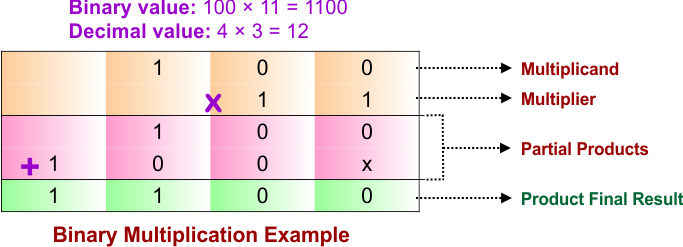
Understanding binary multiplication rules makes it easier to multiply binary numbers with different numbers of bits.
Binary Multiplication Rules
There are four basic binary multiplication rules. These rules determine the result when multiplying two binary digits.
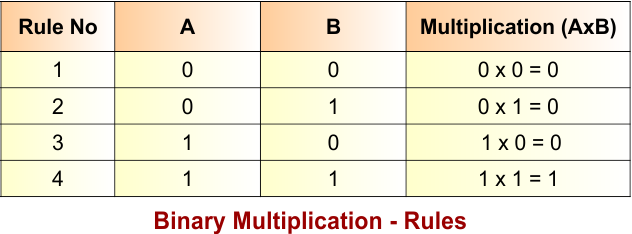
These rules can also be explained as follows:
- 0 × 0 = 0: Multiplying zero by zero gives zero.
- 0 × 1 = 0: Multiplying zero by one gives zero.
- 1 × 0 = 0: Multiplying one by zero gives zero.
- 1 × 1 = 1: Multiplying one by one gives one.
|
Key points
|
How to Multiply Binary Numbers
Binary multiplication follows a process similar to decimal multiplication. However, it uses only 0 and 1. Follow these steps to multiply binary numbers:
- Write the binary numbers vertically, placing the multiplier below the multiplicand.
- Multiply each digit of the multiplicand by the rightmost digit of the multiplier.
- Write the partial products according to the binary multiplication rules.
- Move to the next digit of the multiplier and shift the partial product one position to the left.
- Add all partial products using binary addition rules.
- Write the final binary result.
Binary Multiplication Examples
Binary multiplication becomes easier to understand by solving examples with different numbers of bits.
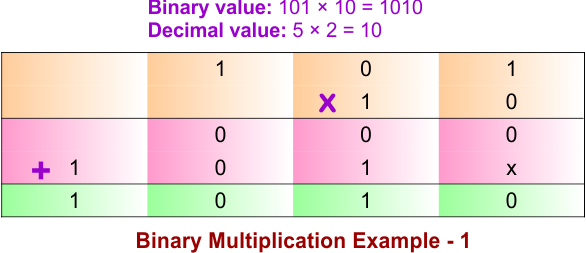
Binary Multiplication Example – 1
Let’s multiply 101 × 10; binary and decimal results are given in the following diagram
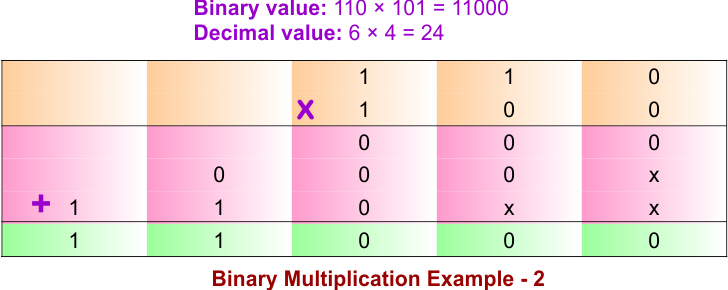
Binary Multiplication Example – 2
Let’s multiply 110 × 101; binary and decimal results are given in the following diagram
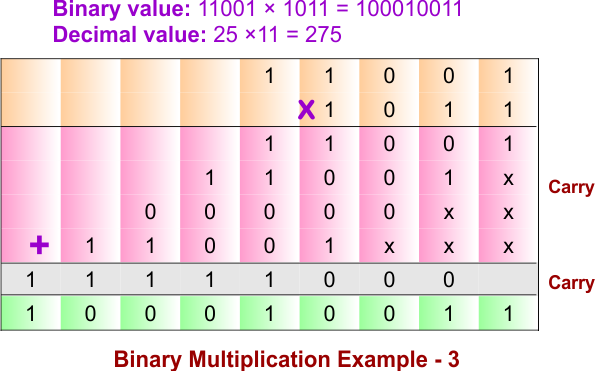
Binary Multiplication Example – 3
Let’s multiply 11001 × 1011; binary and decimal results are given in the following diagram
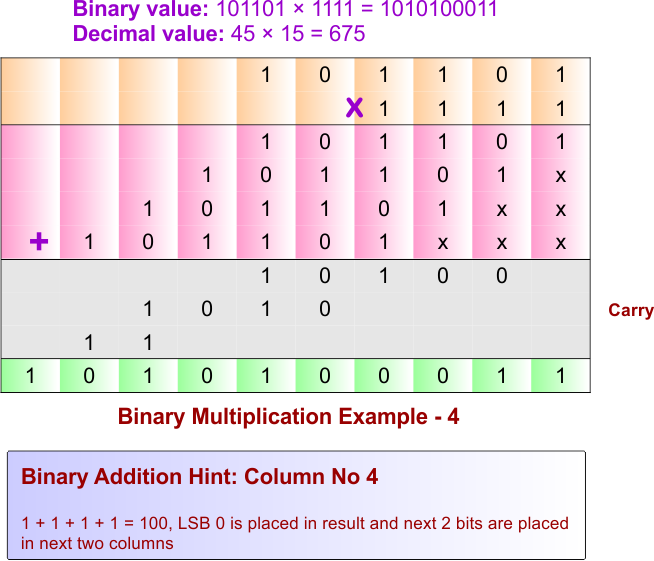
Binary Multiplication Example – 4
Let’s multiply 101101 × 1111; binary and decimal results are given in the following diagram
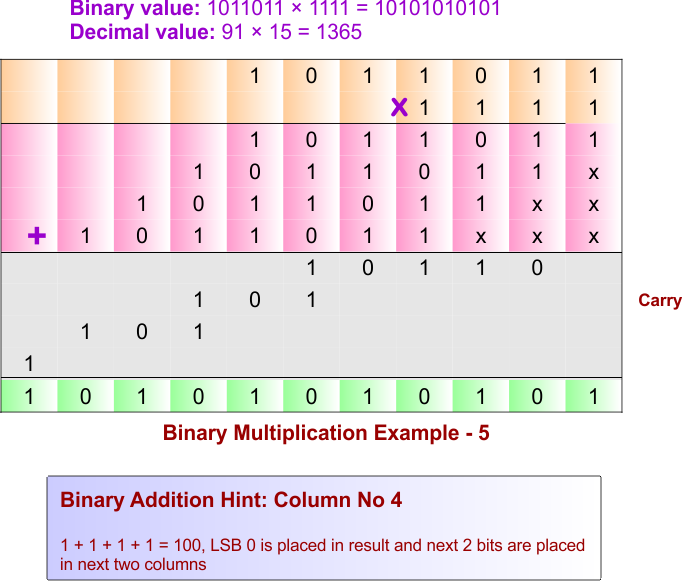
Binary Multiplication Example – 5
Conclusion: Binary multiplication is a simple process based on four basic rules. By applying these rules, shifting partial products, and adding them together, we can multiply binary numbers accurately.