












Binary Addition Rules
Binary addition rules explain how to add binary numbers using 0 and 1. These rules include adding two bits and three bits, calculating the sum, and carrying digits to the next column.
Binary Addition Rules – 2 Bits
Binary addition rules for 2 bits explain how to add two binary digits (0 and 1). There are four basic rules which are shows in the following diagram
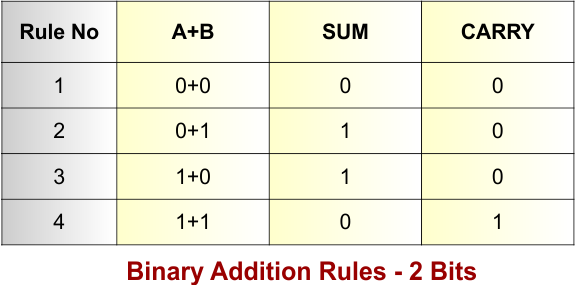
The above diagram says
- 0 + 0 = 0: The sum is 0, and there is no carry.
- 0 + 1 = 1: The sum is 1, and there is no carry.
- 1 + 0 = 1: The sum is 1, and there is no carry.
- 1 + 1 = 10: The sum is 0, and a carry of 1 is generated.
Binary Addition Rules – 3 Bits
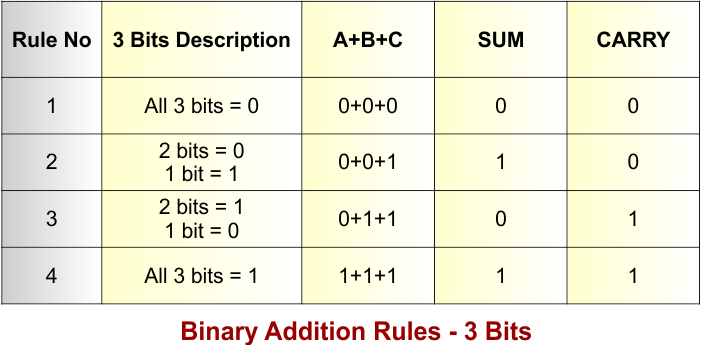
Binary addition rules for 3 bits explain how to add three binary digits. There are four basic rules, which are shown in the following diagram
Binary Addition Rules – More than 3 Bits
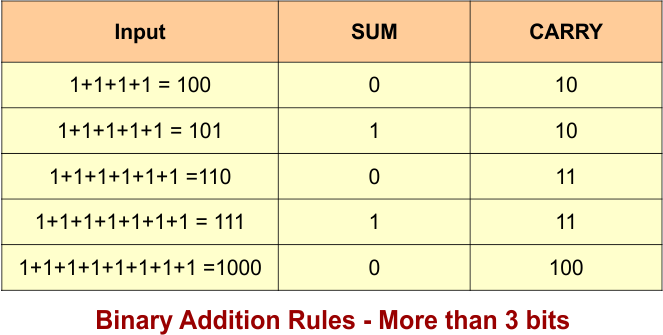
Binary addition rules for more than 3 bits explain how to add binary digits. There are some examples, which are shown in the following diagram
Binary Addition Example using Rules
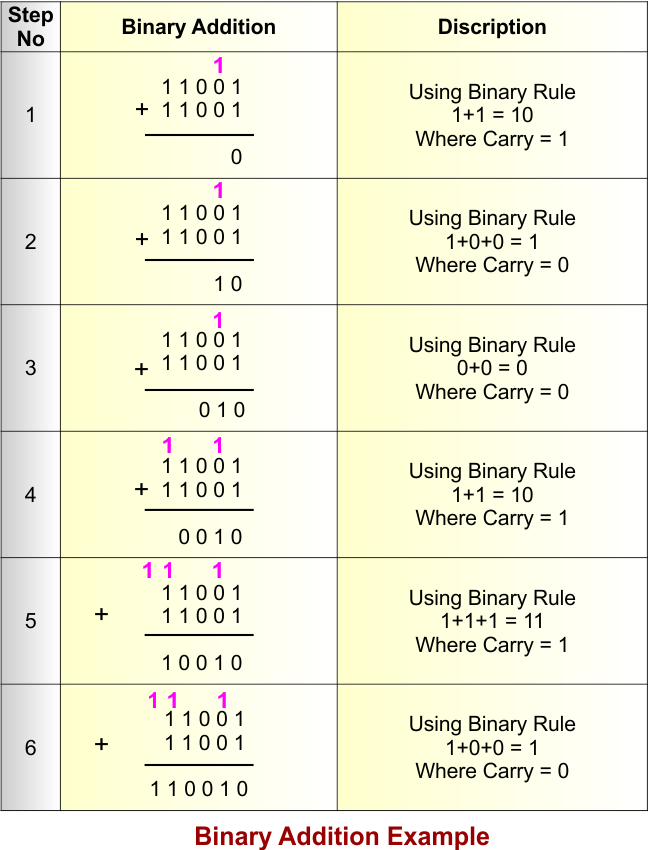
Example 01: Let’s explain a simple example step by step using the binary addition rules discussed earlier in the topic
Example 02: Let’s add the binary addition of 1111+ 0100 + 0110, is shown in the following diagram.
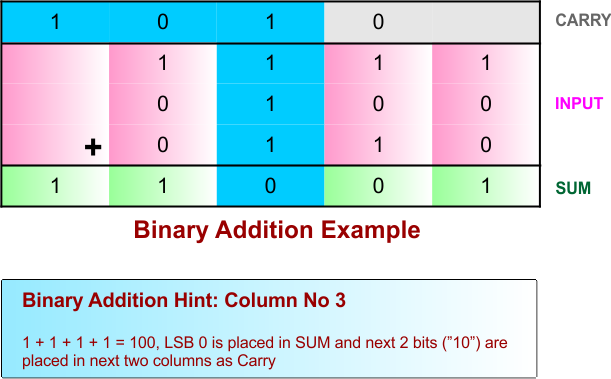
According to the above diagram
- Binary: 1111 + 0100 + 0110 = 11001
- Decimal: 15 + 4 + 6 = 25
- Binary Result: (11001)₂ = (25)₁₀
Both binary and decimal results are equal, so the answer is correct.
Example 03: Let’s add the binary addition of 11101+ 01110 + 01111 + 01101, as shown in the following diagram.
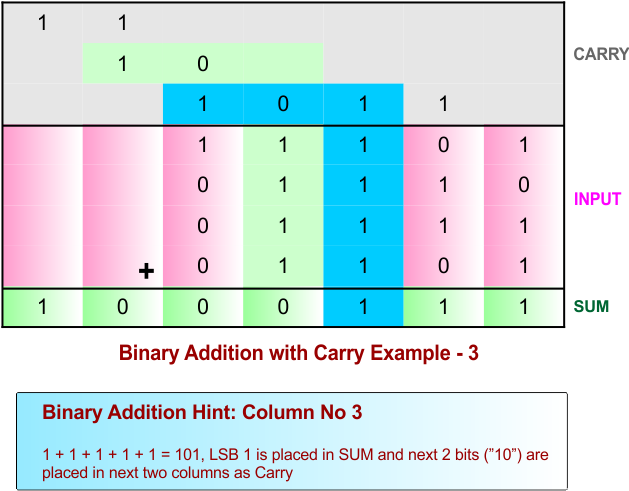
According to the above diagram
- Binary: 11101 + 01110 + 01111 + 01101 = 1011011
- Decimal: 29 + 14 + 15 + 13 = 71
- Binary Result: (1000111)₂ = (71)₁₀
Both binary and decimal results are equal, so the answer is correct.