












4 Variable K-Map Examples
A 4-variable (i.e., A, B, C, D) Karnaugh Map (K-Map) is used to simplify Boolean expressions. It has 16 cells, where each cell represents one possible minterm (i.e., m₀) or maxterm (i.e., M₀).
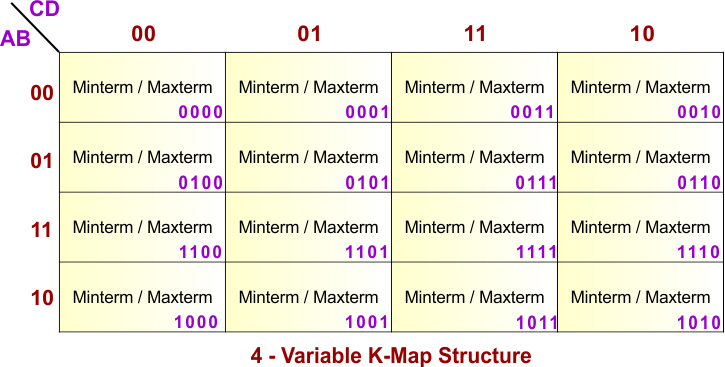
Solving 4 Variable K-Map examples helps students understand how to place minterms and maxterms, group adjacent values, and simplify Boolean expressions using SOP and POS methods.
Minterms and Maxterms in 4 Variable K-Map
Minterms and maxterms represent all possible combinations of four variables (A, B, C, and D) and are used to simplify Boolean expressions in SOP (Sum of Products) and POS (Product of Sums) forms using a 4 Variable K-Map.
Minterms 4 Variable K-Map – SOP
A 4-variable K-Map for minterms is used to simplify Boolean expressions in Sum of Products (SOP) form. It uses 1s to represent the given minterms, which are grouped together to obtain the simplified Boolean expression. The following diagram explains the minterms structure of a 4-variable K-map.
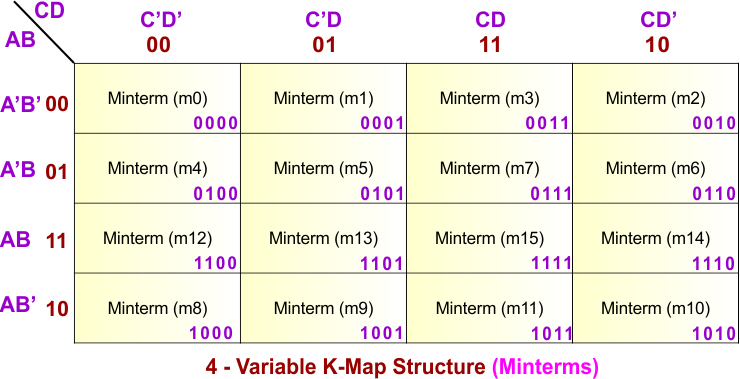
Minterms of four variables (A, B, C, D) are given below:
-
m₀ = 0000 = A’B’C’D’
-
m₁ = 0001 = A’B’C’D
-
m₂ = 0010 = A’B’CD’
-
m₃ = 0011 = A’B’CD
-
m₄ = 0100 = A’BC’D’
-
m₅ = 0101 = A’BC’D
-
m₆ = 0110 = A’BCD’
-
m₇ = 0111 = A’BCD
-
m₈ = 1000 = AB’C’D’
-
m₉ = 1001 = AB’C’D
-
m₁₀ = 1010 = AB’CD’
-
m₁₁ = 1011 = AB’CD
-
m₁₂ = 1100 = ABC’D’
-
m₁₃ = 1101 = ABC’D
-
m₁₄ = 1110 = ABCD’
-
m₁₅ = 1111 = ABCD
Maxterms 4 Variable K-Map – POS
A 4-variable K-Map for maxterms is used to simplify Boolean expressions in Product of Sums (POS) form. It uses 0s to represent the given maxterms, which are grouped together to obtain the simplified Boolean expression. The following diagram explains the maxterms structure of a 4-variable K-map.
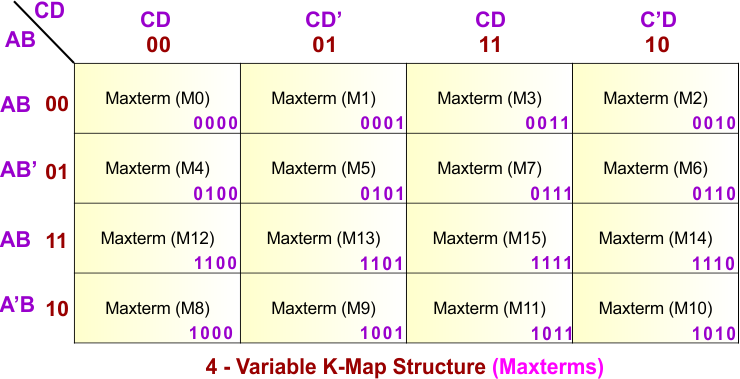
Maxterms of four variables (A, B, C, D) are given below:
-
M₀ = 0000 = (A + B + C + D)
-
M₁ = 0001 = (A + B + C + D’)
-
M₂ = 0010 = (A + B + C’ + D)
-
M₃ = 0011 = (A + B + C’ + D’)
-
M₄ = 0100 = (A + B’ + C + D)
-
M₅ = 0101 = (A + B’ + C + D’)
-
M₆ = 0110 = (A + B’ + C’ + D)
-
M₇ = 0111 = (A + B’ + C’ + D’)
-
M₈ = 1000 = (A’ + B + C + D)
-
M₉ = 1001 = (A’ + B + C + D’)
-
M₁₀ = 1010 = (A’ + B + C’ + D)
-
M₁₁ = 1011 = (A’ + B + C’ + D’)
-
M₁₂ = 1100 = (A’ + B’ + C + D)
-
M₁₃ = 1101 = (A’ + B’ + C + D’)
-
M₁₄ = 1110 = (A’ + B’ + C’ + D)
-
M₁₅ = 1111 = (A’ + B’ + C’ + D’)
Note: In maxterms, a binary bit of 0 is written as an uncomplemented variable, while a bit of 1 is written as a complemented variable.
Rules for Solving 4 Variable K-Map Examples
Follow these rules when solving 4 Variable K-Map examples:
-
Draw a 4 × 4 K-Map containing sixteen cells.
-
Arrange the rows and columns in Gray code order (00, 01, 11, 10).
-
Identify the given minterms or maxterms.
-
For SOP, place 1 in the cells of the given minterms and 0 in the remaining cells.
-
For POS, place 0 in the cells of the given maxterms and 1 in the remaining cells.
-
Make the largest possible groups of adjacent 1s for SOP or adjacent 0s for POS.
-
Groups can contain 1, 2, 4, 8, or 16 cells.
-
Diagonal cells cannot be grouped together.
-
The first and last rows are adjacent, so wrap-around grouping is allowed.
-
The first and last columns are also adjacent, so horizontal wrap-around grouping is allowed.
-
Corner cells are adjacent and can be grouped together.
-
Groups can overlap when it helps simplify the Boolean expression.
-
Write the simplified Boolean expression using the common variables in each group.
4 Variable K-Map Simplification Using Minterms (SOP)
In this section, we will cover different 4 Variable K-Map Simplification Using Minterms (SOP) examples with solutions to understand the simplification process step by step.
4-Variable K-Map Example 1 – SOP (Minterms)
Simplify the Boolean function F(A, B, C, D) = Σm(3) using a 4-Variable K-Map.
Solution:
The following diagram completely solves Example 1, showing the function F(A, B, C, D) = Σm(3) in a descriptive manner using a 4-Variable K-Map.
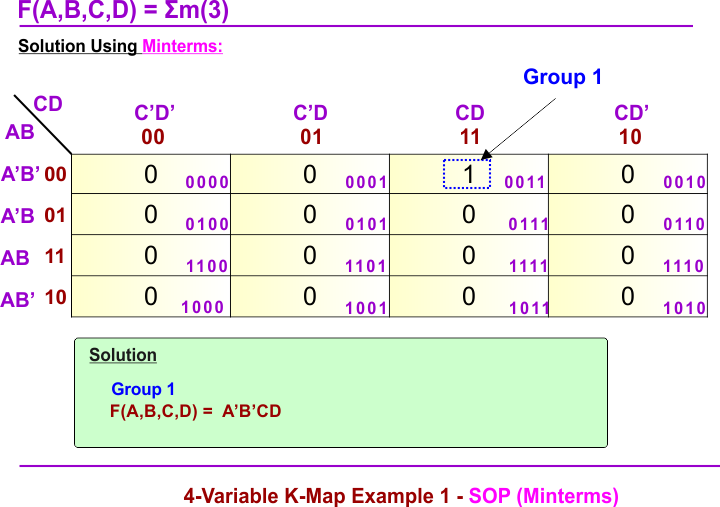
In the above diagram,
There is only a single group that contains “1” in cell 3. The value of cell 3 in terms of variables is A’B’CD. Since there are no adjacent 1s to form a larger group, the Boolean expression A’B’CD cannot be further minimized. Therefore, the final answer is F(A, B, C, D) = A’B’CD.
4-Variable K-Map Example 1 – SOP (Minterms)
Simplify the Boolean function F(A, B, C, D) = Σm(2,3) using a 4-Variable K-Map.
Solution:
The following diagram completely solves Example 2, showing the function F(A, B, C, D) = Σm(2,3) in a descriptive manner using a 4-Variable K-Map.
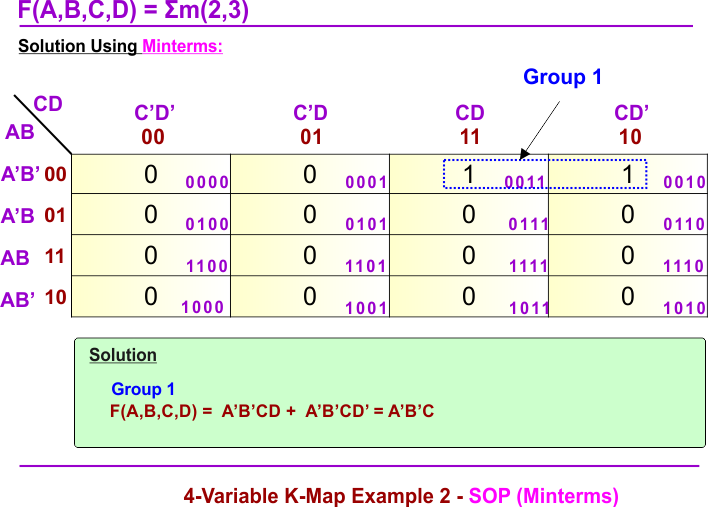
In the above diagram,
There is only one group containing two adjacent 1s in cells 2 and 3. The values of A, B, and C remain unchanged (A’B’C), while the value of D changes from D’ to D. Therefore, D is eliminated. The simplified Boolean expression cannot be further minimized. Therefore, the final answer is F(A, B, C, D) = A’B’C.