












Advantages and Disadvantages of Platform as a Service (PaaS)
Platform as a Service (PaaS) is a cloud computing model that provides a complete development and deployment environment in the cloud. It allows developers to build, run, and manage applications without handling infrastructure. Understanding the advantages and disadvantages of PaaS helps students, developers, and businesses choose the right cloud solution.
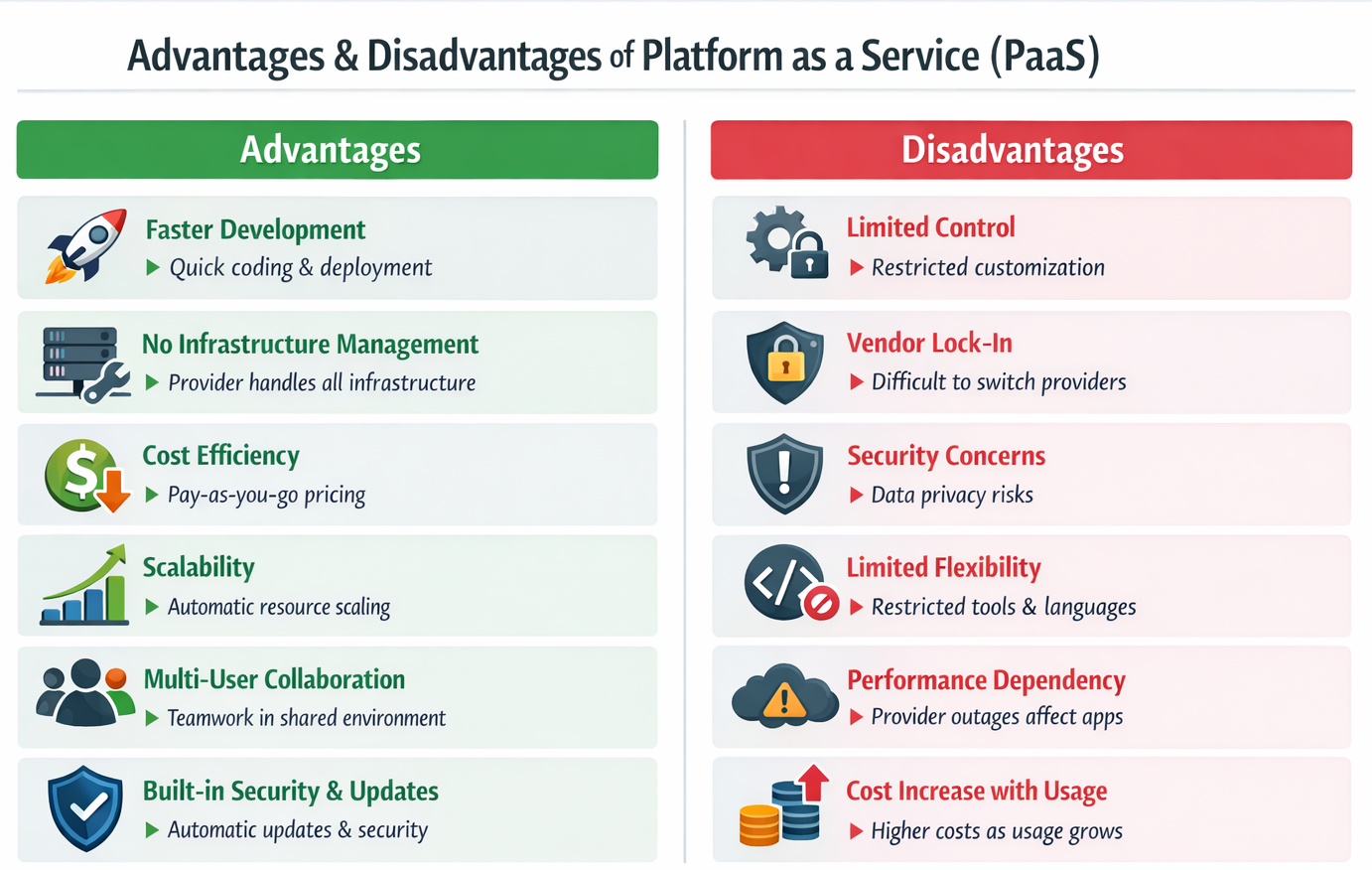
Let us explain each advantage and disadvantage of Platform as a Service (PaaS) in detail.
Advantages of Platform as a Service (PaaS)
PaaS offers several benefits that make application development faster, easier, and more efficient.
1. Faster Development
PaaS provides ready-to-use tools and environments that significantly reduce development time.
Benefits
-
Pre-configured environment: Developers can start coding immediately without setup delays.
-
Built-in tools: Integrated tools speed up coding, testing, and debugging.
-
Reduced development effort: Eliminates repetitive setup tasks.
Example
A startup can build and launch an application in days instead of weeks.
2. No Infrastructure Management
PaaS removes the need to manage servers, storage, and networking.
What Provider Handles
-
Hardware management: Physical servers and infrastructure are fully managed by the provider.
-
Operating system updates: OS maintenance and updates are handled automatically.
-
Runtime environment: Ensures applications run smoothly without manual configuration.
Example
Developers focus only on coding while the platform manages everything else.
3. Cost Efficiency
PaaS reduces costs by eliminating the need for hardware and maintenance.
Benefits
-
Pay-as-you-go model: Users pay only for the resources they use.
-
No upfront investment: No need to purchase expensive infrastructure.
-
Reduced maintenance cost: No need for large IT teams.
Example
A small business can develop applications without investing in servers.
4. Scalability
PaaS platforms automatically scale applications based on demand.
Benefits
-
Handles traffic spikes: Applications remain stable during high usage.
-
Dynamic resource allocation: Resources increase or decrease automatically.
-
Improved performance: Ensures consistent user experience.
Example
An app automatically scales when user traffic increases.
5. Multi-User Collaboration
PaaS enables multiple developers to work on the same project simultaneously.
Benefits
-
Team collaboration: Developers can work together efficiently.
-
Real-time updates: Changes are instantly visible to all users.
-
Shared environment: Reduces compatibility issues.
Example
A team works on a cloud-based project from different locations.
6. Built-in Security and Updates
PaaS providers handle security and system updates automatically.
Features
-
Regular updates: Keeps systems secure and up to date.
-
Data protection: Uses encryption and security measures.
-
Access control: Manages user permissions and authentication.
Example
Developers do not need to worry about applying security patches.
7. Easy Deployment
PaaS simplifies application deployment with automated processes.
Benefits
-
Quick deployment: Applications go live faster.
-
Automated processes: Reduces manual effort.
-
Continuous delivery support: Enables frequent updates.
Example
A developer uploads code, and the application is instantly deployed.
Disadvantages of Platform as a Service (PaaS)
Despite its advantages, PaaS has some limitations that users should consider.
1. Limited Control
PaaS provides less control over infrastructure compared to IaaS.
Challenges
-
Restricted customization: Limited ability to modify system settings.
-
Dependency on provider: Users must follow platform rules.
Example
A developer may not be able to configure the server environment fully.
2. Vendor Lock-In
Switching from one PaaS provider to another can be difficult.
Issues
-
Platform dependency: Applications may rely on specific tools or services.
-
Migration complexity: Moving applications requires effort and changes.
Example
An app built on one platform may need modifications to run on another.
3. Security Concerns
Although providers handle security, users still face certain risks.
Risks
-
Shared environment: Multiple users share the same infrastructure.
-
Data security concerns: Sensitive data may require extra protection.
Example
A company must ensure its application is properly secured.
4. Limited Flexibility
PaaS environments may not support all programming languages or tools.
Challenges
-
Restricted tools: Not all frameworks are supported.
-
Less customization: Limited ability to change configurations.
Example
A developer may not find support for a specific programming language.
5. Performance Dependency
Application performance depends on the cloud provider’s infrastructure.
Issues
-
Server limitations: Performance may vary based on shared resources.
-
Provider downtime: Outages can affect applications.
Example
If the provider experiences downtime, the application may become unavailable.
6. Cost Can Increase with Usage
While initially affordable, costs may increase as usage grows.
Reasons
-
Scaling costs: More users require more resources.
-
Additional services: Extra features may increase expenses.
Example
An application with high traffic may result in higher monthly bills.
Why Understanding Advantages and Disadvantages is Important
Knowing both benefits and limitations helps users make better decisions.
For Students
-
Improves conceptual understanding
-
Helps in exams and interviews
For Developers
-
Helps choose the right platform
-
Improves development efficiency
For Businesses
-
Reduces risks
-
Optimizes cost and performance
-
Supports better decision-making
Conclusion
Platform as a Service (PaaS) is a powerful cloud model that simplifies application development but comes with certain limitations.
-
Enables faster development and deployment
-
Reduces infrastructure management
-
May limit control and flexibility
Understanding both advantages and disadvantages helps users use PaaS effectively in real-world scenarios.