











Disadvantages of Private Cloud
Private cloud is a secure and controlled cloud deployment model, but it also comes with certain limitations. While it offers high security and customization, organizations must consider its drawbacks before implementation. Understanding the disadvantages of private cloud helps in making informed decisions.
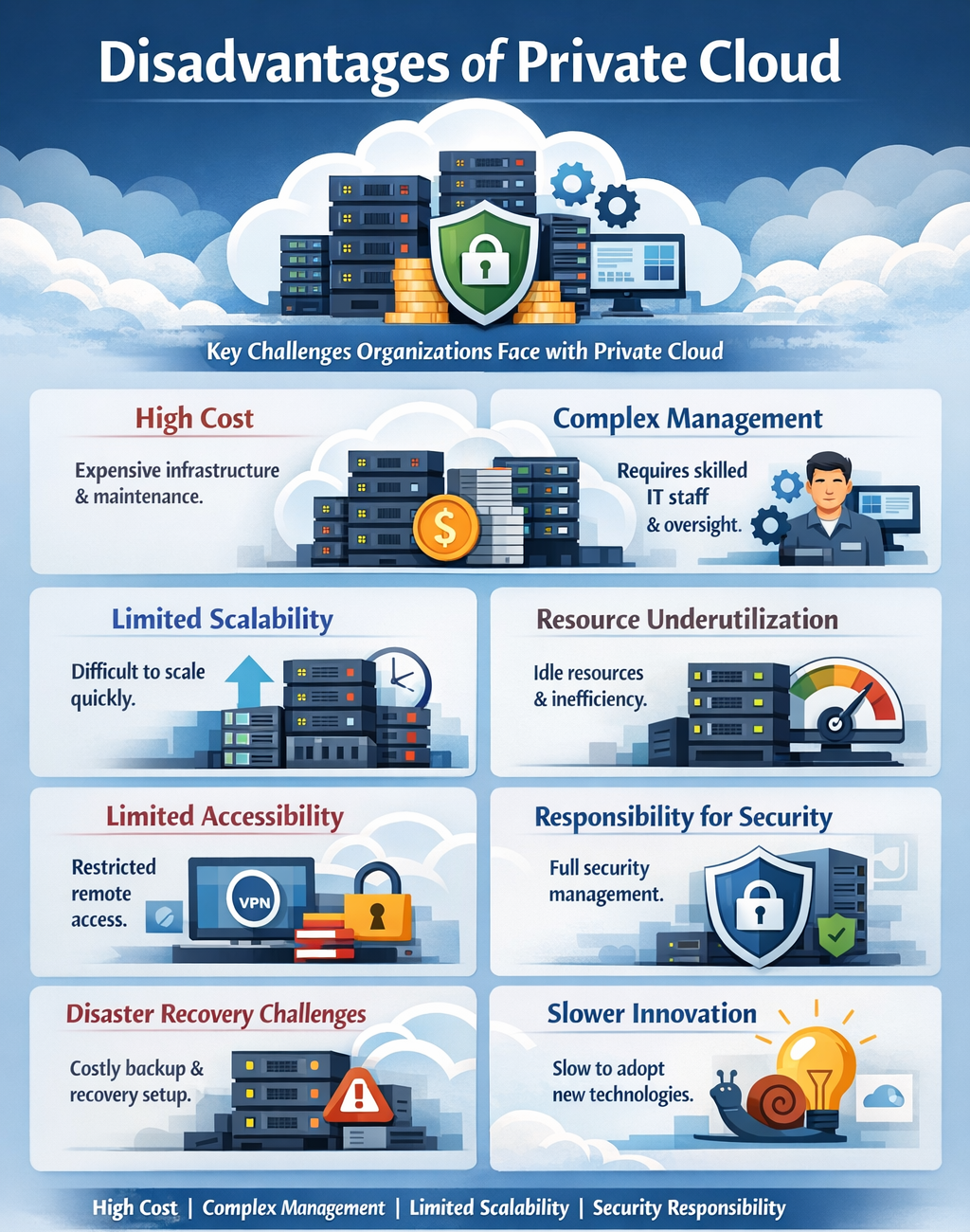
Let us explain each disadvantage of the private cloud in detail.
1. High Cost
Private cloud requires significant investment in infrastructure and maintenance.
Challenges
-
High initial investment: Organizations need to purchase servers, storage, and networking equipment.
-
Maintenance cost: Ongoing expenses for upgrades, power, and system management.
-
Operational cost: Requires dedicated IT staff for monitoring and support.
Example
A company must invest heavily to set up its own data center.
2. Complex Management
Managing a private cloud requires skilled professionals and proper planning.
Challenges
-
Technical expertise required: Needs experienced IT teams to manage systems.
-
System monitoring: Continuous monitoring is needed to ensure performance.
-
Management overhead: Increased workload for maintaining infrastructure.
Example
An organization needs a dedicated IT team to manage servers and security.
3. Limited Scalability
Private cloud does not scale as easily as public cloud.
Challenges
-
Slow expansion: Adding resources requires new hardware setup.
-
Capacity limitations: Limited by available infrastructure.
-
Planning required: Scaling must be planned in advance.
Example
A company cannot instantly increase server capacity during sudden demand.
4. Resource Underutilization
Private cloud resources may not always be used efficiently.
Challenges
-
Unused capacity: Resources may remain idle during low usage.
-
Inefficient utilization: Fixed infrastructure may not match demand.
-
Higher cost impact: Paying for unused resources increases expenses.
Example
Servers may remain idle during non-peak hours, wasting resources.
5. Limited Accessibility
Private cloud may not be as easily accessible as public cloud.
Challenges
-
Restricted access: Access is limited to internal users or networks.
-
Remote access complexity: Requires additional configuration for external access.
-
Less global reach: Not as widely accessible as public cloud.
Example
Employees may need VPN access to use private cloud resources remotely.
6. Responsibility for Security
Although private cloud is secure, the organization is responsible for maintaining security.
Challenges
-
Security management: Organizations must implement and manage security measures.
-
Risk of misconfiguration: Poor setup can lead to vulnerabilities.
-
Continuous monitoring required: Security must be regularly updated and maintained.
Example
A company must ensure its systems are protected against cyber threats.
7. Disaster Recovery Challenges
Private cloud requires proper planning for backup and recovery.
Challenges
-
Manual setup: Backup systems must be configured internally.
-
Cost of recovery systems: Additional investment needed for disaster recovery.
-
Complex recovery process: Requires detailed planning and execution.
Example
A company must build its own backup systems to recover data after failure.
8. Slower Innovation
Private cloud may limit rapid innovation compared to public cloud.
Challenges
-
Long setup time: Infrastructure changes take longer.
-
Limited experimentation: High cost reduces flexibility for testing new ideas.
-
Less agility: Slower adoption of new technologies.
Example
Developers may take longer to test and deploy new applications.
Top 5 FAQs (Interview & Exam Focused)
1. What is the main disadvantage of private cloud?
The main disadvantage is high cost due to infrastructure and maintenance requirements. Organizations need significant investment and skilled IT staff.
2. Why is private cloud expensive?
Because it requires dedicated hardware, infrastructure, and management. Unlike public cloud, costs are not shared among multiple users.
3. Is private cloud scalable?
Private cloud is scalable but not as flexible as public cloud. Scaling requires additional hardware and proper planning.
4. Who manages security in private cloud?
The organization itself is responsible for managing security. It must implement and maintain security policies and protections.
5. When should private cloud not be used?
It may not be suitable for startups or small businesses with limited budgets. It is also less ideal for applications requiring rapid scalability.
Conclusion
Private cloud has several disadvantages that organizations should consider.
-
High cost and complex management
-
Limited scalability and accessibility
-
Responsibility for security and maintenance
Understanding these limitations helps in choosing the right cloud deployment model based on specific needs.