




IoT Architecture Explained for Beginners
IoT (Internet of Things) architecture defines how devices, networks, and systems interact to collect, process, and exchange data. It provides a structured framework that helps beginners understand how smart devices communicate efficiently.
Understanding IoT architecture is essential for students because it builds the foundation for designing smart systems, automation solutions, and real-world applications.
What is IoT Architecture?
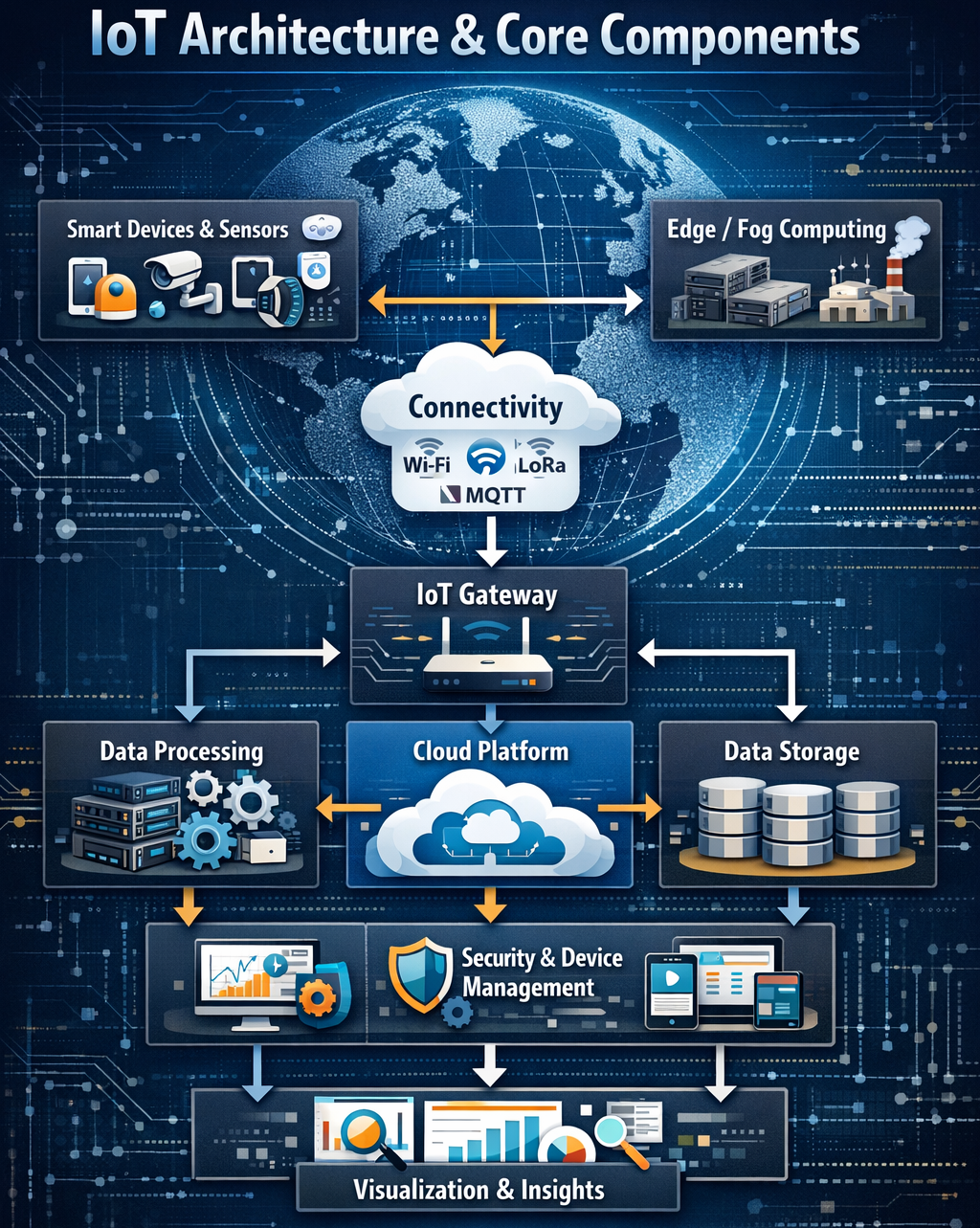
IoT architecture is a structured layered framework that defines how data is collected, transmitted, processed, and presented from connected devices to end users. It helps simplify complex Internet of Things systems into organized and scalable components that support real-time communication and decision-making.
It plays a key role in enabling smart automation, efficient data handling, and seamless device interaction across different IoT environments. The list of key components and layers of IoT architecture given below:
1. Devices (Things)
Devices are the physical foundation of IoT architecture that include sensors, actuators, and smart machines responsible for collecting real-world data.
- Smart sensors: Smart sensors collect environmental data such as temperature, humidity, and motion for real-time monitoring in IoT systems.
- Wearable devices: Wearable devices track human health metrics like heart rate and activity levels for healthcare and fitness applications.
- Industrial machines: Industrial machines generate operational data to improve automation, efficiency, and predictive maintenance in industries.
2. Connectivity
Connectivity refers to the communication system that enables data transfer between IoT devices and processing systems using different networking technologies.
- Wireless communication: Wireless communication enables data exchange using Wi-Fi, Bluetooth, and Zigbee for flexible IoT connectivity.
- Cellular networks: Cellular networks provide wide-area coverage for IoT devices operating in remote or mobile environments.
- Reliable transmission: Reliable transmission ensures uninterrupted data flow between devices and cloud systems for real-time operations.
3. Data Processing
Data processing is the layer where raw data is transformed into meaningful insights using cloud computing or edge computing systems.
- Edge computing: Edge computing processes data near the source to reduce latency and improve real-time decision-making.
- Cloud computing: Cloud computing stores and analyzes large volumes of IoT data for advanced processing and scalability.
- Data transformation: Data transformation converts raw sensor inputs into structured information for further analysis and automation.
4. User Interface
The user interface is the interaction layer that allows users to access, monitor, and control IoT systems through digital platforms.
- Mobile applications: Mobile applications provide real-time access to IoT devices and enable remote monitoring and control.
- Web dashboards: Web dashboards display analyzed data visually to help users understand system performance and trends.
- Smart controls: Smart controls allow users to automate and manage connected devices efficiently through simple interfaces.
Layers of IoT Architecture
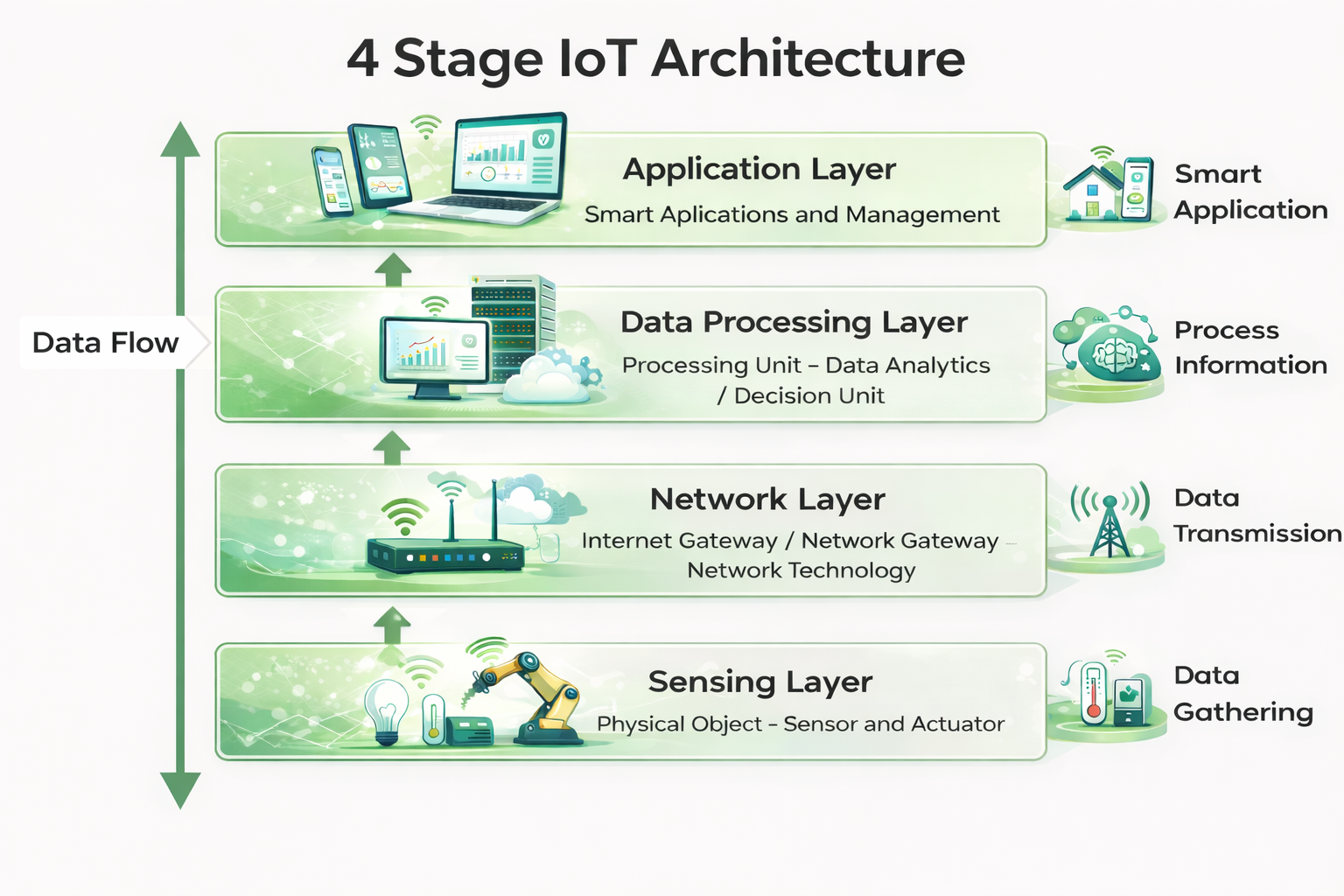
IoT architecture is divided into multiple layers to simplify system design, improve scalability, and manage data flow efficiently across devices and applications. Each layer performs a specific function that contributes to the overall IoT ecosystem. The list of IoT architecture layers given below:
1. Perception Layer
The perception layer is the physical layer responsible for collecting data from the environment using sensors and smart devices.
- Data sensing: Data sensing captures real-world parameters like temperature, pressure, and motion using IoT sensors.
- Signal conversion: Signal conversion transforms physical signals into digital data for further processing in IoT systems.
- Device identification: Device identification ensures each sensor and device is uniquely recognized within the IoT network.
2. Network Layer
The network layer ensures secure and efficient transmission of data collected from the perception layer to processing systems.
- Data transmission: Data transmission enables smooth movement of information between IoT devices and cloud platforms.
- Communication protocols: Communication protocols like Wi-Fi, Zigbee, and 5G ensure standardized and reliable connectivity.
- Network security: Network security protects data during transmission from unauthorized access and cyber threats.
3. Processing Layer (Middleware Layer)
The processing layer handles data storage, analysis, and management using advanced computing systems.
- Data analytics: Data analytics processes large datasets to generate meaningful insights and predictions.
- Cloud storage: Cloud storage securely stores IoT data for scalable access and long-term analysis.
- System management: System management ensures efficient coordination between devices, applications, and databases.
4. Application Layer
The application layer delivers IoT services to end users based on processed and analyzed data.
- Smart home systems: Smart home systems automate lighting, security, and appliances for user convenience.
- Healthcare monitoring: Healthcare monitoring tracks patient health in real time for better medical decision-making.
- Industrial automation: Industrial automation improves production efficiency and reduces manual intervention in industries.
5. Business Layer
The business layer manages overall IoT operations, strategies, and decision-making based on data insights.
- Business analytics: Business analytics uses IoT data to improve operational efficiency and profitability.
- Strategic planning: Strategic planning helps organizations make informed decisions using real-time IoT insights.
- Performance monitoring: Performance monitoring evaluates system efficiency and ensures optimal IoT performance.
IoT Layer Comparison Table
| IoT Layer | Main Function | Key Benefit |
|---|---|---|
| Perception Layer | Collects data from physical environment | Enables real-world data acquisition |
| Network Layer | Transfers data between systems | Ensures reliable communication |
| Processing Layer | Analyzes and stores data | Provides intelligent insights |
| Application Layer | Delivers services to users | Enables practical IoT use cases |
| Business Layer | Manages business decisions | Improves strategy and efficiency |
Types of IoT Architecture
IoT architecture comes in different types depending on system complexity, scalability needs, and application requirements. Each model offers unique benefits for different use cases. The list of IoT architecture types given below:
1. Three-Layer Architecture
The three-layer architecture is the simplest IoT model consisting of perception, network, and application layers.
- Beginner friendly model: Beginner friendly model simplifies IoT structure for students and basic system design understanding.
- Basic communication flow: Basic communication flow ensures simple data movement from devices to applications.
- Limited scalability: Limited scalability makes it suitable for small-scale IoT applications only.
2. Five-Layer Architecture
The five-layer architecture expands the model by adding processing and business layers for advanced functionality.
- Advanced data handling: Advanced data handling supports complex analytics and large-scale IoT systems.
- Improved scalability: Improved scalability allows better performance in enterprise-level applications.
- Structured system design: Structured system design enhances clarity and modular IoT development.
3. Cloud-Based Architecture
Cloud-based IoT architecture uses cloud platforms for data storage, processing, and remote access.
- Remote accessibility: Remote accessibility allows users to control IoT devices from anywhere.
- High scalability: High scalability supports large data volumes and multiple connected devices.
- Cost efficiency: Cost efficiency reduces infrastructure expenses by using cloud resources.
4. Edge-Based Architecture
Edge-based architecture processes data near the source to improve speed and reduce dependency on cloud systems.
- Low latency processing: Low latency processing enables real-time decision-making in critical applications.
- Reduced bandwidth usage: Reduced bandwidth usage minimizes data transfer to cloud systems.
- Real-time performance: Real-time performance is ideal for autonomous systems and smart devices.
Data Flow in IoT Architecture
Data flow in IoT architecture describes how data travels from physical devices to users and back in a continuous cycle. Understanding this flow is essential for building efficient, scalable, and intelligent IoT systems.

It ensures smooth communication, real-time decision-making, and automation across connected devices. Below is a deeper and more structured explanation of each stage:
1. Data Collection (Sensing Layer)
This is the first and most fundamental step in IoT data flow. Sensors and devices collect raw data from the physical environment.
- Sensors measure real-world parameters such as temperature, humidity, pressure, light, motion, and location.
- Devices can include wearables, smart home appliances, industrial machines, and vehicles.
- The data collected is usually unstructured and continuous (streaming data).
- Accuracy and reliability at this stage are critical because poor data quality leads to incorrect insights.
Example: A temperature sensor in a smart home collects room temperature every few seconds.
2. Data Transmission (Network Layer)
Once data is collected, it must be transmitted to other systems for processing.
- Data is sent through communication technologies such as Wi-Fi, Bluetooth, Zigbee, LoRaWAN, or cellular networks (4G/5G).
- Gateways may be used to connect devices to the cloud or central servers.
- Protocols like MQTT, HTTP, and CoAP ensure efficient and lightweight communication.
- Security measures such as encryption and authentication protect data during transmission.
Example: The temperature data is sent via Wi-Fi to a cloud server.
3. Data Processing (Processing Layer)
At this stage, raw data is transformed into meaningful information.
- Data processing can occur in:
- Edge Computing: Processing near the device for low latency
- Fog Computing: Intermediate processing layer
- Cloud Computing: Centralized and powerful processing
- Data is cleaned, filtered, and analyzed using algorithms, AI, and machine learning models.
- Real-time processing enables instant decisions, while batch processing supports long-term analysis.
Example: The system analyzes temperature data to detect if the room is too hot or cold.
4. Data Storage (Optional but Important Layer)
Before or after processing, data is often stored for future use.
- Databases (SQL/NoSQL) store structured and unstructured data.
- Data lakes and cloud storage systems handle large volumes of IoT data.
- Historical data is used for trend analysis, forecasting, and system optimization.
Example: Temperature data is stored to analyze daily or monthly trends.
5. Data Visualization (Application Layer)
Processed data is presented in a human-readable format.
- Dashboards, mobile apps, and web interfaces display insights using graphs, charts, and alerts.
- Visualization helps users monitor system status and performance.
- Custom alerts and notifications inform users about critical conditions.
Example: A mobile app shows the current room temperature and sends alerts if it exceeds a threshold.
6. Decision & Action (Control Layer)
This is where IoT becomes intelligent and interactive.
- Based on analyzed data, the system can:
- Automatically trigger actions (automation)
- Provide recommendations to users
- Actuators perform physical actions like turning on/off devices.
- This creates a feedback loop, making IoT systems self-regulating.
Example: If the temperature is too high, the system automatically turns on the air conditioner.
7. Feedback Loop (Continuous Cycle)
IoT data flow is not linear—it is a continuous cycle.
- Actions taken by the system generate new data.
- This new data is again collected, transmitted, processed, and analyzed.
- Continuous feedback improves system intelligence over time.
Example: After the AC turns on, new temperature readings confirm whether the action was effective.
Summary of IoT Data Flow
The complete IoT data flow can be summarized as:
Data Collection → Transmission → Processing → Storage → Visualization → Decision → Action → Feedback
Advantages of IoT Architecture
IoT architecture offers numerous benefits that improve efficiency, automation, and decision-making in various industries.
Understanding these advantages helps students appreciate the importance of IoT systems. The key advantages are given below:
1. Scalability
IoT systems can easily scale by adding more devices without affecting performance.
This makes them suitable for both small and large applications.
2. Real-Time Monitoring
IoT enables real-time data collection and monitoring, improving system responsiveness.
It is widely used in healthcare, agriculture, and industrial automation.
3. Automation
IoT architecture supports automation by enabling devices to operate without human intervention.
This reduces manual effort and increases efficiency.
4. Improved Decision Making
IoT systems provide data-driven insights that help in making better decisions.
Organizations can optimize operations using real-time analytics.
Challenges in IoT Architecture
Despite its advantages, IoT architecture also faces several challenges that need to be addressed.
Understanding these challenges helps students design more secure and efficient systems. The key challenges are given below:
1. Security Issues
IoT systems are vulnerable to cyberattacks due to the large number of connected devices.
Proper security measures are required to protect sensitive data.
2. Data Privacy
Managing user data securely is a major concern in IoT systems.
Ensuring privacy is essential for user trust and system reliability.
3. Scalability Issues
Handling a large number of devices can be challenging for IoT systems.
Efficient architecture design is needed to manage scalability.
4. Interoperability
Different devices and platforms may not be compatible with each other.
Standard protocols are required to ensure smooth communication.
IoT Architecture Components Overview (Table)
| Component | Description | Examples |
|---|---|---|
| Devices | Collect data using sensors | Smart sensors, wearables |
| Connectivity | Transfers data between devices | Wi-Fi, Bluetooth |
| Processing | Analyzes and processes data | Cloud, Edge computing |
| User Interface | Displays data to users | Mobile apps, dashboards |
Conclusion
IoT architecture is the backbone of modern smart systems, enabling seamless communication between devices, networks, and users. It simplifies complex processes into structured layers, making it easier to design and manage IoT applications.
For beginners, understanding IoT architecture is the first step toward building innovative solutions in fields like smart homes, healthcare, and industrial automation. By mastering its layers, components, and data flow, students can develop efficient and scalable IoT systems.