









Applications of IoT in Daily Life Examples
The Applications of IoT in Daily Life are transforming how people live, work, and interact with technology. From smart homes to healthcare systems, IoT enables automation, real-time monitoring, and intelligent decision-making for improved efficiency and convenience.
What are IoT Applications in Daily Life?
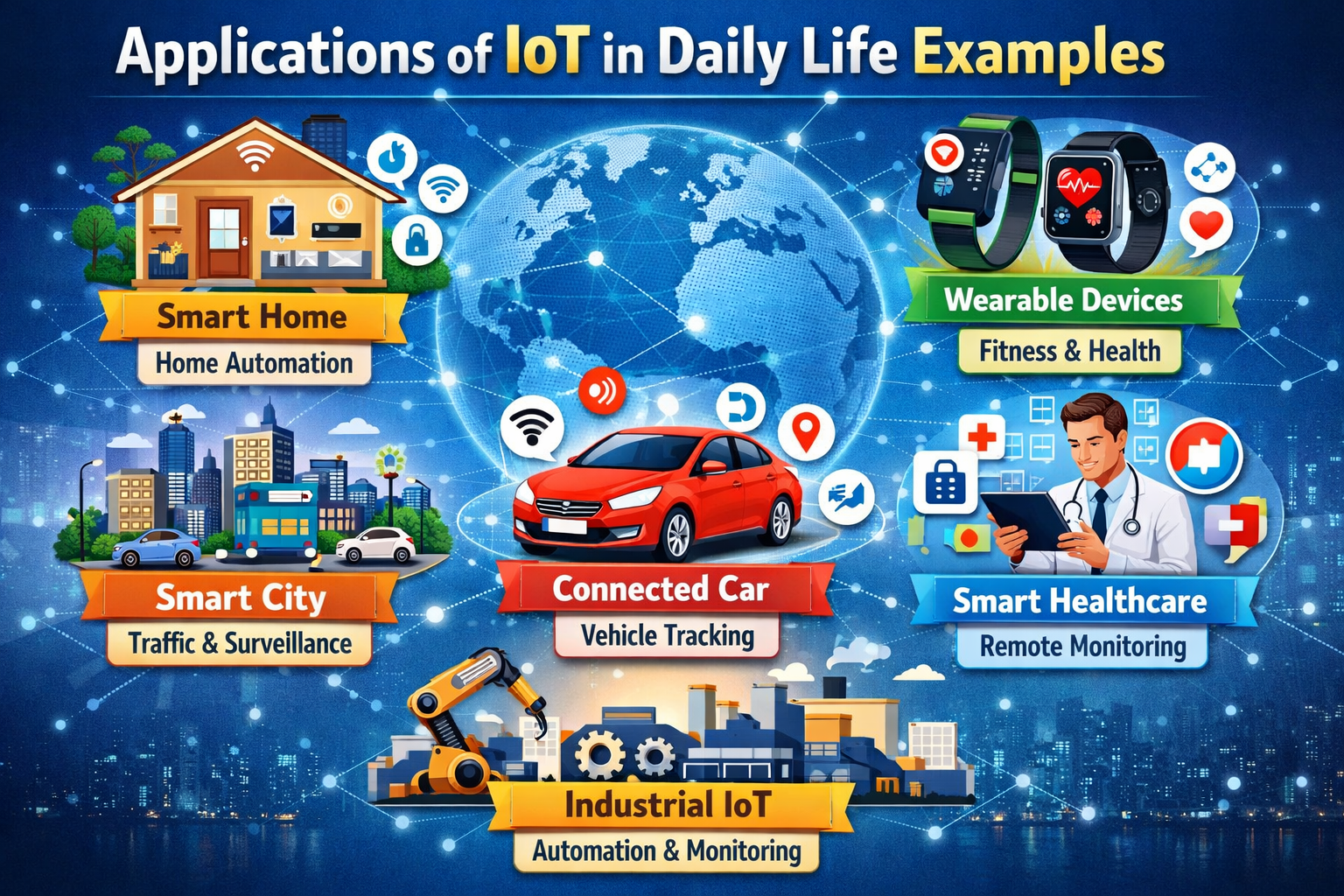
IoT applications in daily life refer to the use of connected devices that collect, share, and analyze data to perform smart actions automatically. These applications help reduce human effort, improve productivity, and enhance the overall quality of life.
Below is the list of key IoT applications used in everyday life.
1. Smart Homes and Home Automation
Smart homes are one of the most common IoT applications where devices are connected to automate household tasks. These systems provide comfort, security, and energy efficiency.
Below is the list of smart home applications.
- Smart Lighting Systems: Lights automatically turn on/off based on presence or schedule, saving electricity
- Smart Thermostats: Adjust temperature automatically for comfort and energy efficiency
- Smart Security Systems: Cameras, motion sensors, and alarms provide real-time home protection
- Smart Appliances: Devices like refrigerators and washing machines operate remotely via mobile apps
2. Healthcare and Smart Monitoring
IoT in healthcare improves patient care by enabling real-time health monitoring and remote medical services. These systems help doctors provide timely treatment.
Below is the list of healthcare applications.
- Wearable Devices: Smartwatches monitor heart rate, steps, and health conditions
- Remote Patient Monitoring: Doctors track patient health data from a distance
- Smart Medical Devices: Devices like insulin pumps and heart monitors work automatically
- Emergency Alerts: Systems notify doctors or hospitals in case of abnormal health conditions
3. Smart Transportation and Traffic Management
IoT enhances transportation systems by improving safety, reducing traffic congestion, and optimizing travel time. It enables smarter and more efficient mobility.
Below is the list of transportation applications.
- Smart Traffic Signals: Adjust signal timing based on traffic conditions
- Connected Vehicles: Vehicles share data for better navigation and safety
- Parking Management Systems: Help drivers find available parking spaces easily
- Public Transport Tracking: Real-time tracking of buses and trains
4. IoT in Smart Cities
Smart cities use IoT technologies to manage infrastructure and public services efficiently. These systems improve urban living standards and sustainability.
Below is the list of smart city applications.
- Smart Waste Management: Sensors monitor waste levels and optimize collection routes
- Smart Street Lighting: Lights adjust brightness based on movement or time
- Water Management Systems: Monitor water usage and detect leaks
- Air Quality Monitoring: Sensors track pollution levels in real time
5. IoT in Agriculture (Smart Farming)
IoT helps farmers increase productivity and reduce resource wastage through smart farming techniques. These applications support sustainable agriculture.
Below is the list of agriculture applications.
- Soil Moisture Sensors: Monitor soil conditions to optimize irrigation
- Smart Irrigation Systems: Automatically water crops based on data
- Crop Monitoring: Drones and sensors track crop health
- Livestock Tracking: Monitor animal health and location
6. IoT in Retail and Shopping
IoT improves customer experience and business operations in retail by providing personalized services and efficient inventory management.
Below is the list of retail applications.
- Smart Shelves: Automatically track product availability
- Personalized Recommendations: Suggest products based on customer behavior
- Automated Checkout Systems: Reduce waiting time in stores
- Inventory Management: Real-time tracking of stock levels
7. IoT in Industrial Automation (IIoT)
Industrial IoT (IIoT) improves manufacturing processes by enabling automation and predictive maintenance. It enhances productivity and reduces operational costs.
Below is the list of industrial applications.
- Predictive Maintenance: Detect equipment issues before failure
- Smart Manufacturing: Automated production lines improve efficiency
- Quality Control Systems: Detect defects using sensors and AI
- Energy Monitoring: Track and optimize energy consumption
8. IoT in Education and Smart Learning
IoT is transforming education by making learning more interactive, personalized, and efficient. It enhances both teaching and student engagement.
Below is the list of education applications.
- Smart Classrooms: Use digital boards and connected devices for learning
- Attendance Tracking Systems: Automatically record student attendance
- Remote Learning Tools: Enable online education with real-time interaction
- Student Performance Monitoring: Track progress and provide insights
9. IoT in Energy Management
IoT helps in efficient energy usage by monitoring and controlling energy consumption in homes and industries. It supports sustainability and cost savings.
Below is the list of energy management applications.
- Smart Grids: Distribute electricity efficiently based on demand
- Energy Consumption Monitoring: Track real-time energy usage
- Smart Meters: Provide accurate billing and usage data
- Renewable Energy Integration: Manage solar and wind energy systems
10. IoT in Daily Personal Use
IoT devices are also widely used in personal daily activities, making life more convenient and connected. These applications simplify everyday tasks.
Below is the list of personal IoT applications.
- Smart Watches and Fitness Bands: Track health and fitness activities
- Smart Assistants: Voice-controlled devices perform tasks like reminders and searches
- Connected Cars: Provide navigation, entertainment, and safety features
- Smart Entertainment Systems: Stream content based on user preferences
Comparison Table of IoT Applications in Daily Life
This table provides a quick comparison of different IoT applications based on their purpose, benefits, and usage areas.
| Application Area | Main Purpose | Key Benefit | Example Use Case |
|---|---|---|---|
| Smart Homes | Home automation | Comfort & energy saving | Automated lighting and security |
| Healthcare | Health monitoring | Improved patient care | Wearable health devices |
| Transportation | Traffic management | Reduced congestion | Smart traffic signals |
| Smart Cities | Infrastructure management | Better urban living | Waste and water management |
| Agriculture | Smart farming | Increased productivity | Automated irrigation |
| Retail | Customer experience | Efficient shopping | Smart shelves and checkout |
| Industrial IoT | Process automation | Higher efficiency | Predictive maintenance |
| Education | Smart learning | Enhanced engagement | Smart classrooms |
| Energy Management | Energy optimization | Cost savings | Smart meters and grids |
| Personal Use | Daily convenience | Improved lifestyle | Smartwatches and assistants |
Benefits of IoT Applications in Daily Life
IoT applications provide numerous benefits that improve efficiency, safety, and convenience in everyday activities. These advantages make IoT an essential part of modern life.
Below is the list of key benefits of IoT applications.
1. Improved Efficiency and Automation
IoT automates repetitive tasks and improves operational efficiency in various systems. It reduces manual work and increases productivity.
- Automatic Operations: Devices perform tasks without human intervention
- Time Saving: Faster execution of daily activities
- Better Resource Utilization: Efficient use of energy and materials
2. Enhanced Safety and Security
IoT systems improve safety by monitoring environments and providing real-time alerts. This helps prevent accidents and security threats.
- Real-Time Alerts: Notify users about risks instantly
- Surveillance Systems: Monitor activities continuously
- Emergency Response: Quick action during critical situations
3. Better Decision Making
IoT provides accurate data and insights that help users make informed decisions. It supports intelligent and data-driven actions.
- Real-Time Data Analysis: Quick understanding of situations
- Predictive Insights: Forecast future trends
- Improved Planning: Better strategies based on data
4. Cost Savings
IoT reduces costs by optimizing resource usage and preventing losses. It helps businesses and individuals save money.
- Reduced Energy Consumption: Lower electricity bills
- Maintenance Cost Reduction: Early issue detection
- Efficient Operations: Minimize waste and improve output
5. Improved Quality of Life
IoT enhances daily living by providing comfort, convenience, and better services. It makes life easier and more connected.
- Convenience: Control devices remotely
- Personalization: Customized experiences
- Better Living Standards: Improved healthcare, safety, and services
Challenges of IoT Applications in Daily Life
Despite its advantages, IoT also faces several challenges that need to be addressed for better implementation and security.
Below is the list of common challenges of IoT.
1. Security and Privacy Issues
IoT devices collect sensitive data, which can be vulnerable to cyberattacks if not properly secured.
- Data Breaches: Unauthorized access to personal information
- Weak Security Systems: Lack of proper encryption
- Privacy Concerns: Misuse of user data
2. High Implementation Cost
Setting up IoT systems can require significant investment in devices, infrastructure, and maintenance.
- Initial Setup Cost: Expensive hardware and software
- Maintenance Expenses: Regular updates and monitoring
- Infrastructure Requirements: Need for strong network systems
3. Complexity and Integration Issues
IoT systems can be complex due to the involvement of multiple devices and technologies.
- Device Compatibility: Different devices may not work together
- System Integration: Difficult to connect various platforms
- Technical Knowledge Required: Skilled professionals needed
4. Data Management Challenges
IoT generates large amounts of data, which can be difficult to manage and analyze effectively.
- Big Data Handling: Large data storage requirements
- Data Processing: Need for powerful systems
- Data Accuracy: Ensuring reliable and correct data
Conclusion
The applications of IoT in daily life are rapidly expanding and transforming the way people interact with technology. From smart homes and healthcare to transportation and education, IoT plays a crucial role in improving efficiency, safety, and convenience. Despite some challenges, the future of IoT is promising, offering smarter and more connected living experiences for everyone.