






IoT Platforms, Tools, and Technologies
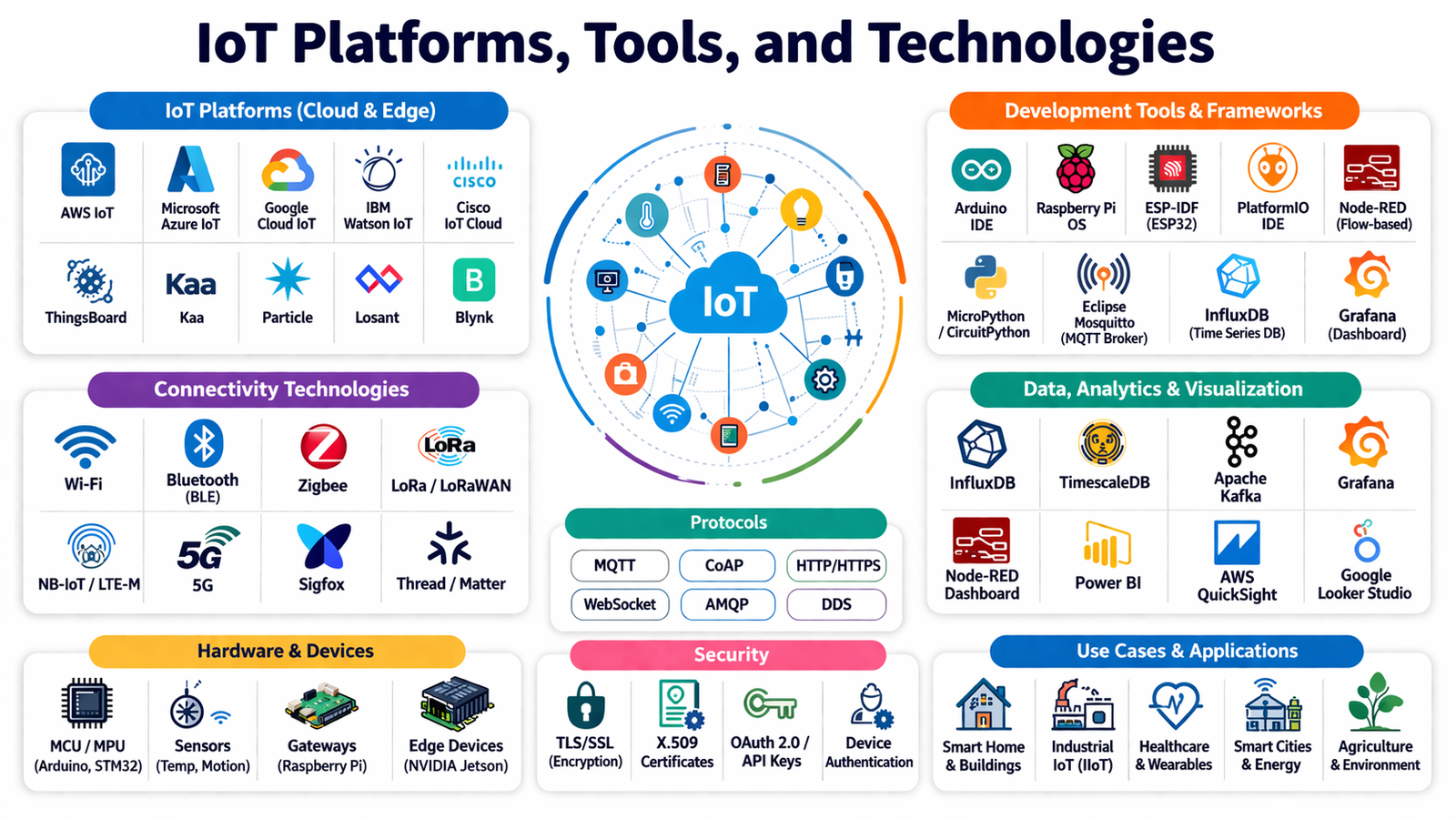
The Internet of Things (IoT) ecosystem relies on powerful platforms, tools, and technologies to connect devices, manage data, and enable smart automation. These components help build scalable, efficient, and secure IoT systems for real-world applications.
What Are IoT Platforms, Tools, and Technologies?
IoT platforms, tools, and technologies are essential elements that support the development and operation of IoT systems. They provide the infrastructure for communication, data processing, device control, and intelligent decision-making.
IoT Platforms
IoT platforms provide a complete environment to connect, manage, and monitor IoT devices while handling data processing, communication, and analytics. These platforms act as the backbone of IoT systems by enabling seamless interaction between devices and cloud services.
1. Device Management Platforms
These platforms manage IoT devices throughout their lifecycle, from initial setup to continuous monitoring and maintenance. They ensure devices remain secure, updated, and fully operational.
- Device Registration: Easily add and configure devices with unique identities, enabling secure onboarding and proper system integration.
- Remote Monitoring: Track device health, performance, and status in real time to detect issues and ensure smooth operation.
- Firmware Updates: Update devices remotely to fix bugs, improve performance, and enhance security without physical access.
2. Connectivity Platforms
Connectivity platforms enable reliable communication between IoT devices and cloud systems using various protocols and network technologies.
- Protocol Support: MQTT, HTTP, and CoAP ensure efficient communication depending on device capability and network conditions.
- Network Integration: Supports Wi-Fi, Bluetooth, cellular networks, and LPWAN for flexible connectivity across different environments.
- Reliable Transmission: Ensures secure and consistent data transfer with minimal data loss and optimized performance.
3. Application Enablement Platforms
These platforms provide development environments and tools that help developers create, deploy, and manage IoT applications efficiently.
- APIs and SDKs: Simplify application development by providing ready-to-use interfaces and libraries.
- Integration Support: Allows seamless integration with third-party services, databases, and enterprise systems.
- Rapid Deployment: Speeds up development cycles by enabling quick testing and deployment of IoT applications.
4. Data Analytics Platforms
Data analytics platforms process IoT data to generate valuable insights, enabling intelligent decision-making and automation.
- Real-Time Processing: Analyze data instantly as it is generated, allowing immediate response to events.
- Visualization Tools: Provide dashboards and reports that make complex data easy to understand and interpret.
- Predictive Analytics: Use historical data and algorithms to forecast trends and predict future outcomes.
IoT Tools
IoT tools are used to design, develop, test, and maintain IoT systems effectively. They support both software and hardware aspects of IoT development.
1. Development Tools
These tools help developers build, test, and deploy IoT applications efficiently while reducing development complexity.
- IDEs: Provide environments for writing, testing, and debugging code with enhanced productivity features.
- Simulation Tools: Allow testing of IoT systems in virtual environments before real-world deployment.
- Frameworks: Offer reusable components and libraries to simplify coding and accelerate development.
2. Hardware Tools
Hardware tools are physical components that form the foundation of IoT systems, enabling sensing, processing, and action.
- Microcontrollers: Arduino and Raspberry Pi act as the brain of IoT devices, controlling operations and processing data.
- Sensors: Collect real-world data such as temperature, motion, light, and humidity from the environment.
- Actuators: Perform actions like turning on devices, moving components, or controlling systems based on processed data.
3. Testing and Debugging Tools
These tools ensure that IoT systems function correctly and efficiently before and after deployment.
- Device Testing: Verify that devices operate correctly under different conditions and workloads.
- Network Testing: Evaluate communication performance, latency, and data transfer reliability.
- Error Detection: Identify bugs and system issues to improve overall system stability and performance.
4. Security Tools
Security tools protect IoT systems from cyber threats and ensure safe communication between devices and platforms.
- Encryption Tools: Secure data during transmission and storage to prevent unauthorized access.
- Authentication Systems: Verify the identity of users and devices to maintain system integrity.
- Monitoring Tools: Continuously observe system activity to detect and respond to suspicious behavior.
IoT Technologies
IoT technologies provide the core technical foundation that enables communication, processing, and intelligent automation in IoT systems.
1. Communication Technologies
These technologies allow devices to exchange data efficiently across different environments and distances.
- Wi-Fi: Provides high-speed connectivity for devices within local networks.
- Bluetooth: Enables short-range communication with low power consumption.
- Cellular (4G/5G): Supports wide-area connectivity and real-time data transmission over long distances.
- LPWAN: Offers low-power, long-range communication for devices that send small amounts of data over extended periods.
2. Cloud Computing in IoT
Cloud computing provides the infrastructure required for storing, processing, and managing IoT data at scale.
- Data Storage: Store large volumes of structured and unstructured IoT data securely.
- Scalability: Handle increasing numbers of devices and data without performance issues.
- Remote Access: Enable users to access IoT systems and data from anywhere in the world.
3. Edge and Fog Computing
These technologies improve system performance by processing data closer to the source instead of relying entirely on the cloud.
- Edge Computing: Processes data at the device level, reducing latency and enabling faster responses.
- Fog Computing: Acts as an intermediate layer between devices and the cloud, distributing processing tasks efficiently.
- Low Latency: Ensures quick decision-making, which is critical for real-time applications like automation and monitoring.
4. Artificial Intelligence and Machine Learning
AI and ML enhance IoT systems by enabling smart decision-making and automation based on data analysis.
- Pattern Recognition: Identify trends and patterns in IoT data to improve system intelligence.
- Predictive Maintenance: Detect potential failures before they occur, reducing downtime and maintenance costs.
- Automation: Enable systems to perform actions automatically without human intervention.
5. Big Data Technologies
Big data technologies handle and analyze massive volumes of IoT data to extract meaningful insights.
- Data Frameworks: Process large-scale data streams efficiently using distributed systems.
- Storage Systems: Manage both structured and unstructured data across multiple storage solutions.
- Analytics Engines: Analyze data to generate insights that support decision-making and optimization.
Popular IoT Platforms and Tools
Various IoT platforms and tools provide the foundation for building, managing, and scaling connected systems. These platforms simplify device connectivity, data processing, and application development, making IoT solutions more efficient and reliable.
1. Cloud-Based IoT Platforms
Cloud-based IoT platforms offer scalable infrastructure, powerful analytics, and centralized device management, making them ideal for enterprise and large-scale IoT deployments.
- AWS IoT Core: Enables secure device connectivity and communication between devices and the cloud. It supports large-scale deployments and integrates with services like data storage, analytics, and serverless computing to build intelligent IoT applications.
- Microsoft Azure IoT Hub: Provides a complete environment for managing IoT devices with bidirectional communication. It integrates with AI, analytics, and security tools, making it suitable for enterprise applications such as smart industries and healthcare systems.
- Google Cloud IoT: Focuses on real-time data processing and advanced analytics. It integrates with big data and machine learning services to generate insights from IoT data, making it ideal for data-driven applications like smart cities.
2. Open-Source IoT Platforms
Open-source IoT platforms provide flexibility, customization, and cost-effective solutions, making them suitable for developers and small-scale projects.
- ThingsBoard: Offers device management, data collection, and visualization through customizable dashboards. It supports multiple communication protocols and enables real-time monitoring and rule-based automation.
- Kaa IoT Platform: Provides a modular and flexible architecture that allows developers to build custom IoT solutions. It supports device management, data processing, and integration with external systems.
- OpenHAB: Designed for smart home automation, allowing users to connect and control various devices through a unified interface. It supports a wide range of devices and communication protocols.
3. Development Frameworks
Development frameworks simplify the design, coding, and deployment of IoT applications.
- Node-RED: A flow-based development tool that uses a visual interface to connect devices, APIs, and services. It simplifies application logic and is widely used for rapid prototyping and integration.
- Arduino IDE: A beginner-friendly platform for programming microcontrollers. It is widely used for building IoT prototypes and embedded systems with strong community support and libraries.
- PlatformIO: An advanced development ecosystem that supports multiple hardware platforms. It provides tools for debugging, testing, and library management, making it suitable for professional IoT development.
Benefits of IoT Platforms, Tools, and Technologies
IoT platforms, tools, and technologies improve efficiency, scalability, and intelligence in IoT systems.
- Simplified Development: Pre-built services, APIs, and tools reduce complexity and allow developers to focus on building applications instead of managing infrastructure.
- Scalability: IoT platforms support millions of connected devices and can scale resources dynamically based on system demand without performance issues.
- Real-Time Insights: Continuous data processing enables instant decision-making, which is essential for applications like healthcare monitoring and industrial automation.
- Enhanced Security: Built-in features such as encryption, authentication, and access control help protect devices, data, and networks from cyber threats.
- Cost Efficiency: Pay-as-you-go models reduce upfront investment and allow organizations to optimize costs by paying only for the resources they use.
Challenges in IoT Platforms and Technologies
IoT systems face several challenges due to their complexity, scale, and diverse technologies.
- Integration Issues: Connecting different devices, platforms, and systems can be complex due to differences in technologies and communication protocols.
- Security Risks: IoT devices are often vulnerable to attacks, and ensuring end-to-end security across devices, networks, and cloud systems is challenging.
- Data Management: IoT systems generate massive volumes of data, requiring efficient storage, processing, and analysis strategies.
- Compatibility Problems: Lack of standardization leads to interoperability issues, making it difficult for different devices and platforms to work together.
- High Setup Costs: Initial investment in hardware, infrastructure, and platform setup can be high. Organizations must carefully plan and optimize resources to manage these costs effectively.
Conclusion
IoT platforms, tools, and technologies are essential for building smart and connected systems. They enable seamless communication, efficient data processing, and intelligent automation. By selecting the right platforms and tools, organizations can develop scalable, secure, and high-performance IoT solutions for real-world applications.
IoT Platforms, Tools, and Technologies – Subtopics
Explore IoT Platforms, Tools, and Technologies to understand the essential systems used for building, managing, and scaling IoT applications. Learn how cloud platforms, development tools, and communication technologies enable efficient device connectivity and data processing.
- IoT Platforms Explained for Beginners
- Top IoT Platforms List and Comparison
- Best IoT Development Tools for Beginners
- Popular IoT Technologies and Frameworks Explained
- Cloud Platforms for IoT (AWS IoT, Azure IoT, Google Cloud IoT)
- Open Source IoT Platforms and Tools
- IoT Hardware Platforms (Arduino, Raspberry Pi, ESP32)
- IoT Software Development Tools and IDEs
- IoT Device Management Platforms Explained
- IoT Data Management and Analytics Tools
- Edge Computing Platforms for IoT Systems
- IoT Connectivity Technologies (WiFi, Bluetooth, Zigbee)
- Mobile and Web Tools for IoT Development
- IoT Simulation and Testing Tools Explained
- IoT Integration Tools and Middleware Platforms
- Security Tools for IoT Systems Explained
- Real World IoT Platforms Use Cases and Examples
- IoT Dashboard and Visualization Tools
- Challenges in Choosing IoT Platforms and Tools
- Future Trends in IoT Technologies and Platforms