










IoT in the Era of Artificial Intelligence and Automation
The integration of Internet of Things (IoT) with Artificial Intelligence (AI) and automation is transforming modern technology into intelligent, self-operating systems. This powerful combination enables smart decision-making, predictive analysis, and real-time automation across industries.
Introduction to IoT, AI, and Automation
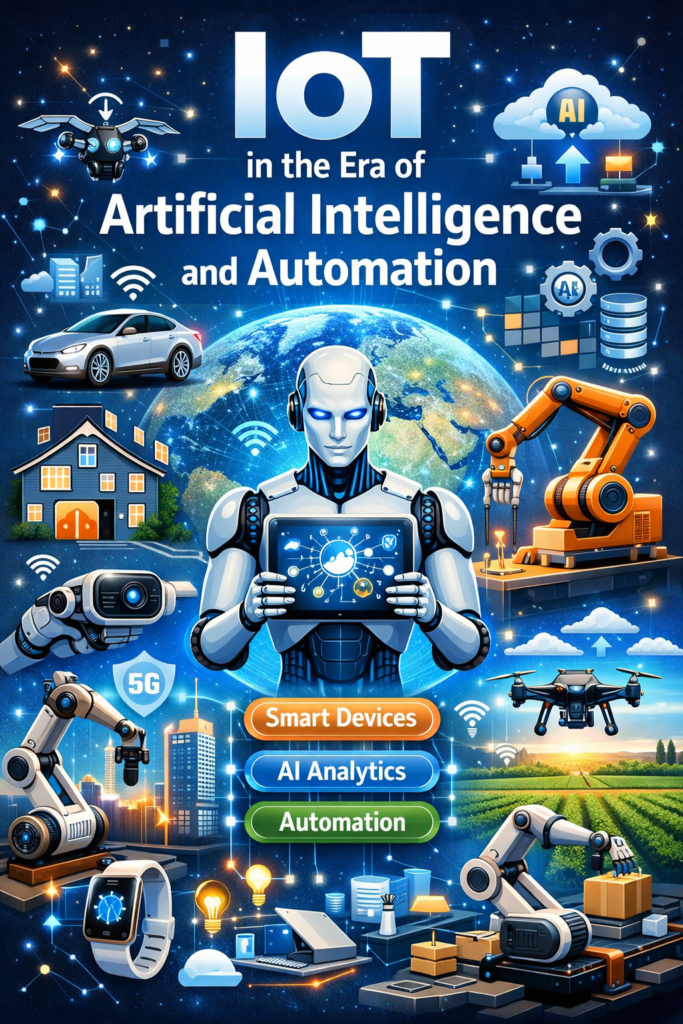
IoT connects physical devices to the internet, while AI adds intelligence and automation enables self-execution of tasks. Together, they create smart ecosystems capable of learning and acting independently. The list of core concepts of IoT, AI, and automation integration is given below.
1. IoT (Internet of Things)
IoT refers to a network of connected devices that collect and exchange data through the internet. These devices include sensors, smart appliances, and industrial machines.
- Data Collection: Devices gather real-time data from the environment
- Connectivity: Data is transmitted via networks like Wi-Fi or cellular
- Device Interaction: Enables communication between machines
- Real-Time Monitoring: Continuous tracking of systems and environments
2. Artificial Intelligence (AI)
AI enables machines to analyze data, learn from patterns, and make decisions without human intervention. It adds intelligence to IoT systems.
- Machine Learning: Systems learn from data and improve over time
- Data Analysis: Processes large volumes of IoT-generated data
- Decision Making: AI algorithms make smart decisions
- Pattern Recognition: Identifies trends and anomalies
3. Automation
Automation allows systems to perform tasks automatically based on predefined rules or AI insights. It reduces manual effort and increases efficiency.
- Task Execution: Automatically performs actions
- Process Optimization: Improves efficiency and speed
- Reduced Human Intervention: Minimizes manual work
- Consistency: Ensures reliable and repeatable operations
How IoT, AI, and Automation Work Together
The combination of IoT, AI, and automation creates intelligent systems that can sense, think, and act. This integration enhances system performance and efficiency. The working process of IoT with AI and automation is explained below.
1. Data Collection through IoT Devices
IoT devices such as sensors collect data from the physical environment like temperature, motion, and humidity.
- Sensors Capture Data: Real-world information is gathered
- Continuous Monitoring: Devices operate 24/7
- Data Transmission: Information is sent to cloud or edge systems
2. Data Processing using AI
AI processes and analyzes the collected data to generate insights and predictions.
- Big Data Analysis: Handles large-scale data efficiently
- Predictive Analytics: Forecasts future events
- Real-Time Processing: Quick decision-making
3. Automated Decision and Action
Based on AI insights, automation systems perform actions without human involvement.
- Trigger-Based Actions: Events initiate automated responses
- Self-Operating Systems: Systems act independently
- Feedback Loop: Continuous improvement through learning
Key Features of AI-Driven IoT Systems
AI-powered IoT systems provide advanced features that improve performance, intelligence, and automation. These features make systems smarter and more efficient. The list of key features is given below.
1. Smart Decision Making
AI enables IoT systems to make intelligent decisions based on real-time data.
- Data-Driven Decisions: Based on analyzed data
- Faster Response: Immediate action without delay
- Improved Accuracy: Reduces human error
2. Predictive Maintenance
AI predicts equipment failures before they occur, reducing downtime and maintenance costs.
- Early Detection: Identifies issues in advance
- Cost Savings: Reduces repair expenses
- Increased Lifespan: Extends device life
3. Real-Time Automation
Systems automatically respond to changes in the environment.
- Instant Actions: Immediate response to events
- Efficiency Improvement: Faster operations
- Reduced Delays: Eliminates manual processing time
4. Enhanced Data Analytics
AI improves data analysis capabilities in IoT systems.
- Deep Insights: Extracts meaningful information
- Trend Analysis: Identifies patterns
- Decision Support: Helps in strategic planning
Applications of IoT with AI and Automation
The integration of IoT, AI, and automation is widely used across industries to improve efficiency and innovation. These applications demonstrate real-world use cases of smart systems. The list of applications is given below.
1. Smart Homes
IoT and AI enable automation of home appliances for comfort and energy efficiency.
- Smart Thermostats: Adjust temperature automatically
- Voice Assistants: Control devices through voice
- Security Systems: Monitor and alert users
2. Healthcare Systems
AI-powered IoT improves patient monitoring and medical diagnosis.
- Remote Monitoring: Tracks patient health in real-time
- Wearable Devices: Collect health data continuously
- AI Diagnosis: Assists doctors in decision-making
3. Industrial Automation (IIoT)
Industries use IoT and AI to automate production and improve efficiency.
- Smart Manufacturing: Automated production lines
- Quality Control: AI detects defects
- Supply Chain Optimization: Improves logistics
4. Smart Cities
IoT and AI help manage urban infrastructure efficiently.
- Traffic Management: Reduces congestion
- Smart Lighting: Energy-efficient streetlights
- Waste Management: Automated garbage collection
5. Agriculture (Smart Farming)
IoT and AI improve farming productivity and resource management.
- Soil Monitoring: Tracks moisture and nutrients
- Automated Irrigation: Efficient water usage
- Crop Prediction: AI forecasts yield
Benefits of IoT with AI and Automation
The combination of IoT, AI, and automation provides significant benefits across various sectors. These advantages improve productivity, efficiency, and innovation. The list of benefits is given below.
1. Improved Efficiency
Automation reduces manual work and speeds up processes.
- Faster Operations: Quick task execution
- Reduced Errors: Minimizes human mistakes
- Better Resource Utilization: Efficient use of resources
2. Cost Reduction
Organizations save money through optimized operations and reduced downtime.
- Lower Maintenance Costs: Predictive maintenance
- Reduced Labor Costs: Automation replaces manual tasks
- Energy Savings: Efficient systems
3. Enhanced Accuracy
AI improves decision-making accuracy using data analysis.
- Precise Results: Data-driven outcomes
- Consistent Performance: Reliable operations
- Reduced Risks: Better predictions
4. Scalability and Flexibility
Systems can easily scale based on demand.
- Dynamic Scaling: Adjust resources automatically
- Flexible Deployment: Works across environments
- Adaptability: Responds to changing conditions
Challenges of AI-Driven IoT Systems
Despite many benefits, integrating IoT with AI and automation also presents challenges. Understanding these challenges helps in better system design. The list of challenges is given below.
1. Data Security and Privacy
Large volumes of data increase the risk of cyber threats.
- Data Breaches: Sensitive information exposure
- Unauthorized Access: Security vulnerabilities
- Privacy Concerns: User data protection
2. High Implementation Cost
Initial setup of AI and IoT systems can be expensive.
- Hardware Costs: Sensors and devices
- Software Development: AI model creation
- Infrastructure Investment: Cloud and networks
3. Complexity of Integration
Combining IoT, AI, and automation requires advanced technical expertise.
- System Compatibility: Integration issues
- Data Management: Handling large datasets
- Technical Skills: Need for experts
4. Dependence on Internet Connectivity
IoT systems rely heavily on network availability.
- Network Failure: System disruption
- Latency Issues: Delayed responses
- Limited Access: Remote areas challenges
Comparison Table: Traditional IoT vs AI-Driven IoT
This table highlights the key differences between traditional IoT systems and AI-powered IoT systems for better understanding.
| Feature | Traditional IoT | AI-Driven IoT |
|---|---|---|
| Decision Making | Rule-Based | Intelligent & Learning-Based |
| Data Processing | Limited | Advanced & Real-Time |
| Automation Level | Basic | Fully Automated |
| Predictive Capability | Low | High |
| Efficiency | Moderate | High |
| Human Involvement | Required | Minimal |
Future Trends of IoT with AI and Automation
The future of IoT combined with AI and automation is promising, with continuous innovation and advancements. These trends will shape the next generation of smart technologies. The list of future trends is given below.
1. Edge AI Integration
AI processing will move closer to devices for faster decision-making.
- Reduced Latency: Faster processing
- Real-Time Insights: Immediate actions
- Bandwidth Efficiency: Less cloud dependency
2. Autonomous Systems
Fully automated systems will operate without human control.
- Self-Driving Vehicles: Intelligent transportation
- Smart Robots: Automated tasks
- Independent Operations: Minimal human input
3. AI-Powered Cybersecurity
AI will enhance security in IoT systems.
- Threat Detection: Identifies attacks
- Real-Time Protection: Immediate response
- Adaptive Security: Learns new threats
4. Digital Twins Technology
Virtual models of physical systems will improve monitoring and optimization.
- Simulation: Test systems virtually
- Performance Optimization: Improve efficiency
- Predictive Analysis: Forecast issues
Conclusion
IoT in the era of Artificial Intelligence and automation represents the next stage of technological evolution, where systems become smarter, faster, and more efficient. By combining connectivity, intelligence, and automation, industries can achieve higher productivity, better decision-making, and innovative solutions for real-world challenges.