












Hybrid Cloud Use Cases
Hybrid cloud is widely used in real-world scenarios where organizations need a balance between security, flexibility, and scalability. By combining private and public cloud, it allows businesses to optimize performance while protecting sensitive data.
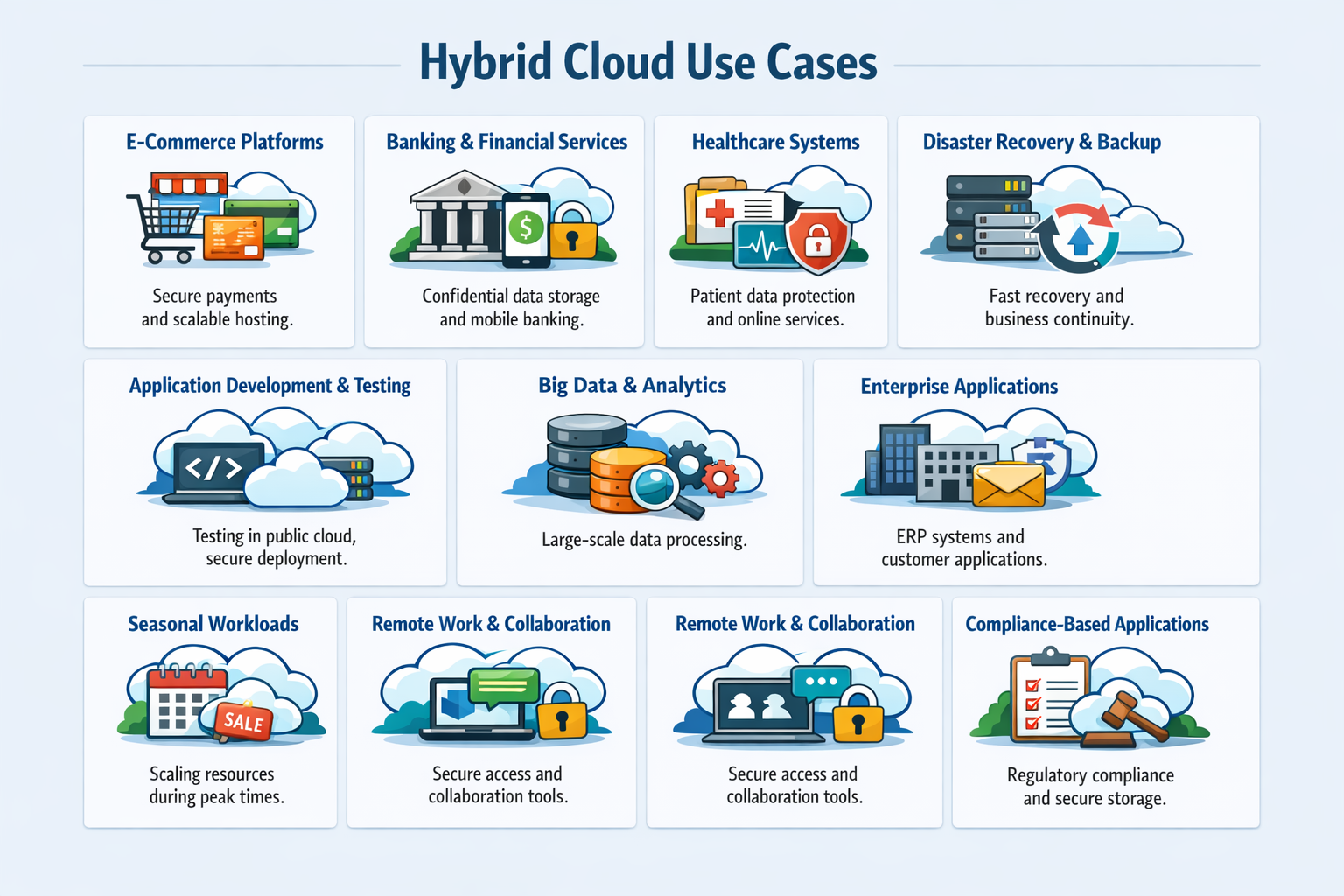
Let us explore the major hybrid cloud use cases in detail.
1. E-commerce Platforms
Hybrid cloud is widely used in e-commerce to balance security, scalability, and performance for online shopping systems.
Use Case Details
These points explain how hybrid cloud supports e-commerce operations.
- Secure Payment Processing: Sensitive customer and payment data is stored in a private cloud for maximum security.
- Scalable Website Hosting: Public cloud handles high traffic during peak times like sales and promotions.
- Performance Optimization: Ensures fast loading and smooth user experience even under heavy demand.
Example
An online store keeps payment data in a private cloud while using the public cloud to handle large traffic during festive sales.
2. Banking and Financial Services
Hybrid cloud helps financial institutions maintain strict security while delivering efficient digital services.
Use Case Details
These points highlight how hybrid cloud supports banking systems.
- Confidential Data Storage: Financial records and transactions are securely stored in a private cloud.
- Customer-Facing Applications: Public cloud is used for mobile banking apps and online services.
- Compliance Support: Helps meet regulatory requirements and industry standards.
Example
A bank stores sensitive customer data in a private cloud while running its mobile banking applications on a public cloud.
3. Healthcare Systems
Healthcare organizations use hybrid cloud to protect patient data while enabling accessible healthcare services.
Use Case Details
These points show how hybrid cloud supports healthcare operations.
- Patient Data Protection: Medical records are securely stored in a private cloud.
- Application Hosting: Public cloud supports patient portals and healthcare applications.
- Secure Data Sharing: Enables safe exchange of data between systems and departments.
Example
Hospitals store patient records privately while using public cloud systems for appointment booking and online services.
4. Disaster Recovery and Backup
Hybrid cloud is highly effective for ensuring data protection and business continuity.
Use Case Details
These points explain how hybrid cloud supports backup and recovery.
- Backup Storage: Public cloud stores backup copies of critical data.
- Fast Recovery: Systems can be restored quickly in case of failure or disaster.
- Business Continuity: Minimizes downtime and ensures uninterrupted operations.
Example
A company backs up its private cloud data to the public cloud, allowing quick recovery after system failure.
5. Application Development and Testing
Hybrid cloud provides an ideal environment for developing, testing, and deploying applications efficiently.
Use Case Details
These points highlight how hybrid cloud supports development workflows.
- Testing in Public Cloud: Developers test applications without affecting live systems.
- Secure Deployment: Final applications are deployed in a private cloud for security.
- Cost Efficiency: Reduces infrastructure costs by using public cloud resources for testing.
Example
Developers build and test applications in the public cloud and then deploy them securely in the private cloud environment.
6. Big Data and Analytics
Hybrid cloud is used to process large volumes of data efficiently while maintaining data security.
Use Case Details
These points explain how hybrid cloud supports data analytics.
- Secure Data Storage: Sensitive and raw data is stored in a private cloud for protection.
- High Processing Power: Public cloud handles heavy analytics and computation workloads.
- Scalable Computing: Easily processes large datasets using on-demand resources.
Example
A company stores raw customer data in a private cloud and uses the public cloud to perform analytics and generate insights.
7. Enterprise Applications
Hybrid cloud enables organizations to run both internal and external applications efficiently.
Use Case Details
These points highlight hybrid cloud usage in enterprise systems.
- Internal Systems: ERP, HR, and internal tools run in a private cloud for security.
- Customer Applications: Public cloud hosts external apps and services.
- Integrated Workflow: Both environments work together seamlessly for operations.
Example
A company runs its internal HR system in a private cloud while hosting customer-facing applications on a public cloud.
8. Seasonal Workloads
Hybrid cloud is ideal for handling temporary spikes in demand without over-investing in infrastructure.
Use Case Details
These points explain how hybrid cloud manages peak workloads.
- Peak Demand Handling: Public cloud resources are used during high traffic periods.
- Cost Savings: Avoids permanent expansion of private infrastructure.
- Efficient Scaling: Resources are added or removed based on demand.
Example
Retail companies use public cloud during holiday sales to handle increased website traffic.
9. Remote Work and Collaboration
Hybrid cloud supports secure remote access and modern collaboration tools.
Use Case Details
These points show how hybrid cloud enables remote work.
- Secure Internal Access: Employees access private systems safely from remote locations.
- Public Cloud Tools: Collaboration platforms run on public cloud for accessibility.
- Flexible Work Environment: Supports distributed teams and remote operations.
Example
Employees use public cloud tools for communication while securely accessing company data stored in a private cloud.
10. Compliance-Based Applications
Hybrid cloud is widely used in industries that require strict regulatory compliance and data protection.
Use Case Details
These points highlight compliance-focused usage.
- Sensitive Data Storage: Critical data is stored in private cloud to meet regulations.
- Public Services: Non-sensitive applications run on public cloud.
- Audit Support: Helps maintain compliance with legal and industry standards.
Example
A financial company stores regulated data in a private cloud while running customer-facing services on a public cloud.
Top 5 FAQs (Interview & Exam Focused)
1. What are hybrid cloud use cases?
Hybrid cloud use cases include e-commerce, banking, healthcare, and data analytics.
It is used where both security and scalability are required.
2. Why is hybrid cloud used in e-commerce?
Because it allows secure handling of payment data and scalable website hosting.
It ensures smooth performance during high traffic periods.
3. Is hybrid cloud useful for disaster recovery?
Yes, it provides backup and recovery by storing data across environments.
This ensures business continuity during failures.
4. Can hybrid cloud be used for development?
Yes, developers use public cloud for testing and private cloud for deployment.
This improves efficiency and reduces cost.
5. Which industries use hybrid cloud?
Industries like healthcare, finance, retail, and IT use hybrid cloud.
It helps them balance security, performance, and flexibility.
Conclusion
Hybrid cloud is widely used in real-world applications where flexibility and security are both important.
- Supports scalable and secure systems
- Optimizes performance and cost
- Used across multiple industries
Understanding these use cases helps in applying hybrid cloud concepts effectively in practical scenarios.