












Benefits of Hybrid Cloud Computing
Hybrid cloud computing combines the strengths of public cloud and private cloud to create a flexible, secure, and efficient IT environment. It allows organizations to optimize performance, cost, and security by using the right environment for different workloads.
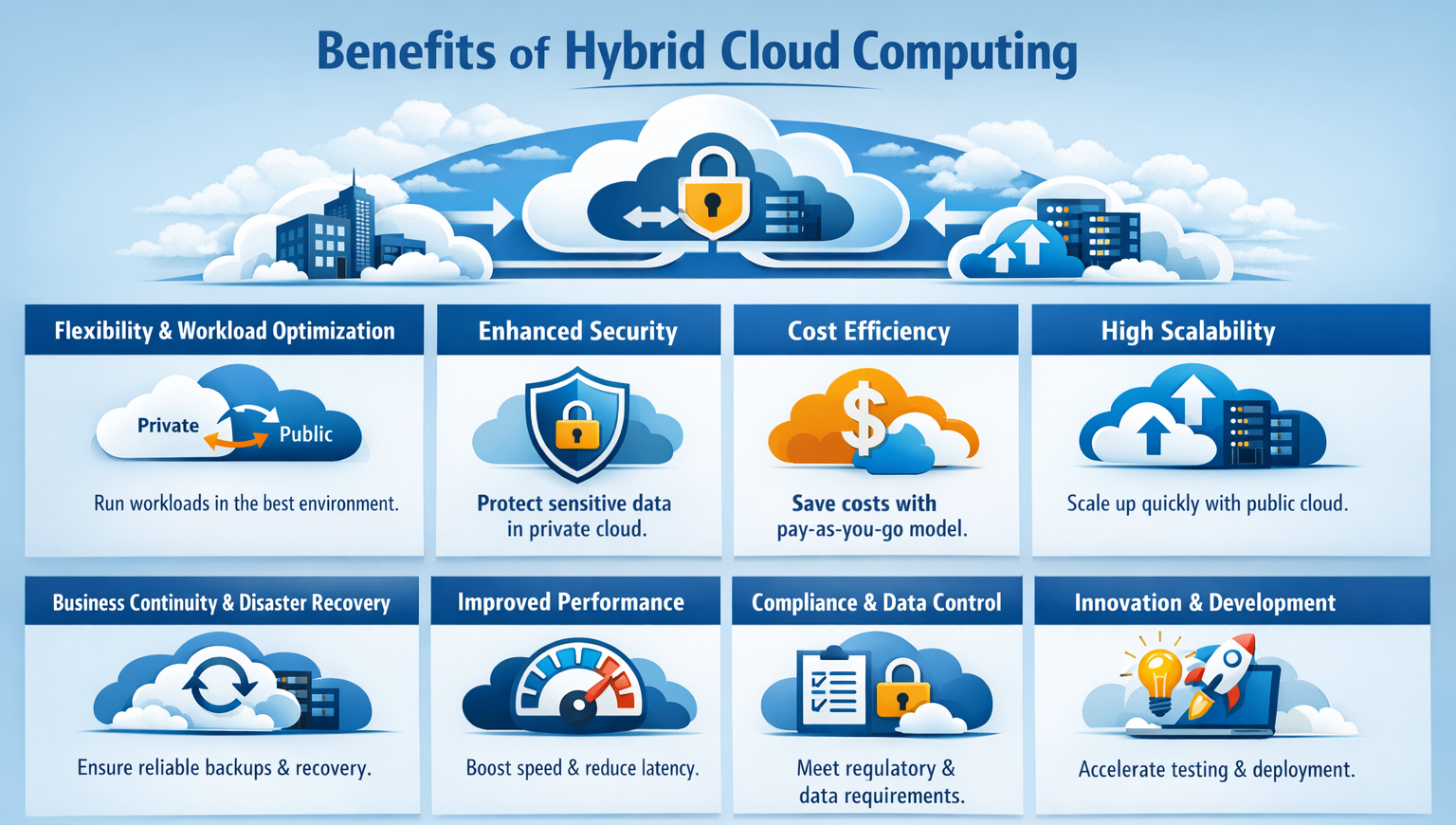
Let us explain each benefit of hybrid cloud computing in detail.
1. Flexibility and Workload Optimization
Hybrid cloud allows organizations to run workloads in the most suitable environment.
Benefits
-
Workload distribution: Applications can run in public or private cloud based on requirements.
-
Task optimization: Sensitive tasks stay private while general tasks run on public cloud.
-
Improved efficiency: Resources are used in the most effective way.
Example
A company runs secure databases in private cloud and websites in public cloud.
2. Enhanced Security
Hybrid cloud improves security by keeping sensitive data in a private environment.
Benefits
-
Data protection: Critical information is stored in private cloud.
-
Controlled access: Sensitive data is accessed only by authorized users.
-
Secure architecture: Combines security of private cloud with flexibility of public cloud.
Example
A bank stores financial data in private cloud while using public cloud for mobile apps.
3. Cost Efficiency
Hybrid cloud helps reduce costs by optimizing resource usage.
Benefits
-
Reduced infrastructure cost: No need to expand private cloud for temporary needs.
-
Pay-as-you-go usage: Public cloud is used only when needed.
-
Efficient resource utilization: Avoids over-investment in hardware.
Example
A company uses public cloud during peak demand instead of buying new servers.
4. High Scalability
Hybrid cloud provides excellent scalability by using public cloud resources when needed.
Benefits
-
On-demand scaling: Public cloud handles increased workload instantly.
-
Supports growth: Easy to expand applications and services.
-
Performance stability: Maintains smooth operation during high demand.
Example
An e-commerce website scales up using public cloud during festive sales.
5. Business Continuity and Disaster Recovery
Hybrid cloud improves reliability and ensures business continuity.
Benefits
-
Backup systems: Data is stored across multiple environments.
-
Disaster recovery: Systems can recover quickly after failure.
-
Reduced downtime: Ensures continuous availability of services.
Example
A company restores operations quickly after a system failure using cloud backups.
6. Improved Performance
Hybrid cloud enhances performance by distributing workloads efficiently.
Benefits
-
Optimized processing: Tasks run where they perform best.
-
Reduced latency: Data can be processed closer to users.
-
Balanced load: Workloads are evenly distributed.
Example
A streaming service delivers content faster using cloud resources.
7. Better Compliance and Data Control
Hybrid cloud helps organizations meet regulatory requirements.
Benefits
-
Data governance: Sensitive data stays in private cloud.
-
Regulatory compliance: Meets industry standards and laws.
-
Control over data location: Organizations decide where data is stored.
Example
A healthcare system stores patient data in private cloud to meet compliance standards.
8. Supports Innovation and Development
Hybrid cloud enables faster development and testing of applications.
Benefits
-
Quick testing: Developers can use public cloud for testing environments.
-
Faster deployment: Applications can be launched quickly.
-
Encourages innovation: Reduces risk and cost of experimentation.
Example
Developers test new applications in public cloud before deploying them in private cloud.
Top 5 FAQs (Interview & Exam Focused)
1. What is the main benefit of hybrid cloud?
The main benefit is combining security of private cloud with scalability of public cloud.
It allows organizations to optimize cost, performance, and flexibility.
2. Why is hybrid cloud cost-effective?
Hybrid cloud reduces cost by using public cloud only when needed.
It avoids unnecessary investment in private infrastructure.
3. How does hybrid cloud improve security?
Sensitive data is stored in private cloud with controlled access.
Public cloud is used for less critical workloads.
4. Is hybrid cloud scalable?
Yes, hybrid cloud is highly scalable using public cloud resources.
It can handle sudden increases in workload efficiently.
5. Who should use hybrid cloud?
Hybrid cloud is ideal for businesses needing both security and flexibility.
It is widely used in e-commerce, healthcare, and enterprise systems.
Conclusion
Hybrid cloud computing offers several benefits that make it a powerful cloud deployment model.
-
Flexible and scalable
-
Secure and cost-efficient
-
Supports innovation and performance
These benefits make hybrid cloud an ideal solution for modern businesses and applications.