












What Is Hybrid Cloud? Definition and Architecture
Hybrid cloud is a cloud deployment model that combines both public cloud and private cloud environments. It allows organizations to use the benefits of both models, scalability from public cloud and security from private cloud. Understanding hybrid cloud helps students and professionals design flexible and efficient cloud systems.
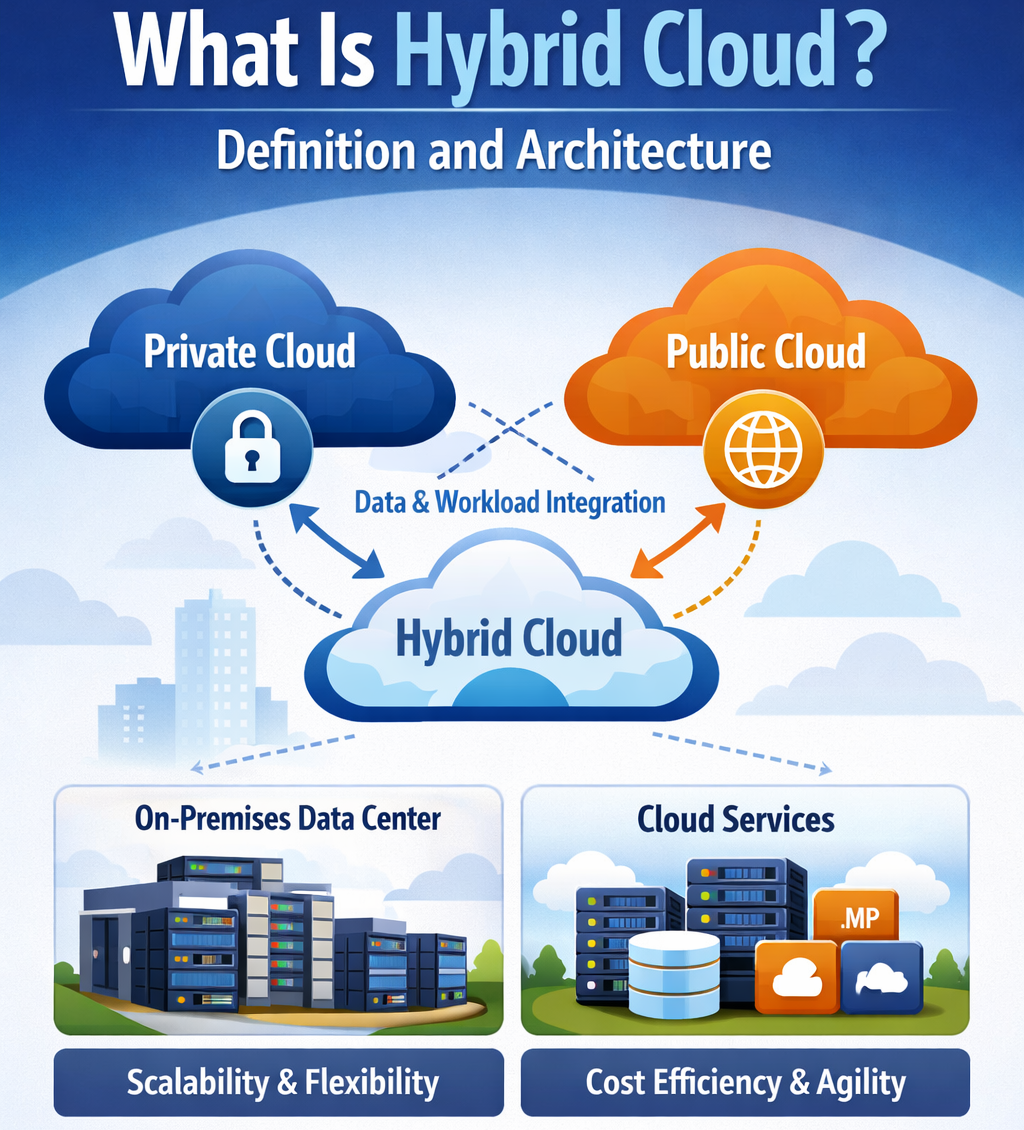
What Is Hybrid Cloud in Simple Terms?
Hybrid cloud is a combination of public and private cloud where data and applications can be shared between them.
Simple Explanation
Think of hybrid cloud like a smart combination:
-
Mix of two environments: Uses both public and private cloud together for better efficiency.
-
Data separation: Sensitive data stays in private cloud while general tasks run on public cloud.
-
Flexible usage: Organizations choose where to run applications based on needs.
Definition of Hybrid Cloud
Hybrid cloud is a cloud computing environment that integrates private cloud, public cloud, and on-premise infrastructure, allowing data and applications to move between them.
Hybrid Cloud Architecture
Hybrid cloud architecture defines how different cloud environments are connected and work together.
Main Components of Hybrid Cloud Architecture
-
Private Cloud: Stores sensitive data and critical applications securely.
-
Public Cloud: Handles scalable workloads and non-sensitive tasks.
-
On-Premise Infrastructure: Existing systems within the organization.
-
Networking Connection: Connects all environments using secure networks (VPN or APIs).
-
Management Tools: Monitor and control resources across environments.
How Hybrid Cloud Architecture Works
Hybrid cloud works by integrating multiple environments into a unified system.
Step-by-Step Working
-
Data distribution: Sensitive data is stored in private cloud.
-
Workload allocation: Applications run on public or private cloud based on need.
-
Secure communication: Data moves between environments through secure connections.
-
Centralized management: Tools manage all resources together.
Key Features of Hybrid Cloud Architecture
Hybrid cloud architecture offers flexibility and efficiency.
Features
-
Workload flexibility: Run applications in the most suitable environment.
-
Scalability: Use public cloud for additional capacity.
-
Data control: Keep sensitive data secure in private cloud.
-
Integration capability: Connect existing systems with cloud environments.
Real-Life Example of Hybrid Cloud
Hybrid cloud is widely used in modern organizations.
Example: E-commerce Platform
-
Private cloud: Stores customer payment data securely
-
Public cloud: Hosts website and handles traffic
-
Hybrid system: Combines both for performance and security
Benefits of Hybrid Cloud Architecture
Hybrid cloud provides multiple advantages for organizations.
Benefits
-
Improved flexibility: Choose the best environment for each workload.
-
Cost optimization: Use public cloud only when needed.
-
Enhanced security: Protect sensitive data in private cloud.
-
Better performance: Optimize workloads across environments.
Why Hybrid Cloud Is Important
Hybrid cloud is important because it balances security and scalability.
Key Reasons
-
Combines best of both worlds: Public and private cloud advantages
-
Supports modern applications: Ideal for dynamic workloads
-
Improves efficiency: Optimizes resource usage
Top 5 FAQs (Interview & Exam Focused)
1. What is hybrid cloud?
Hybrid cloud is a combination of public and private cloud environments. It allows data and applications to be shared between both systems.
2. Why is hybrid cloud used?
Hybrid cloud is used to balance security and scalability. Sensitive data stays private while other workloads use public cloud.
3. What are the components of hybrid cloud architecture?
It includes private cloud, public cloud, networking, and management tools. These components work together to create a unified system.
4. Is hybrid cloud secure?
Yes, hybrid cloud is secure when sensitive data is stored in private cloud. Secure connections ensure safe communication between environments.
5. Where is hybrid cloud used?
Hybrid cloud is used in e-commerce, healthcare, and enterprise systems. It is ideal for applications requiring both flexibility and security.
Conclusion
Hybrid cloud is a powerful cloud deployment model that combines public and private cloud environments.
-
Offers flexibility and scalability
-
Ensures security for sensitive data
-
Optimizes performance and cost
Understanding hybrid cloud architecture helps in building modern and efficient cloud solutions.