












How Cloud Service Models Work in Simple Terms
Cloud service models explain how different types of computing services are delivered over the internet. They help businesses choose how much control they want versus how much they want the provider to manage. Understanding cloud service models makes it easier to use technology without needing physical hardware.
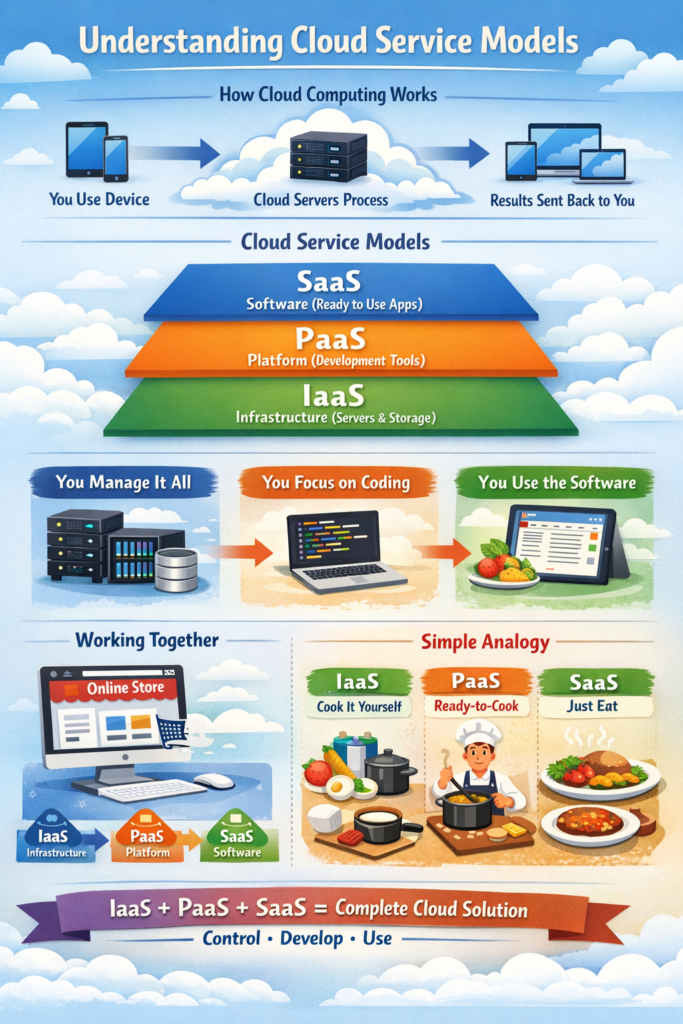
What is the Basic Working of Cloud Computing?
Cloud computing works by processing your requests on remote servers instead of your personal device.
Simple Process
-
You open an app or website on your device
-
Your request is sent over the internet
-
Cloud servers process your request
-
The result is sent back to your device
Example
When you open Google Docs, your browser connects to cloud servers where your document is stored and processed.
Cloud Service Models as Layers
Cloud service models are organized in layers, where each layer builds on top of the previous one to simplify usage.
Three Main Layers
-
Infrastructure (IaaS)
-
Platform (PaaS)
-
Software (SaaS)
Each layer hides complexity and makes it easier for users to work efficiently.
How IaaS Works (Infrastructure as a Service)
IaaS provides basic computing resources such as servers, storage, and networking over the internet, giving users maximum control.
Step-by-Step Working
-
You rent a virtual machine from a cloud provider
-
You install an operating system (like Windows or Linux)
-
You install required software and applications
-
You manage your data and security
Real-Life Example
Suppose a company wants to host a website:
-
It rents a server from a cloud provider
-
Installs web server software
-
Uploads website files
In this case, the company controls everything except the physical hardware.
Key Idea
In IaaS, you manage most of the system.
How PaaS Works (Platform as a Service)
PaaS provides a ready-to-use platform where developers can build and deploy applications without worrying about infrastructure.
Step-by-Step Working
-
Developer writes application code
-
Uploads code to the cloud platform
-
Platform automatically handles server setup and runtime
-
Application runs and becomes accessible to users
Real-Life Example
A student creates a web application:
-
Uploads code to a platform like Heroku
-
The platform runs the app automatically
No need to worry about servers or operating systems.
Key Idea
In PaaS, you focus only on development, not infrastructure.
How SaaS Works (Software as a Service)
SaaS delivers ready-to-use software applications over the internet, fully managed by the provider.
Step-by-Step Working
-
User opens software in a browser or app
-
Logs into the account
-
Uses the software online
-
Data is automatically saved in the cloud
Real-Life Example
Using Google Docs:
-
You open it in a browser
-
Start writing
-
Your work is saved automatically
No installation or maintenance is needed.
Key Idea
In SaaS, everything is managed by the provider.
How All Three Models Work Together
Cloud service models are interconnected and work together to deliver complete cloud solutions.
Relationship Between Models
-
IaaS provides the infrastructure
-
PaaS uses that infrastructure to run applications
-
SaaS delivers those applications to end users
Example
An online shopping website:
-
Runs on IaaS servers
-
Built using PaaS tools
-
Used by customers as SaaS
Simple Analogy to Understand Workflow
A simple analogy helps in understanding how these models function in real life.
Food Example
-
IaaS: You buy raw ingredients and cook everything yourself
-
PaaS: Ingredients are prepared; you just cook
-
SaaS: Food is already cooked; you just eat
Real-World Scenario: Online Education System
Cloud service models are widely used in education systems to deliver efficient and scalable solutions.
How It Works
A university system uses:
-
IaaS to store student data and manage servers
-
PaaS to build internal applications like portals
-
SaaS to provide tools like online classes and assignments
All models work together to deliver a smooth experience.
Why Understanding This is Important
Understanding cloud service models helps different users make better decisions based on their needs.
For Students
-
Helps in exams and interviews
-
Builds strong IT concepts
-
Useful for projects and assignments
For Developers
-
Helps choose the right platform
-
Improves efficiency and productivity
For Businesses
-
Saves cost
-
Enables scalability
-
Improves performance
Conclusion
Cloud service models work by dividing responsibilities between users and providers, making cloud computing simple and efficient.
-
IaaS gives full control
-
PaaS simplifies development
-
SaaS provides ready-to-use solutions
Understanding these models is essential for students, developers, and businesses in today’s digital world.