












Half Adder
A Half Adder is a basic combinational logic circuit used to add two single-bit binary numbers. It has two inputs (i.e. A and B), and produces two outputs known as Sum (S) and Carry (C).
- The Sum represents the addition result, while the Carry indicates whether an extra bit is generated during operation.
- A Half Adder uses an XOR gate to generate the Sum and an AND gate to generate the Carry.
The Boolean expressions for a Half Adder are given below
- Sum (S) = A ⊕ B
- Carry (C) = A · B
Where A and B are binary inputs, “⊕” represents the XOR operation. and “·” represents the AND operation.
Half Adder Circuit Diagram
A Half Adder circuit consists of two logic gates: an XOR gate and an AND gate. Both gates receive the same inputs, A and B. The following diagram shows the half adder circuit diagram
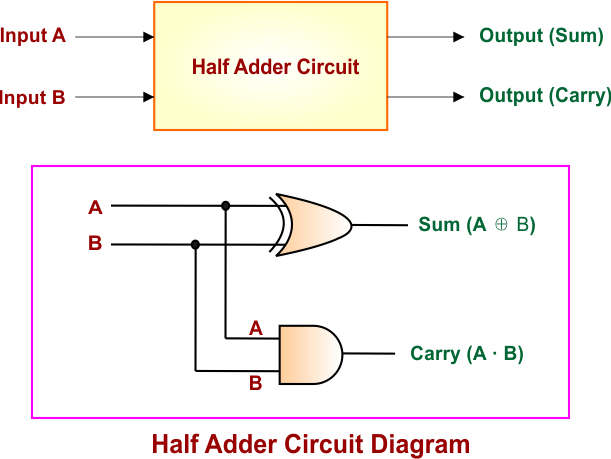
Working:
- The XOR gate produces the Sum output.
- The AND gate produces the Carry output.
- Both outputs are generated simultaneously.
Half Adder Truth Table
The half adder truth table shows all possible combinations of two binary inputs and their corresponding Sum and Carry outputs. The following diagram shows the half adder truth table diagram
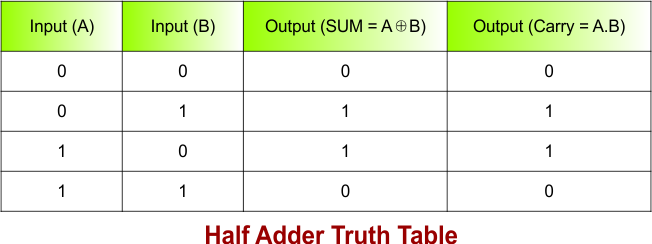
Explanation:
- When A = 0 and B = 0, the Sum and Carry are both 0.
- When A = 0 and B = 1, the Sum is 1 and Carry is 0.
- When A = 1 and B = 0, the Sum is 1 and Carry is 0.
- When A = 1 and B = 1, the Sum is 0 and Carry is 1.
For example, 1 + 1 = 10 in binary. Therefore, the Sum is 0 and the Carry is 1.
K-Map for Half Adder
A Karnaugh Map (K-Map) is used to simplify Boolean expressions. A Half Adder has two inputs, A and B, so each output can be represented using a 2-variable K-Map. The following diagram shows the Karnaugh Map for Half Adder
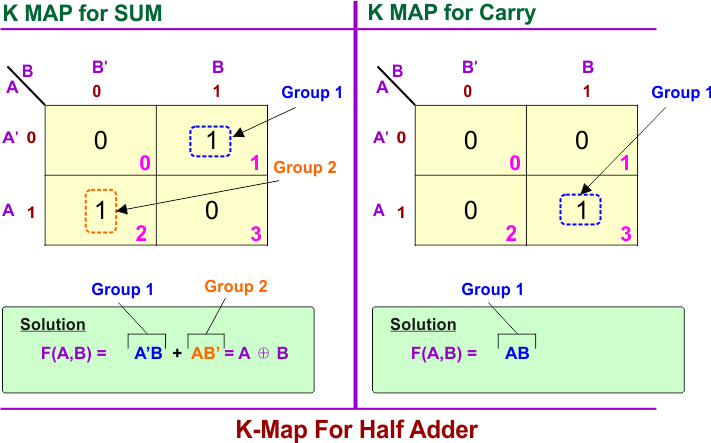
The Sum output is 1 when the inputs are different (01 and 10). Therefore, the simplified expression is given below
- Sum = A’B + AB’ = A ⊕ B
The Carry output is 1 only when both inputs are 1 (11). Therefore, the simplified Carry expression is given below
- Carry = AB.
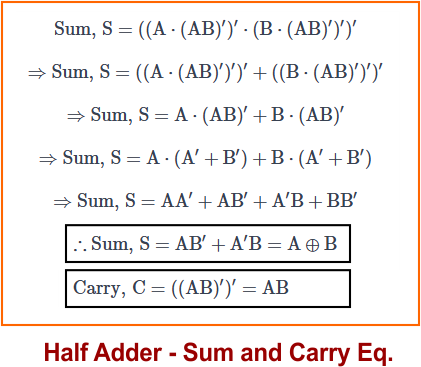
Half Adder Using NAND Gate
A Half Adder can be implemented using NAND gates only because NAND is a universal logic gate.
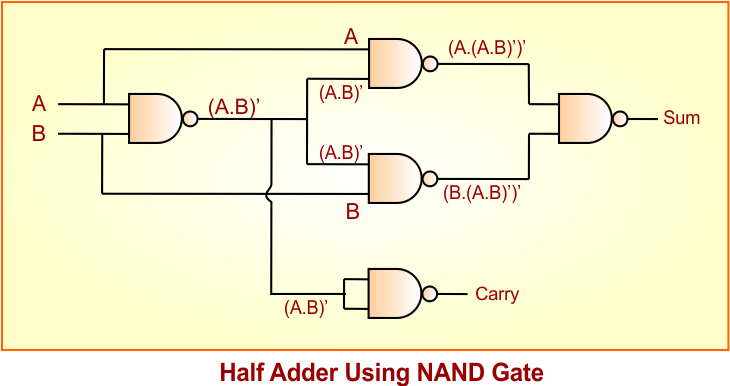
A NAND-based Half Adder requires five NAND gates.
Boolean expressions:
Let:
X = A NAND B
Then:
Y = A NAND X
Z = B NAND X
The outputs are:
S = Y NAND Z
C = X NAND X
This circuit produces the same Sum and Carry outputs as a conventional Half Adder.
Half Adder Using NOR Gates
A Half Adder can also be constructed using NOR gates only. Since NOR is a universal gate, it can implement both XOR and AND operations.
The required Boolean expressions are:
S = A ⊕ B
C = AB
The XOR and AND functions can be constructed using combinations of NOR gates to generate both outputs.
Half Adder Using MUX
A Half Adder can be implemented using multiplexers (MUX). A 2:1 multiplexer can implement a Boolean function by selecting an input according to its select line.
For the Sum output:
S = A ⊕ B
For the Carry output:
C = AB
Using A as the select line:
| Output | I₀ | I₁ | Select |
|---|---|---|---|
| Sum | B | B’ | A |
| Carry | 0 | B | A |
Two 2:1 multiplexers can therefore implement a complete Half Adder.
Half Adder Using CMOS
A Half Adder can be designed using CMOS (Complementary Metal-Oxide-Semiconductor) technology. CMOS circuits use both PMOS and NMOS transistors to implement logic functions.
The Sum output requires an XOR function, while the Carry output requires an AND function.
CMOS implementation offers:
-
Low power consumption.
-
High noise immunity.
-
High integration density.
-
Reliable operation in digital circuits.
Half Adder and Full Adder
A Half Adder and a Full Adder are both combinational circuits used for binary addition. However, they differ in the number of inputs and their ability to handle carry inputs.
| Feature | Half Adder | Full Adder |
|---|---|---|
| Number of inputs | 2 | 3 |
| Number of outputs | 2 | 2 |
| Inputs | A, B | A, B, Cin |
| Outputs | Sum, Carry | Sum, Carry |
| Carry input | Not supported | Supported |
| XOR gates | 1 | 2 |
| Basic implementation | XOR and AND | XOR, AND and OR |
| Complexity | Simple | More complex |
Difference Between Half Adder and Full Adder
The main difference between a Half Adder and a Full Adder is the carry input.
A Half Adder adds two binary bits without considering any previous carry. In contrast, a Full Adder adds three binary bits, including the carry input (Cin) from the previous stage.
For example:
-
Half Adder: 1 + 1 = 10
-
Full Adder: 1 + 1 + 1 = 11
A Full Adder is more suitable for multi-bit binary addition because it can accept the carry generated by the previous bit position.
Applications of Half Adder
Half Adders are used in different digital electronic circuits and arithmetic operations.
-
Arithmetic Logic Units (ALUs): Used as basic components in arithmetic circuits.
-
Calculators: Help perform binary addition operations.
-
Digital Computers: Used in basic arithmetic circuit designs.
-
Processors: Can be used in arithmetic circuit components.
-
Full Adder Design: Two Half Adders and an OR gate can be combined to construct a Full Adder.
Advantages of Half Adder
-
Simple circuit design.
-
Requires fewer logic gates.
-
Produces Sum and Carry simultaneously.
-
Easy to implement using basic logic gates.
-
Useful for learning binary arithmetic and digital electronics.
Limitations of Half Adder
-
Cannot accept a carry input from a previous stage.
-
Cannot directly perform multi-bit addition independently.
-
Requires a Full Adder for handling carry propagation in multi-bit addition.
Frequently Asked Questions (FAQs)
1. What is a Half Adder?
A Half Adder is a combinational logic circuit that adds two single-bit binary inputs and produces two outputs: Sum and Carry.
2. What are the outputs of a Half Adder?
A Half Adder has two outputs: Sum (S) and Carry (C). The Sum is generated using an XOR gate, while the Carry is generated using an AND gate.
3. How many gates are required for a Half Adder?
A basic Half Adder requires two logic gates: one XOR gate and one AND gate.
4. What is the Boolean expression for a Half Adder?
The Boolean expressions are:
S = A ⊕ B
C = AB
5. Can we design a Half Adder using NAND gates?
Yes. A Half Adder can be implemented using five NAND gates because NAND is a universal logic gate.
6. What is the main difference between a Half Adder and a Full Adder?
A Half Adder has two inputs and cannot accept a carry input. A Full Adder has three inputs, including a carry input from the previous stage.