











Choosing the Right Cloud Service Model for Your Business
Choosing the right cloud service model is important for building efficient, scalable, and cost-effective systems. Businesses must decide between IaaS, PaaS, and SaaS based on their goals, technical skills, and operational needs.
What Does Choosing the Right Model Mean?
Selecting the right cloud model means picking the level of control and management that best fits your business requirements.
- Right Fit: Match cloud services with business needs
- Balanced Approach: Consider cost, control, and complexity
- Future Ready: Choose a model that supports growth
Why Choosing the Right Model is Important
Making the right decision can improve performance and reduce costs, while a wrong choice can create inefficiencies.
- Cost Efficiency: Avoid paying for unnecessary resources
- Better Performance: Use the most suitable services
- Scalability: Support business growth easily
- Operational Efficiency: Reduce management complexity
Overview of Cloud Service Models
Understanding each model helps in making the right decision.
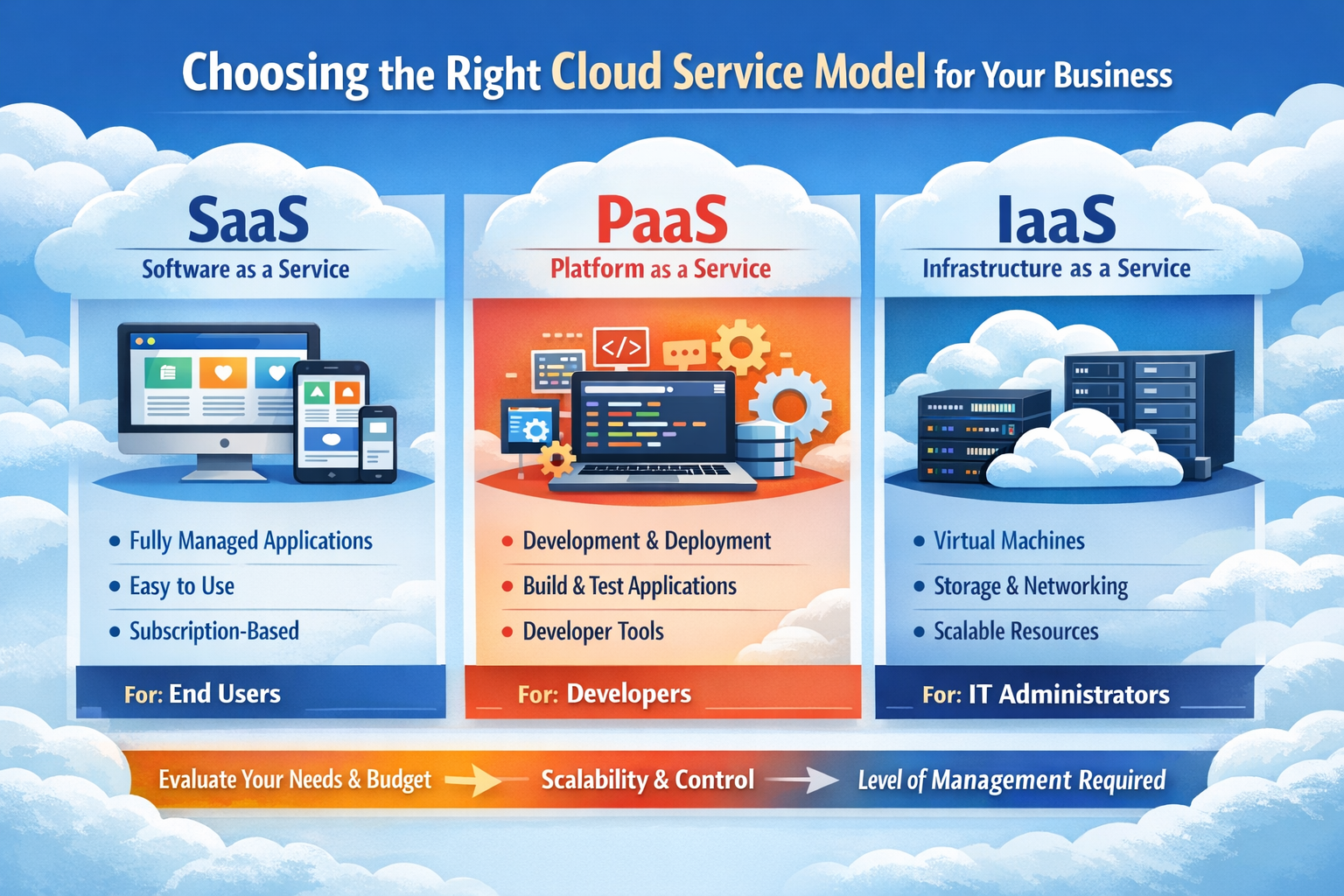
Infrastructure as a Service (IaaS)
Provides basic infrastructure like servers and storage with full control.
- Suitable for custom systems
- Requires technical expertise
Platform as a Service (PaaS)
Provides a development platform for building and deploying applications.
- Focus on development
- No need to manage infrastructure
Software as a Service (SaaS)
Provides ready-to-use applications over the internet.
- Easy to use
- No setup or maintenance required
Factors to Consider When Choosing a Model
Businesses should evaluate multiple factors before selecting a cloud model.
1. Business Requirements
Understand what your business needs from cloud services.
- Simple Needs: SaaS is sufficient for basic tasks
- Development Needs: PaaS is ideal for building applications
- Complex Systems: IaaS is better for custom solutions
2. Level of Control
Decide how much control you want over systems and infrastructure.
- Full Control: Choose IaaS
- Partial Control: Choose PaaS
- Minimal Control: Choose SaaS
3. Technical Expertise
Evaluate the skills available in your team.
- High Expertise: IaaS is manageable
- Moderate Skills: PaaS is suitable
- Low Skills: SaaS is the best option
4. Budget and Cost
Consider your budget and cost management strategy.
- Low Budget: SaaS reduces infrastructure costs
- Moderate Budget: PaaS balances cost and features
- Flexible Budget: IaaS offers full customization
5. Scalability Needs
Check how much your business needs to grow in the future.
- Rapid Growth: IaaS and PaaS provide high scalability
- Stable Usage: SaaS works well for consistent workloads
6. Time to Deployment
Consider how quickly you need to launch your solution.
- Immediate Use: SaaS is ready instantly
- Quick Development: PaaS speeds up deployment
- Custom Setup: IaaS takes more time
Decision Guide (Simple Understanding)
This section helps in quickly deciding the right model.
- Use IaaS when you need full control and customization
- Use PaaS when you want fast development without managing infrastructure
- Use SaaS when you need ready-to-use software
Real-World Business Scenarios
Understanding real use cases makes decision-making easier.
Small Business
Small businesses usually prefer simple and cost-effective solutions.
- Use SaaS for email, accounting, and collaboration
- Reduces setup and maintenance effort
Startup
Startups focus on speed and innovation.
- Use PaaS for building applications quickly
- Combine with SaaS for business tools
Large Enterprise
Enterprises need control, security, and scalability.
- Use IaaS for custom infrastructure
- Use PaaS for development
- Use SaaS for productivity tools
Common Mistakes to Avoid
Avoiding these mistakes helps in making better decisions.
- Choosing Wrong Model: Leads to inefficiency and higher costs
- Ignoring Scalability: Limits future growth
- Underestimating Costs: Can result in unexpected expenses
- Lack of Planning: Causes deployment and management issues
Best Practices
Follow these practices to choose the right cloud model.
- Analyze business needs clearly
- Start with simple solutions and scale later
- Combine multiple models if needed
- Monitor usage and costs regularly
- Ensure security and compliance
Benefits of Choosing the Right Model
Selecting the correct model improves overall business performance.
- Improved Efficiency: Better use of resources
- Cost Savings: Reduced unnecessary expenses
- Faster Deployment: Quick application launch
- Better Scalability: Easy business growth
Conclusion
Choosing the right cloud service model is essential for business success. By understanding IaaS, PaaS, and SaaS and evaluating your business needs, you can select the most suitable model that ensures efficiency, scalability, and cost-effectiveness.