












Challenges in Multi-Cloud Environments
Multi-cloud environments involve using multiple cloud service providers to run applications and manage data. While this approach offers flexibility and reliability, it also introduces several challenges. Understanding these challenges helps organizations plan and manage multi-cloud systems effectively.
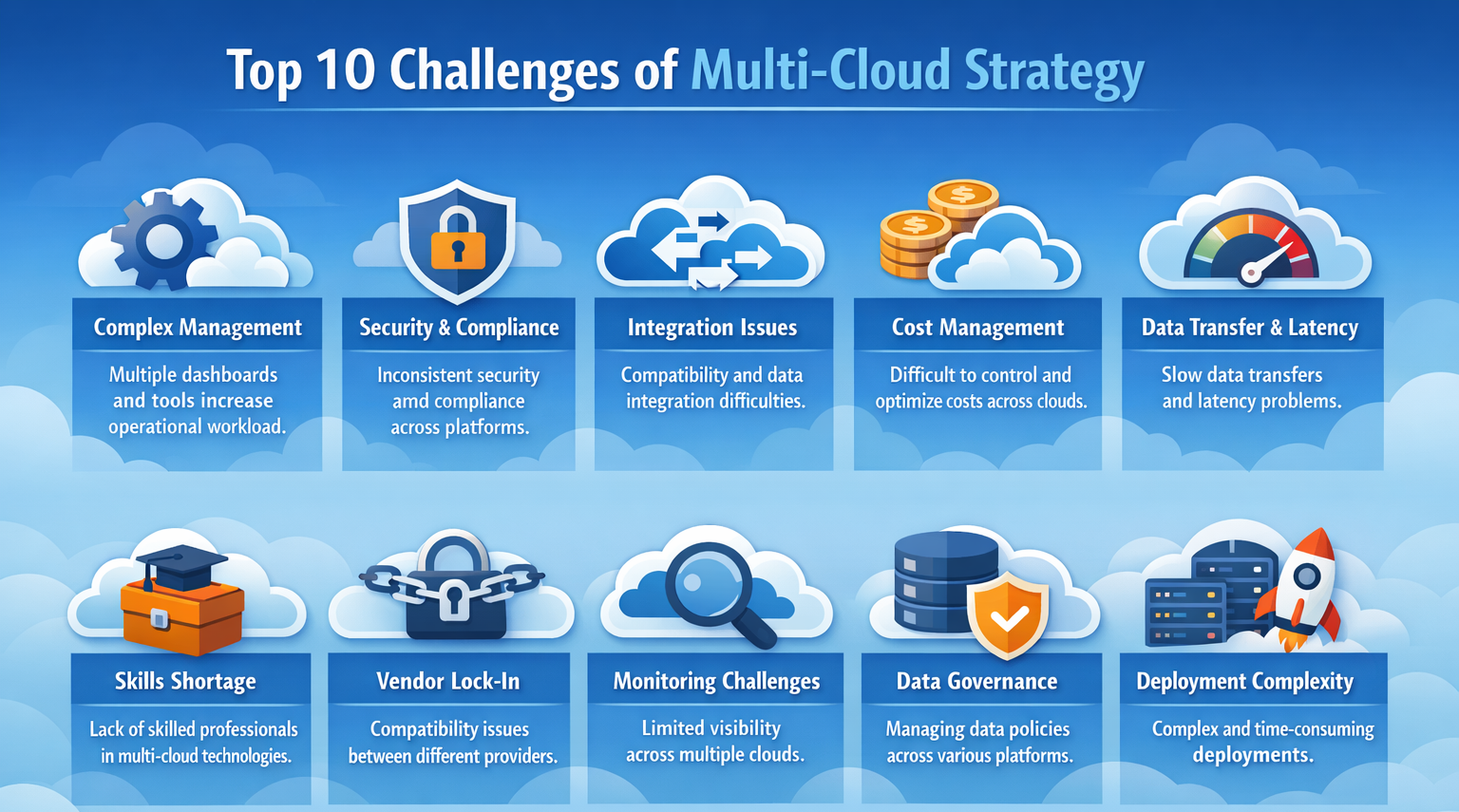
Let us explain the key challenges in multi-cloud environments in detail.
1. Complex Management
Managing multiple cloud platforms increases operational complexity and requires strong coordination.
Challenges
- Multiple Dashboards: Each provider has its own interface, making centralized management difficult.
- Different Tools and Services: Teams must learn and handle different technologies and ecosystems.
- Higher Operational Overhead: Managing multiple environments increases workload and administrative effort.
Example
An IT team struggles to monitor and manage services across AWS, Azure, and Google Cloud simultaneously.
2. Security and Compliance Issues
Maintaining consistent security across multiple cloud providers can be challenging.
Challenges
- Different Security Models: Each provider follows its own security policies and frameworks.
- Configuration Risks: Misconfigurations across platforms can create vulnerabilities.
- Compliance Complexity: Meeting regulatory standards across multiple environments is difficult.
Example
A company finds it hard to enforce uniform security policies across all cloud providers.
3. Integration and Interoperability Problems
Connecting different cloud platforms and ensuring they work together smoothly is complex.
Challenges
- Compatibility Issues: Providers use different technologies and architectures.
- Data Integration Difficulties: Synchronizing data across clouds is challenging.
- Application Interoperability: Applications may not function seamlessly across platforms.
Example
An application designed for one cloud provider may require major changes to run on another.
4. Increased Cost Management Complexity
Managing costs across multiple providers requires detailed monitoring and analysis.
Challenges
- Complex Billing Systems: Each provider has different pricing models and billing structures.
- Hidden Costs: Data transfer, storage, and usage charges can increase expenses.
- Budget Tracking Difficulties: Hard to get a clear view of total spending.
Example
A company overspends because it lacks visibility into combined multi-cloud expenses.
5. Data Transfer and Latency Issues
Transferring data between cloud providers can impact performance and speed.
Challenges
- Data Transfer Delays: Large data movements take time and resources.
- Latency Problems: Distance between data centers affects response time.
- Bandwidth Requirements: High data transfer requires strong and stable networks.
Example
An application slows down due to frequent data exchange between different cloud platforms.
6. Lack of Skilled Professionals
Multi-cloud environments require expertise across multiple cloud platforms.
Challenges
- Skill Gap: Teams must understand multiple cloud technologies.
- Continuous Training Needs: Ongoing learning is required to stay updated.
- Limited Talent Availability: Skilled multi-cloud professionals are in high demand.
Example
An organization struggles to manage its infrastructure due to a shortage of trained cloud experts.
7. Vendor Compatibility Issues
Different cloud providers may not always work well together.
Challenges
- Different Standards: Providers use different architectures and APIs.
- Limited Compatibility: Some services cannot integrate easily across platforms.
- Migration Complexity: Moving workloads between providers can be difficult.
Example
A service built for AWS may not run efficiently on Azure without modifications.
8. Monitoring and Visibility Challenges
Tracking performance and health across multiple cloud platforms is difficult.
Challenges
- No Centralized Monitoring: Lack of a single dashboard for all environments.
- Performance Tracking Issues: Hard to analyze system-wide performance.
- Limited Visibility: Issues in one cloud may go unnoticed.
Example
IT teams find it difficult to monitor application performance across multiple providers.
9. Data Governance Issues
Managing data across different platforms creates governance challenges.
Challenges
- Data Inconsistency: Multiple copies of data may become mismatched.
- Policy Enforcement Issues: Difficult to apply consistent data rules.
- Compliance Risks: Data may be stored in different regions with different laws.
Example
A company struggles to maintain consistent data policies across multiple cloud environments.
10. Deployment Complexity
Deploying applications across multiple cloud platforms requires careful planning and configuration.
Challenges
- Different Deployment Processes: Each provider has unique deployment methods.
- Configuration Complexity: Requires managing multiple configurations.
- Time-Consuming Setup: Deployment takes longer compared to a single cloud.
Example
A developer spends extra time configuring and deploying applications across different cloud providers.
Top 5 FAQs (Interview & Exam Focused)
1. What is the main challenge of multi-cloud environments?
The main challenge of multi-cloud environments is managing multiple cloud platforms efficiently. Organizations must handle different tools, dashboards, and configurations, which increases operational complexity. This makes monitoring, integration, and overall system management more difficult.
2. Why is security difficult in multi-cloud?
Security is challenging in multi-cloud because each cloud provider has its own security models, policies, and configurations. Maintaining consistent security standards across all platforms requires careful planning and coordination, and any misconfiguration can lead to vulnerabilities.
3. How does multi-cloud affect cost management?
Multi-cloud makes cost management more complex due to different pricing models used by each provider. It becomes difficult to track overall expenses, and hidden costs such as data transfer and additional service usage can increase total spending.
4. What are integration issues in multi-cloud?
Integration issues occur because different cloud providers use different technologies and architectures. This can make it difficult for applications and data to work seamlessly across platforms, often requiring additional tools and configurations.
5. Why are skills important in multi-cloud?
Skills are essential in multi-cloud because managing multiple platforms requires knowledge of different cloud services and tools. Organizations need skilled professionals who can handle deployment, security, monitoring, and optimization across all environments.
Conclusion
Multi-cloud environments offer flexibility and performance benefits, but they also introduce several challenges.
- Complex Management and Integration: Managing multiple platforms increases operational difficulty
- Security and Compliance Issues: Maintaining consistent protection across providers is challenging
- Cost and Performance Challenges: Tracking expenses and ensuring optimal performance requires careful planning
Understanding these challenges helps organizations design and implement multi-cloud strategies more effectively and efficiently.