









Key Features of Private Cloud
Private cloud is a cloud deployment model where computing resources are dedicated to a single organization. It provides high security, control, and customization, making it ideal for handling sensitive data and critical applications. Understanding the key features of private cloud helps users utilize it effectively in real-world scenarios.
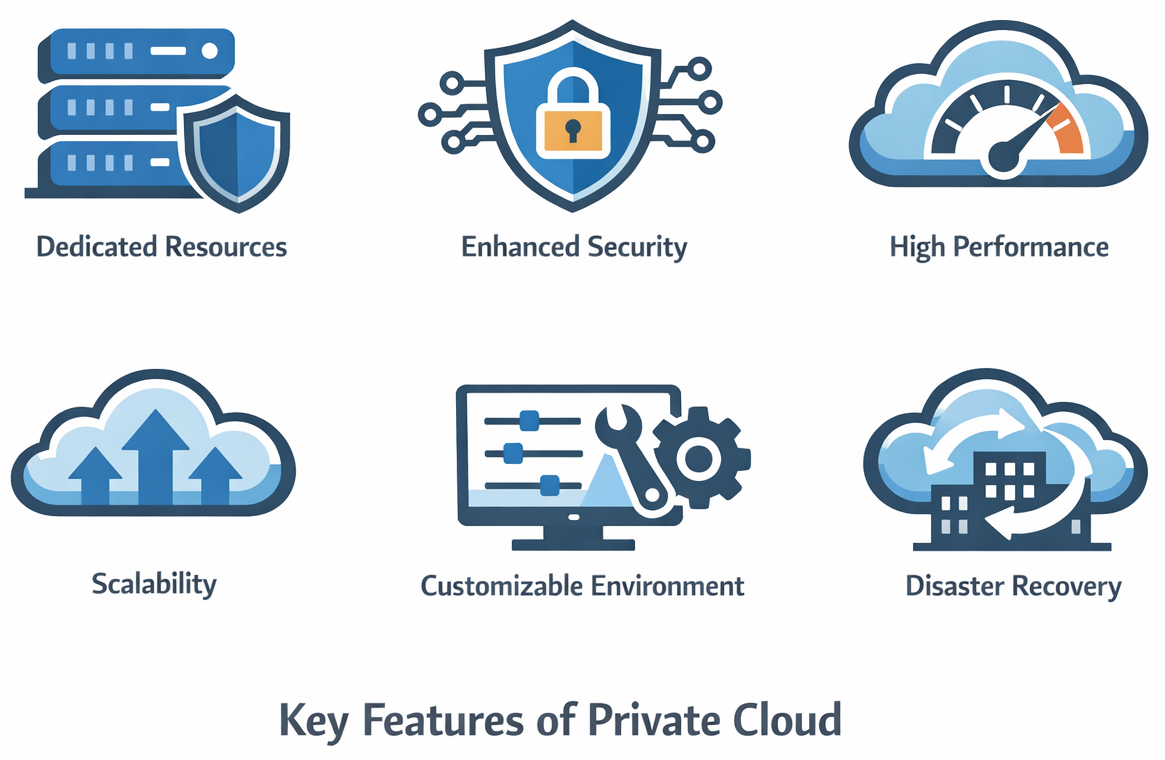
Let us explain each key feature of private cloud in detail.
1. Dedicated Infrastructure
Dedicated infrastructure ensures that all cloud resources are exclusively used by a single organization, providing strong isolation, reliability, and consistent performance.
How It Works
Dedicated infrastructure operates in a controlled environment designed specifically for one organization.
- Single-Tenant Environment: Resources are not shared with other users, ensuring complete privacy and isolation.
- Exclusive Access: Only one organization uses the infrastructure at any given time, eliminating external interference.
- Consistent Performance: Dedicated resources deliver stable, predictable, and high-quality performance.
Example
A bank uses its own dedicated servers to securely manage and process financial data without sharing resources.
2. High Security
Private cloud provides enhanced security by enabling organizations to implement strict protection measures and control access to data and systems.
Security Features
These features ensure strong data protection and system safety.
- Restricted Access: Only authorized users can access systems, reducing unauthorized entry risks.
- Data Protection: Sensitive data remains within a secure and controlled environment.
- Custom Security Policies: Organizations can define and enforce their own security rules and compliance standards.
Example
Hospitals use private cloud systems to securely store and manage patient records while maintaining confidentiality.
3. Full Control Over Infrastructure
Private cloud gives organizations complete control over computing resources, configurations, and operational policies.
What You Control
Organizations manage all critical components of the system environment.
- Hardware and Software: Full authority over system setup, configuration, and usage.
- Security Settings: Ability to define, customize, and enforce security policies.
- Access Control: Manage user roles, permissions, and authentication mechanisms.
Example
A company configures its cloud infrastructure based on specific business requirements and security needs.
4. Customization and Flexibility
Private cloud allows systems to be fully customized and adapted to meet unique business requirements and workloads.
Benefits
These benefits highlight the flexibility of private cloud environments.
- Tailored Solutions: Infrastructure is designed to support specific applications and business processes.
- Flexible Configurations: Systems can be adjusted dynamically based on workload and performance needs.
- Support for Specialized Workloads: Ideal for complex, high-performance, or industry-specific applications.
Example
An enterprise customizes its cloud setup to support high-performance computing and data-intensive applications.
5. High Performance
Private cloud delivers consistent, fast, and reliable performance because resources are dedicated to a single organization.
Benefits
These benefits ensure efficient and uninterrupted system operations.
- No Resource Sharing: Performance is not impacted by other users or workloads.
- Optimized Workloads: Systems are configured specifically for organizational tasks and applications.
- Stable Performance: Ensures smooth operation of critical and high-demand applications.
Example
A financial system processes transactions quickly and reliably without delays or performance fluctuations.
6. Improved Compliance and Regulation
Private cloud helps organizations meet strict industry standards and legal requirements, making it ideal for regulated environments.
Benefits
These benefits support compliance and regulatory requirements effectively.
- Regulatory Compliance: Meets industry-specific standards such as healthcare, finance, and government regulations.
- Data Control: Keeps data within specific geographic or organizational boundaries to meet legal requirements.
- Audit Support: Enables easy monitoring, logging, and reporting for audits and inspections.
Example
A financial institution complies with strict regulations by storing and managing data in a private cloud.
7. Enhanced Data Privacy
Private cloud ensures confidentiality and protection of sensitive information through controlled environments.
Features
These features strengthen data privacy and protection.
- Isolated Environment: Data is not shared with other organizations, ensuring privacy.
- Secure Storage: Information is stored within a controlled and protected system.
- Access Restrictions: Only authorized users can access or modify sensitive data.
Example
Government organizations store confidential data securely in private cloud systems.
8. Reliable Backup and Recovery
Private cloud provides robust backup and disaster recovery solutions to ensure business continuity.
Features
These features help protect data and recover systems quickly.
- Regular Backups: Data is saved periodically to prevent loss.
- Disaster Recovery: Systems can be restored quickly after failures or disruptions.
- Data Protection: Ensures continuous operations during unexpected events.
Example
A company restores its system after a failure using private cloud backup solutions.
9. Integration with Legacy Systems
Private cloud supports seamless integration with existing systems, enabling smooth transition from traditional infrastructure.
Benefits
These benefits improve system compatibility and operational continuity.
- Compatibility: Works efficiently with older systems and legacy software.
- Smooth Transition: Simplifies migration from traditional IT environments to cloud.
- Hybrid Support: Can be integrated with public cloud for hybrid solutions.
Example
A business integrates its existing database and applications with a private cloud system for improved performance.
10. Controlled Scalability
Private cloud provides scalable resources with controlled and planned growth, ensuring efficient expansion.
Benefits
These benefits help in managing resources effectively.
- Planned Scaling: Resources can be increased based on business requirements.
- Better Resource Management: Ensures optimal utilization of infrastructure.
- Predictable Growth: Scaling is controlled and aligned with long-term planning.
Example
An organization increases storage capacity gradually as its data grows over time.
Top 5 FAQs (Interview & Exam Focused)
1. What is the main feature of private cloud?
The main feature is dedicated infrastructure used by a single organization.
This ensures high security, control, and data privacy.
2. Why is private cloud more secure than public cloud?
Because resources are not shared and access is restricted.
Organizations can implement custom security policies for better protection.
3. What does full control mean in private cloud?
It means organizations manage hardware, software, and security settings.
This allows complete customization and control over the environment.
4. Can private cloud be customized?
Yes, private cloud can be tailored to meet specific business needs.
Organizations can configure systems based on their requirements.
5. Is private cloud scalable?
Yes, but scalability is more controlled compared to public cloud.
Organizations can expand resources based on planned needs.
Conclusion
Private cloud provides a secure, controlled, and highly customizable environment designed to meet the needs of organizations that handle sensitive and mission-critical data. With dedicated infrastructure, strong security measures, and full control over systems, it ensures data privacy, reliable performance, and regulatory compliance. These capabilities make private cloud an ideal solution for industries such as finance, healthcare, and government, where security, control, and stability are top priorities.