












Types of Private Cloud (On-Premise vs Hosted)
Private cloud can be deployed in different ways depending on where the infrastructure is located and who manages it. The two main types of private cloud are On-Premise Private Cloud and Hosted Private Cloud. Understanding these types helps organizations choose the right setup based on control, cost, and management needs.
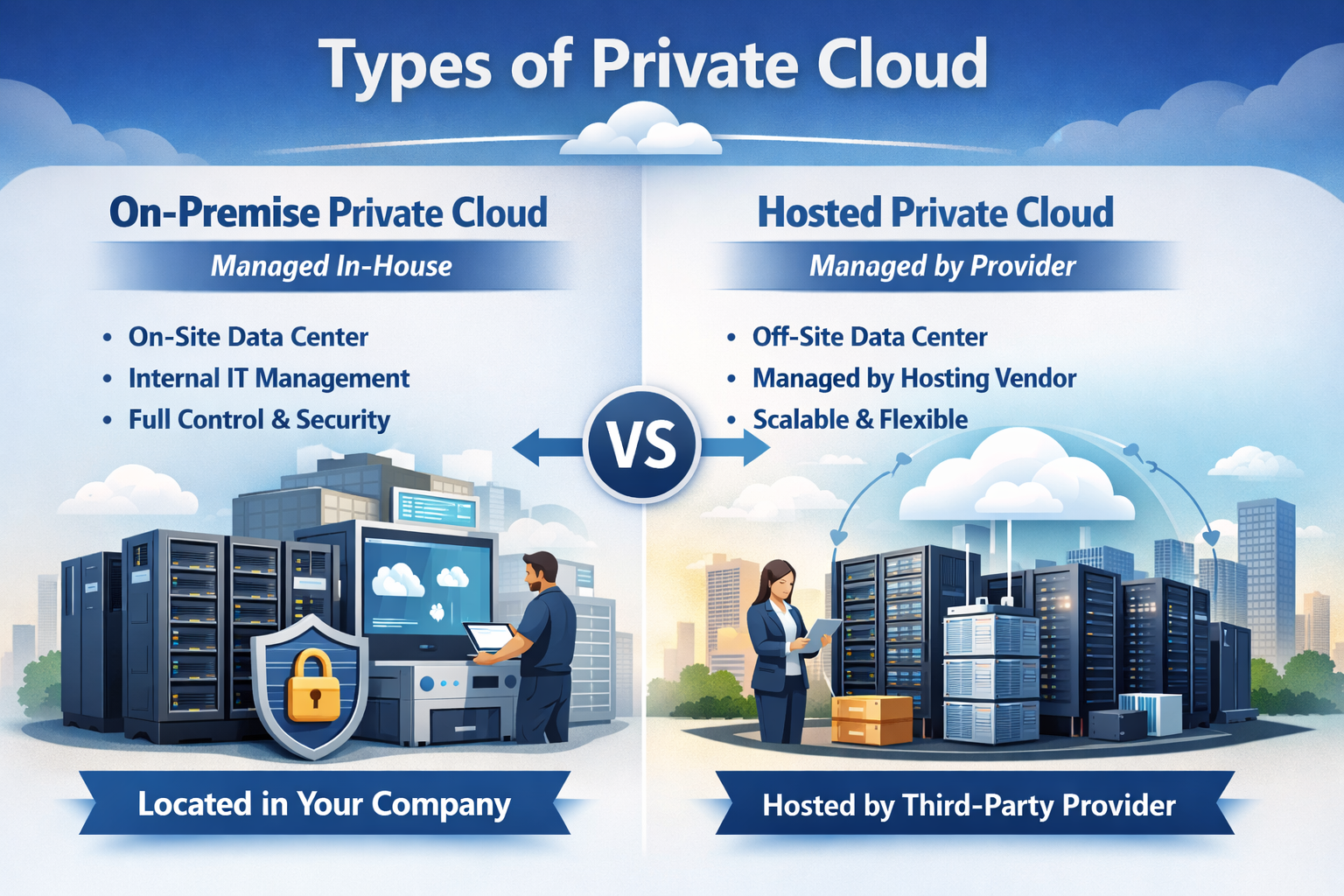
Let us explain each type of private cloud in detail.
1. On-Premise Private Cloud
On-premise private cloud is a cloud environment that is built, hosted, and managed within an organization’s own physical location, providing maximum control and security.
Key Features
These features explain how on-premise private cloud operates within an organization.
- Infrastructure Located On-Site: All servers, storage, and networking systems are installed within the organization’s premises, ensuring full physical control.
- Full Control Over Resources: Organizations manage hardware, software, configurations, and security policies without relying on external providers.
- High Security: Data remains inside the organization, reducing exposure to external threats and unauthorized access.
- Customization: Systems can be fully tailored to meet specific business and application requirements.
- Compliance Support: Easier to meet strict regulatory and legal requirements due to complete control over data.
Example
A bank sets up its own data center within its building to store and manage sensitive financial data, ensuring maximum security and compliance.
2. Hosted Private Cloud
Hosted private cloud is a cloud environment that is managed by a third-party provider but dedicated exclusively to a single organization.
Key Features
These features explain how hosted private cloud combines control with managed services.
- Off-Site Infrastructure: Servers and systems are located in the provider’s data center instead of the organization’s premises.
- Managed Services: The provider handles maintenance, updates, monitoring, and infrastructure management.
- Dedicated Environment: Resources are reserved for one organization only, ensuring privacy and security.
- Scalability: Easier to scale resources compared to on-premise setups.
- Reduced Management Burden: Organizations focus on applications while the provider manages infrastructure.
Example
A company rents a dedicated private cloud environment from providers like IBM or Microsoft Azure to securely host its applications without managing physical infrastructure.
Key Differences Between On-Premise and Hosted Private Cloud
This comparison highlights how both private cloud types differ in location, management, control, and cost.
| Feature | On-Premise Private Cloud | Hosted Private Cloud |
|---|---|---|
| Location | Located within the organization’s premises | Located at the provider’s data center |
| Management | Fully managed by the organization | Managed by the cloud provider |
| Control | Full control over infrastructure and configurations | Limited control compared to on-premise |
| Cost | Higher cost due to infrastructure and maintenance | Lower cost as provider manages infrastructure |
| Security | Very high security with internal control | High security with dedicated environment |
| Scalability | Limited scalability based on in-house resources | More scalable due to provider resources |
| Maintenance | Organization handles updates, monitoring, and maintenance | Provider handles maintenance and updates |
| Customization | Highly customizable according to business needs | Customization available but within provider limits |
| IT Effort | Requires skilled IT team and resources | Reduced IT effort due to managed services |
When to Choose Each Type
Choosing between on-premise and hosted private cloud depends on control, security needs, cost, and IT capabilities.
Use On-Premise Private Cloud When
On-premise private cloud is suitable for organizations that require maximum control and strict security.
- Complete Control Over Infrastructure: You need full authority over hardware, software, and configurations.
- Handling Highly Sensitive Data: Ideal for financial, healthcare, or government data that must remain on-site.
- Strong IT Resources Available: Organization has skilled IT staff to manage infrastructure and security.
- Strict Compliance Requirements: Data must meet strict regulatory and legal standards.
Use Hosted Private Cloud When
Hosted private cloud is ideal for organizations that want security with reduced management complexity.
- Reduced Maintenance Effort: Provider handles infrastructure, updates, and monitoring.
- Provider-Managed Infrastructure: No need to manage physical servers or hardware.
- Security with Simplicity: Dedicated environment with less operational burden.
- Scalability Needs: Easier to scale resources compared to on-premise setups.
Real-World Scenario
This example shows how organizations combine both types for optimal performance and security.
Example: Financial Institution
- On-Premise Private Cloud: Used to store and manage highly sensitive financial data with full control and security.
- Hosted Private Cloud: Used for running applications, customer services, and less sensitive workloads.
- Balanced Approach: Combines strong security with operational flexibility.
- Improved Efficiency: Reduces management burden while maintaining compliance and performance.
Top 5 FAQs (Interview & Exam Focused)
1. What are the types of private cloud?
The two main types are on-premise private cloud and hosted private cloud.
They differ based on infrastructure location and management responsibility.
2. What is on-premise private cloud?
It is a private cloud set up within an organization’s own data center.
The organization has full control over infrastructure and security.
3. What is hosted private cloud?
It is a private cloud hosted and managed by a third-party provider.
The infrastructure is off-site but dedicated to a single organization.
4. Which private cloud type is more secure?
On-premise private cloud is generally more secure because data stays within the organization.
However, hosted private cloud can also be secure with proper configurations.
5. Which type is more cost-effective?
Hosted private cloud is usually more cost-effective because it reduces infrastructure and maintenance costs.
On-premise cloud requires higher investment and management effort.
Conclusion
Private cloud can be deployed as on-premise or hosted, depending on an organization’s requirements for control, security, and management. On-premise private cloud offers maximum control, customization, and high-level security, making it ideal for handling highly sensitive data. In contrast, hosted private cloud reduces operational complexity and maintenance effort by allowing providers to manage the infrastructure.
Both models provide dedicated, secure, and reliable environments, ensuring data privacy and compliance. Understanding these deployment types helps organizations select the most suitable private cloud approach to build secure, efficient, and scalable systems aligned with their business needs.