












On-Demand Self-Service in Cloud Computing
On-demand self-service is a key feature of cloud computing that allows users to access and manage cloud resources instantly without human interaction from the service provider.
What is On-Demand Self-Service?
On-demand self-service means users can provision (create) and manage resources whenever they need.
- Instant Access: Resources are available anytime
- No Manual Approval: No need to contact provider
- User Control: Users manage services directly
What Does On-Demand Mean in Cloud?
On-demand refers to the ability to use cloud services whenever required without delay.
- Anytime Usage: Services are available 24/7
- Flexible Access: Use resources as needed
- Quick Provisioning: Resources are created instantly
How On-Demand Self-Service Works
On-demand self-service works by allowing users to access, configure, and manage cloud resources directly through automated systems without human intervention. Cloud providers offer dashboards and APIs that make the entire process fast and simple.Let Explain Step-by-Step Process
1. User Accesses Cloud Platform
The process starts when a user logs into a cloud platform using a web dashboard or API. Users authenticate using credentials to securely access their account.
2. Service Selection
The user selects the required cloud service such as virtual machines, storage, or databases. Different options are available based on performance, size, and usage needs.
3. Configuration of Resources
Users configure settings like CPU, memory, storage size, region, and operating system. This step allows customization based on specific application requirements.
4. Request Submission
After configuration, the user submits the request by clicking a button or using an API call. The system receives the request and prepares for execution.
5. Automated Provisioning
Cloud systems automatically allocate and set up the requested resources. No manual intervention is required from the provider side.
6. Resource Deployment
The configured resources are created and made ready for use within seconds or minutes. Users can immediately start using the services.
7. Monitoring and Management
Users can monitor performance, usage, and costs through dashboards. They can also modify, scale, or delete resources anytime.
8. Scaling and Optimization
Resources can be increased or decreased based on demand. This ensures efficient usage and cost control.
Simple Flow (Quick View)
Login → Select Service → Configure → Submit → Auto Provision → Use → Monitor & Scale
Key Features of On-Demand Self-Service
On-demand self-service allows users to quickly access and manage cloud resources without waiting for provider support, making cloud computing fast and efficient.
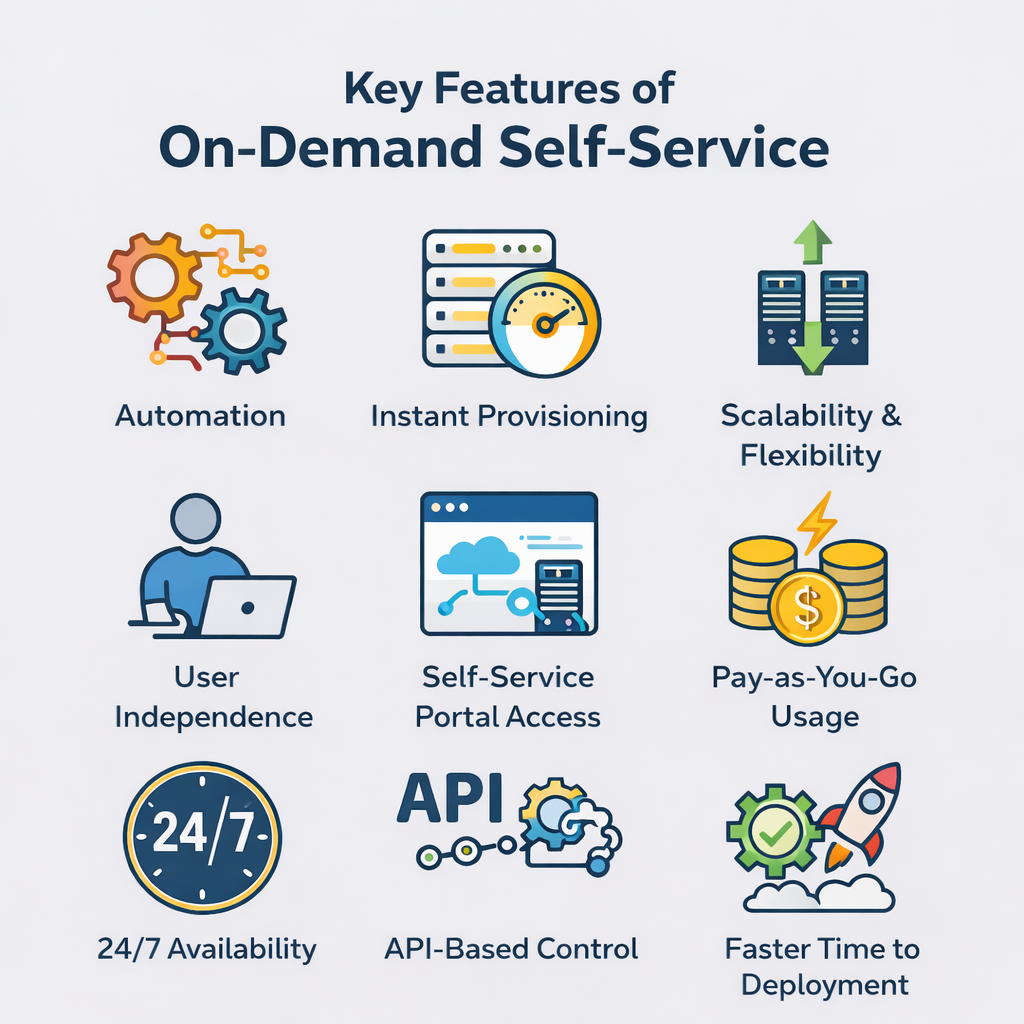
1. Automation
Cloud systems operate automatically without manual intervention from the provider.
Example: Creating a virtual server instantly using a cloud dashboard.
2. Instant Provisioning
Resources are available within seconds or minutes after request.
Example: Launching a new website server in seconds on a cloud platform.
3. Scalability and Flexibility
Resources can be increased or decreased based on demand.
Example: An online store increases server capacity during a sale.
4. User Independence
Users can manage services without contacting support teams.
Example: A developer deploys an app without asking the provider.
5. Self-Service Portal Access
Users control resources through easy-to-use dashboards or portals.
Example: Managing storage and databases from a cloud control panel.
6. Pay-as-You-Go Usage
Users are charged only for what they use.
Example: Paying only for the storage space used in cloud backup.
7. 24/7 Availability
Services are accessible anytime without restrictions.
Example: Accessing cloud applications at midnight without downtime.
8. API-Based Control
Services can be managed programmatically using APIs.
Example: Automatically scaling servers using scripts or tools.
9. Reduced Operational Effort
Cloud providers handle maintenance and infrastructure tasks.
Example: No need to update servers manually, cloud does it automatically.
10. Faster Time to Deployment
Applications can be launched quickly without setup delays.
Example: Launching a mobile app backend in minutes.
Benefits of On-Demand Self-Service
This feature provides several advantages.
- Speed: Resources are available instantly
- Flexibility: Use services anytime
- Cost Efficiency: Pay only for what you use
- Productivity: Reduces waiting time
- Scalability: Easily increase or decrease resources
- User Control: Full control over services and configurations
- Automation: No need for manual setup or intervention
- Accessibility: Access services from anywhere
- Faster Deployment: Launch applications quickly
- Efficient Resource Usage: Avoid wasting unused resources
- Reduced IT Dependency: Less reliance on support teams
- Improved Performance: Quick access to powerful infrastructure
- Time Saving: No delays in resource provisioning
- Business Agility: Quickly adapt to changing needs
Challenges of On-Demand Self-Service
Some challenges need to be managed properly in on demand self service which are given below
- Overuse of Resources: Users may create unnecessary resources
- Cost Increase: Improper usage can raise costs
- Security Risks: Misconfiguration can expose systems
- Lack of Cost Control: Without monitoring, spending can grow quickly
- Resource Sprawl: Too many unused or forgotten resources remain active
- Limited Governance: Hard to enforce rules across all users
- Access Mismanagement: Improper permissions can lead to misuse
- Compliance Issues: May not meet legal or industry standards
- Performance Issues: Poor configuration can reduce system efficiency
- Dependency on Internet: Requires stable and fast connectivity
- Skill Gap: Users need proper knowledge to manage resources correctly
- Vendor Lock-In: Difficult to switch providers once heavily used
- Monitoring Complexity: Hard to track all activities and usage
Importance of On-Demand Self-Service in Cloud Computing
On-demand self-service is a fundamental feature of cloud computing. key points are given below
- Enables Rapid Deployment: Quick setup of systems
- Improves Efficiency: Reduces delays
- Supports Scalability: Adjust resources easily
- Enhances Productivity: Users can focus on tasks instead of setup
- Reduces Operational Cost: No need for large IT teams or infrastructure
- Provides Flexibility: Resources can be changed anytime as needed
- Speeds Up Innovation: Faster development and testing of applications
- Ensures Better Resource Utilization: Use only what is required
- Supports Business Agility: Quickly respond to changing demands
- Minimizes Human Errors: Automation reduces mistakes
- Improves User Experience: Easy and quick access to services
- Enables Self-Control: Users manage their own resources independently
- Increases Service Availability: Services can be accessed anytime
Conclusion
On-demand self-service in cloud computing allows users to access and manage resources instantly without provider interaction. It improves speed, flexibility, and efficiency, making it a core feature of modern cloud systems.