
Key Characteristics of Cloud Computing Explained
Cloud computing is defined by a set of key characteristics that make it flexible, scalable, and efficient. These characteristics explain how cloud services work and why they are widely used.
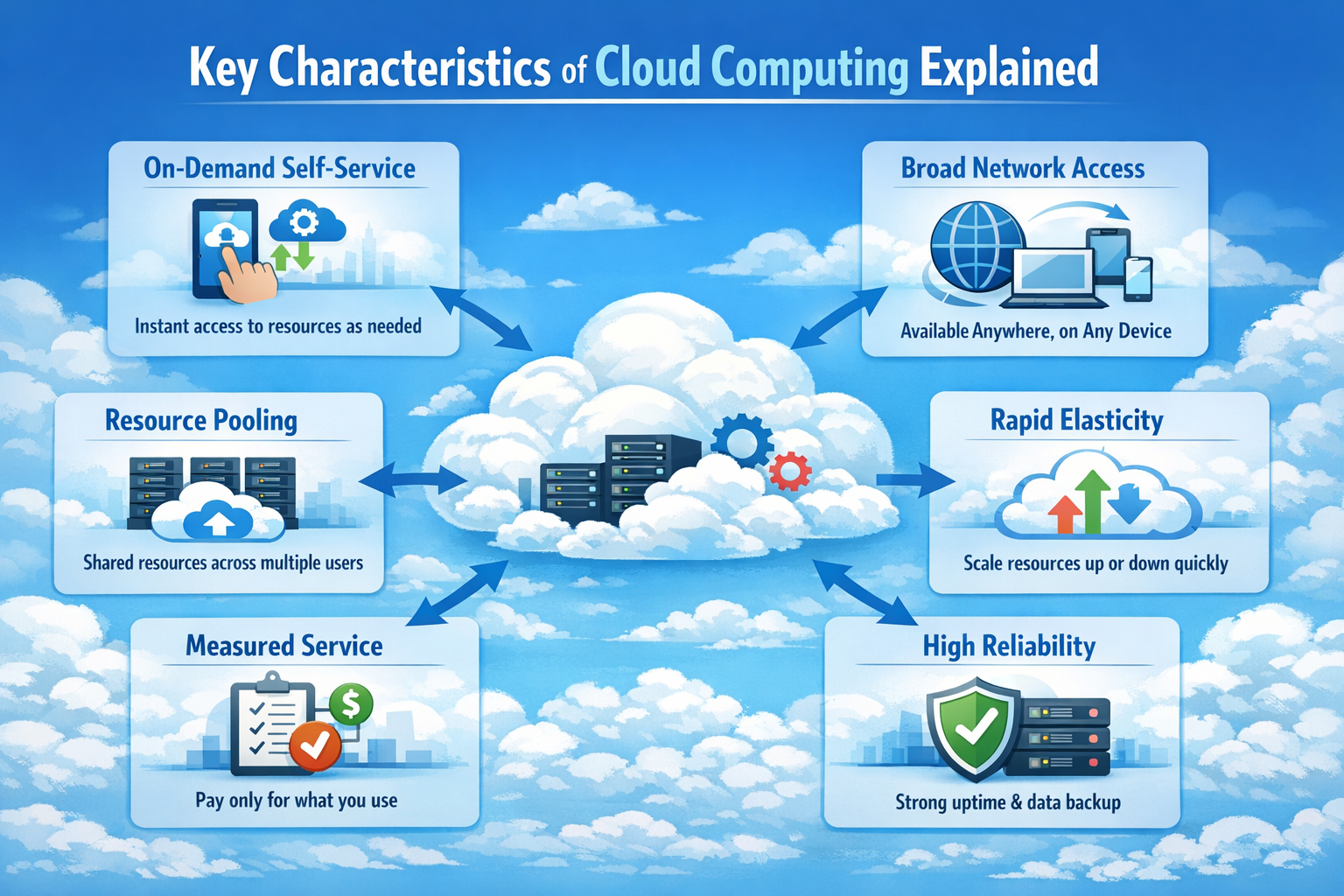
What are the Key Characteristics of Cloud Computing?
Key characteristics are the core features that define cloud computing and make it different from traditional IT systems.
1. Standard Features
These are the common properties present in all cloud systems.
Key Points
- Available on-demand without manual setup
- Accessible over the internet
- Uses shared resources (multi-user environment)
- Scalable and flexible infrastructure
- Built-in monitoring and billing system
2. Service Behavior
These explain how cloud services operate behind the scenes.
- Resources are automatically allocated and managed
- Services scale up and down based on demand
- Systems ensure high availability and reliability
- Usage is tracked and optimized continuously
- Operations are handled by cloud providers
3. User Benefits
These are the advantages users experience when using cloud computing.
- No need to buy or maintain hardware
- Cost savings with pay-as-you-go model
- Access services from anywhere
- Faster deployment of applications
- High performance and reliability
Why These Characteristics are Important
Understanding these characteristics helps in using cloud computing effectively and wisely.
1. Better Understanding
Learn how the cloud works in a simple and clear way.
- Understand system behavior and structure
- Build strong foundation for learning cloud
- Easily understand advanced topics
2. Improved Usage
Use cloud services in a more efficient and optimized way.
- Use only required resources
- Avoid unnecessary costs
- Manage services effectively
3. Smart Decisions
Choose the right cloud solutions based on your needs.
- Select suitable cloud service models
- Plan resources according to demand
- Control budget and costs
- Choose reliable providers
Main Characteristics of Cloud Computing
These are the five essential characteristics of cloud computing.
1. On-Demand Self-Service
On-demand self-service allows users to access and manage cloud resources instantly without human interaction.
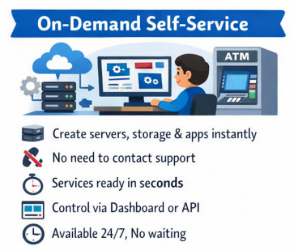
Examples for On-Demand Self-Service
Here are some examples of on-demand self-service
Example 1: ATM Machine
On-demand self-service is like using an ATM machine.
- You can withdraw money anytime without bank staff
- No need to wait in line or request help
- Services are available 24/7
- You control the process yourself
Same in the cloud: Users can create servers or storage anytime without contacting the provider.
Example 2: Online Shopping
It is like ordering products from an online store.
- You select and order items by yourself
- No need to talk to a salesperson
- Instant confirmation after placing order
- Available anytime from anywhere
Same in cloud: Users can choose and activate services instantly through a dashboard.
Key Points about On-Demand Self-Service
- Users can create and manage resources anytime
- No need to contact service provider
- Instant access to services (fast provisioning)
- Fully controlled through dashboard or API
- Saves time and reduces manual work
- Available 24/7 without delay
- Easy to scale resources when needed
2. Broad Network Access
Broad network access means cloud services are available over the internet and can be accessed from different devices and locations.
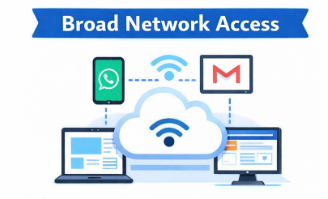
Example for Broad Network Access
Here are some examples of broad network access
Example 1: Gmail / Email Service
Broad network access is like using email services such as Gmail.
- You can open your email on phone, laptop, or tablet
- Access from home, office, or anywhere
- Only an internet connection is needed
- Same data is available on all devices
Same in the cloud: Users can access applications and data from any device through the internet.
Example 2: YouTube / Streaming Services
It is like watching videos on YouTube.
- Watch videos on mobile, laptop, or smart TV
- Access content from anywhere in the world
- No need to download files
- Works on different platforms (Android, iOS, Windows)
Same in cloud: Cloud services are accessible globally across multiple devices.
Key Points about Broad Network Access
- Accessible from smartphones, laptops, tablets, and desktops
- Requires internet connectivity
- Supports multiple platforms and operating systems
- Enables remote work and global access
- No dependency on a specific device or location
- Easy and flexible access for users worldwide
Broad network access means cloud services can be accessed from anywhere using the internet. It is like using WhatsApp or Gmail; you can open it on any device anywhere.
3. Resource Pooling
Resource pooling means cloud providers share their resources among many users.
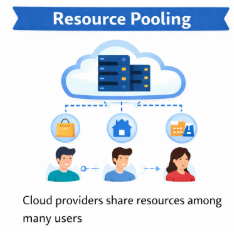
Example for Resource Pooling
Here are some examples of resource pooling
Example 1: Electricity Supply
Resource pooling is like electricity in your home.
- Many homes use electricity from the same power grid
- You don’t know which exact power station your electricity comes from
- Power is distributed based on demand
- Everyone shares the same infrastructure
Same in the cloud: Many users share servers, but each gets what they need.
Example 2: Internet (Wi-Fi / ISP)
It is like using the internet service in your area.
- Many users connect to the same network
- Bandwidth is shared among users
- Resources are managed automatically
- Each user experiences separate usage
Same in cloud: Multiple users share network and servers efficiently.
Key Points about Resource Pooling
- Multiple users share servers, storage, and networks
- Resources are assigned based on demand
- Uses a multi-tenant model (many users, one system)
- Improves efficiency and reduces cost
- Users don’t know the exact resource location
- Managed automatically by the cloud system
4. Rapid Elasticity
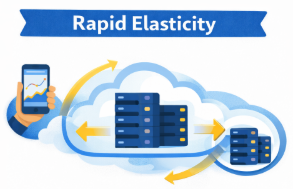
Rapid elasticity means the cloud can quickly increase or decrease resources automatically. It is like a rubber band — it stretches when needed and shrinks back.
Example for Rapid Elasticity
Here are some examples of rapid elasticity
Example 1: Online Shopping Sale
Rapid elasticity is like an online store during a big sale.
- More users visit the website during sales
- The system automatically handles high traffic
- Extra resources are added instantly
- After the sale, resources are reduced
Same in the cloud: Resources increase during high demand and decrease when demand is low.
Example 2: Video Streaming Peak Time
It is like watching videos during peak hours.
- More people watch videos at night
- Platform increases capacity automatically
- Smooth streaming without interruption
- Resources reduce when fewer users are active
Same in cloud: Cloud adjusts resources automatically to maintain performance.
Key Points about Rapid Elasticity
- Resources scale up during high demand
- Scale down when demand decreases
- Automatic scaling without manual effort
- Handles traffic spikes easily
- Saves cost by using only required resources
- Ensures consistent performance
5. Measured Service (Pay-as-You-Go)
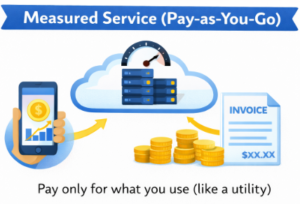
Measured service means you pay only for what you use, just like utility services.
Example for Measured Service
Here are some examples of measured service
Example 1: Electricity Bill
Measured service is like your electricity usage.
- You pay for the units you consume
- Usage is recorded by a meter
- No fixed cost if usage is low
- Billing is transparent
Same in the cloud: You pay only for the resources you use.
Example 2: Mobile Data Plan
It is like using mobile internet data.
- You are charged based on data usage
- More usage means higher cost
- Less usage means lower cost
- Usage is tracked automatically
Same in cloud: Cloud tracks usage and charges accordingly.
Key Points about Measured Service
- Usage is tracked (CPU, storage, bandwidth, etc.)
- Pay-as-you-go pricing model
- No upfront cost required
- Transparent and flexible billing
- Helps control and optimize costs
- Suitable for all business sizes
6. High Availability
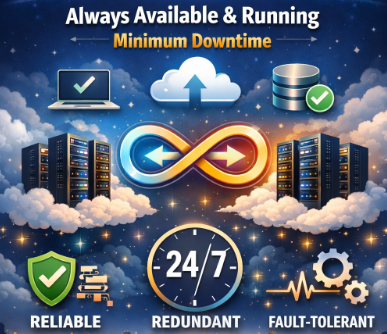
High availability means cloud services are always available and running with minimum downtime.
Example for High Availability
Here are some examples of high availability
Example 1: Power Backup System
High availability is like having a power backup (UPS or generator).
- If electricity goes off, backup power starts instantly
- No interruption in important work
- System keeps running continuously
- Users may not even notice the switch
Same in the cloud: If one server fails, another server immediately takes over.
Example 2: Multiple Roads to a Destination
It is like having multiple roads to reach the same place.
- If one road is blocked, you can take another route
- Travel continues without stopping
- No single point of failure
- Alternative paths ensure smooth movement
Same in cloud: Cloud uses multiple servers and paths to keep services available.
Key Points about High Availability
- Systems remain active 24/7 with minimal downtime
- Backup systems (redundancy) are always available
- Automatic failover if a server fails
- Load balancing distributes traffic across servers
- Data is stored in multiple locations (data centers)
- Ensures reliable and continuous service
- Important for critical applications (banking, e-commerce)
Deep Concepts in Cloud Characteristics
Understanding these concepts gives deeper insight into cloud computing.
Multi-Tenancy
Multiple users share the same infrastructure securely.
Each user’s data is isolated from others.
Scalability vs Elasticity
Scalability allows growth of resources.
Elasticity adjusts resources automatically.
Automation
Cloud systems automate provisioning and management.
This reduces manual work and errors.
Real-World Example
A company uses cloud services for its application:
- Creates servers instantly (on-demand)
- Users access app from different devices (broad access)
- Resources are shared (resource pooling)
- System scales during high traffic (elasticity)
- Pays based on usage (measured service)
This shows all key characteristics working together.
Benefits of These Characteristics
These characteristics provide major advantages.
- Flexibility: Use services anytime
- Scalability: Handle growth easily
- Cost Efficiency: Pay only for usage
- Performance: Fast and reliable systems
Conclusion
The key characteristics of cloud computing—on-demand self-service, broad network access, resource pooling, rapid elasticity, and measured service—define how cloud systems operate. Understanding these features helps users take full advantage of cloud technology.