
History and Evolution of Cloud Computing
Cloud computing has evolved over time from simple computing concepts to a powerful technology that supports modern applications and services. Understanding its history helps in learning how cloud systems developed and improved.
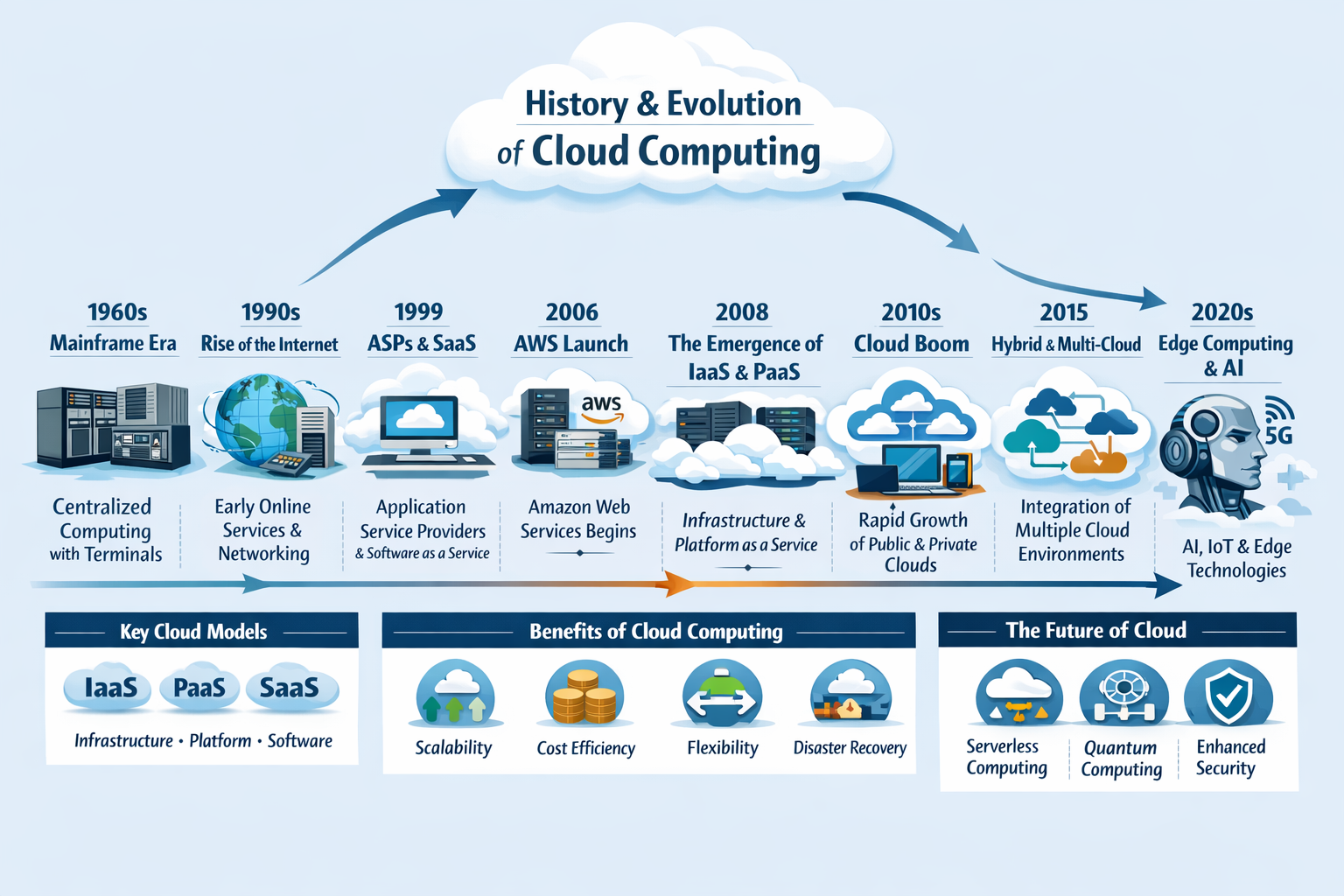
What is the History of Cloud Computing?
The history of cloud computing refers to the development of technologies that led to modern cloud systems.
- Early Concepts: Idea of shared computing resources
- Technological Growth: Development of internet and virtualization
- Modern Cloud: On-demand services and global platforms
Why Understanding the Evolution is Important
Learning the evolution of cloud computing helps in understanding current technologies and future trends.
- Better Understanding: See how cloud developed
- Technology Awareness: Learn key innovations
- Future Insight: Understand upcoming advancements
Early Computing Era (1960s – 1980s)
This period introduced the concept of shared computing resources.
Key Developments
- Mainframe Computing: Large computers used by multiple users
- Time-Sharing Systems: Users shared computing power
- Concept of Utility Computing: Idea of computing as a service
Client-Server Model (1990s)
The client-server model improved communication between systems.
Key Developments
- Personal Computers: Increased use of individual devices
- Client-Server Architecture: Clients request services from servers
- Network Growth: Expansion of internet connectivity
Internet and Web-Based Services (Late 1990s – Early 2000s)
The internet enabled online services and applications.
Key Developments
- Web Applications: Software accessed through browsers
- Data Centers: Centralized systems for data storage
- Early SaaS Models: Software delivered over the internet
Emergence of Cloud Computing (2000s)
Modern cloud computing began to take shape during this period.
Key Developments
- Virtualization Technology: Efficient use of hardware
- On-Demand Services: Resources available instantly
- Launch of Cloud Platforms: AWS, Google Cloud, Azure
Growth and Expansion (2010s)
Cloud computing became widely adopted across industries.
Key Developments
- Scalability: Ability to handle large workloads
- Mobile and Web Integration: Cloud supports apps and devices
- Big Data and Analytics: Processing large datasets
Modern Cloud Era (2020s – Present)
Cloud computing continues to evolve with advanced technologies.
Key Developments
- AI and Machine Learning Integration: Smarter cloud systems
- Serverless Computing: No infrastructure management
- Multi-Cloud and Hybrid Cloud: Flexible deployment models
- Edge Computing: Faster processing near users
Deep Concepts in Cloud Evolution
Understanding these concepts helps in learning how cloud evolved.
Virtualization
Enabled multiple virtual systems on one machine.
This made cloud computing efficient and scalable.
Distributed Computing
Workloads are spread across multiple systems.
This improves performance and reliability.
Service-Oriented Architecture (SOA)
Applications are built as services.
This supports modular and flexible systems.
Timeline Summary
A simple overview of cloud computing evolution.
- 1960s–1980s: Mainframes and time-sharing
- 1990s: Client-server model
- 2000s: Emergence of cloud computing
- 2010s: Rapid growth and adoption
- 2020s: Advanced and intelligent cloud systems
Real-World Impact
Cloud computing has transformed industries and daily life.
- Online services and applications
- Remote work and collaboration
- Data storage and analytics
- Streaming and social media
Benefits of Cloud Evolution
The evolution of cloud computing has brought major advantages.
- Improved Performance: Faster and efficient systems
- Global Access: Services available worldwide
- Scalability: Handle growing demands
- Innovation: Support modern technologies
Conclusion
The history and evolution of cloud computing show how technology has progressed from shared computing systems to advanced cloud platforms. This evolution has made cloud computing a vital part of modern digital infrastructure.