












Binary Division Rules
Binary division is a basic arithmetic operation in the binary number system. It is used to divide one binary number by another binary number. Binary division follows a process similar to decimal division, but it uses only two digits: 0 and 1.
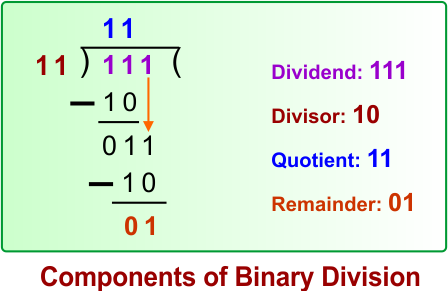
Binary division consists of four main components:
- Dividend: The binary number that is being divided.
- Divisor: The binary number used to divide the dividend.
- Quotient: The result obtained after division.
- Remainder: The value left after completing the division.
The following diagram shows the components of binary division
What Are Binary Division Rules?
Binary division rules explain how to divide binary digits. These rules are simple because the binary number system contains only two digits.
The following table shows the basic binary division rules
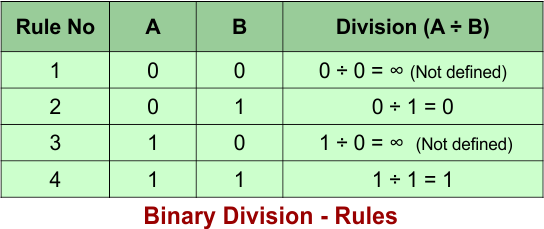
According to the above diagram, the following points explain how binary division works:
- Dividing 0 by 1 always gives 0.
- Dividing 1 by 1 always gives 1.
- Dividing any number by 0 is undefined.
- Binary division follows the same long-division process as decimal division.
- Subtraction and multiplication are used during binary long division.
Important: Division by zero is undefined in both binary and decimal number systems.
How to Perform Binary Division?
Binary division uses a step-by-step process similar to decimal long division. Follow these steps to divide binary numbers:
- Step 1: Compare the divisor with the current bits of the dividend and write 0 or 1 in the quotient.
- Step 2: Multiply the divisor by the quotient digit and write the product below the selected bits.
- Step 3: Subtract the product from the selected bits to find the remainder.
- Step 4: Bring down the next bit of the dividend and repeat the process until all bits have been used.
Binary Division Examples
The following binary division examples explain how to apply binary division rules to different binary numbers.
Example 1: Divide (11)₂ by (11)₂
Let’s divide the binary 11 by 11. The following diagram explains the process
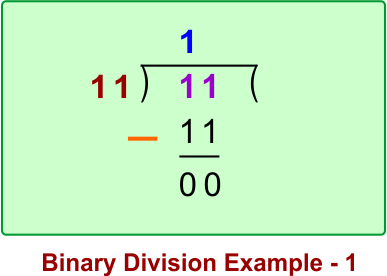
According to the above diagram, Example 1
- Binary value: 11 ÷ 11 = 1
- Quotient = 1
- Remainder = 0
- Decimal proof: 3 ÷ 3 = 1
Example 2: Divide (11)₂ by (10)₂
Let’s divide the binary 11 by 10. The following diagram explains the process
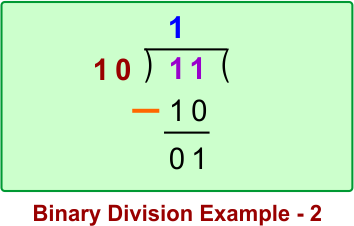
According to the above diagram, Example 2
- Binary value: 11 ÷ 10 = 1
- Quotient = 1
- Remainder = 1
- Decimal proof: 3 ÷ 2 = 1, remainder 1.
Example 3: Divide (111)₂ by (10)₂
Let’s divide the binary 111 by 10. The following diagram explains the process
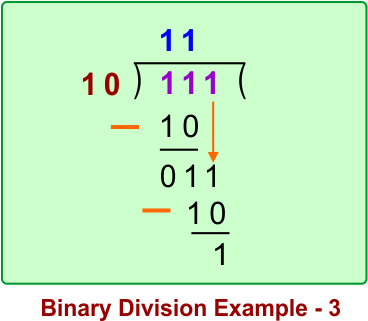
According to the above diagram, Example 3
- Binary value: 111 ÷ 10 = 11
- Quotient = 11
- Remainder = 1
- Decimal proof: 7 ÷ 2 = 3, remainder 1.
Example 4: Divide (11101)₂ by (10)₂
Let’s divide the binary 11101 by 10. The following diagram explains the process
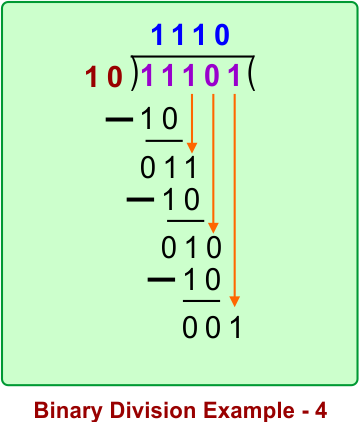
According to the above diagram, Example 4
- Binary value: 11101 ÷ 10 = 1110
- Quotient = 1110
- Remainder = 1
- Decimal proof: 29 ÷ 2 = 14, remainder 1.
Example 5: Divide (1110010)₂ by (10)₂
Let’s divide the binary 1110010 by 10. The following diagram explains the process
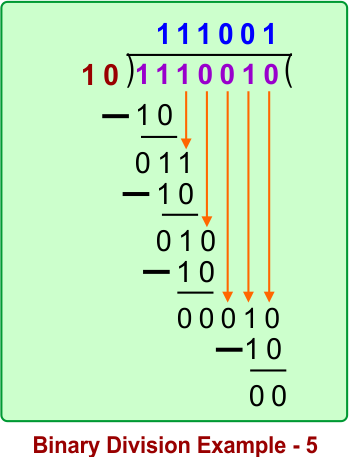
According to the above diagram, Example 5
- Binary value: 1110010 ÷ 10 = 111001
- Quotient = 111001
- Remainder = 0
- Decimal proof: 114 ÷ 2 = 57.