








Microsoft Power Platform Partners That Specialize in Manufacturing Automation Solutions
Smart manufacturing is now the entry ticket, not a moon-shot. Deloitte’s 2025 survey shows 92 percent of manufacturers see it as their top competitiveness driver through 2028. Yet many plants still juggle siloed ERP, MES, spreadsheets, and paper checklists—so data hides and automation stalls.
Microsoft Power Platform unblocks flow with low-code apps, flows, portals, and dashboards—but the partner you choose makes the difference. We scored 20 firms on public proof of manufacturing results, platform depth, IP, Microsoft standing, outcomes, and reach, and mapped when each excels. Use the scorecard and RFP checklist to close the gap with confidence.
What we mean by manufacturing automation on Microsoft Power Platform
We’re talking about workflows that keep production moving, not lab pilots. Picture a tablet app that records a quality check, a flow that pushes a parts request straight into ERP, or a dashboard that flags unplanned downtime within seconds.
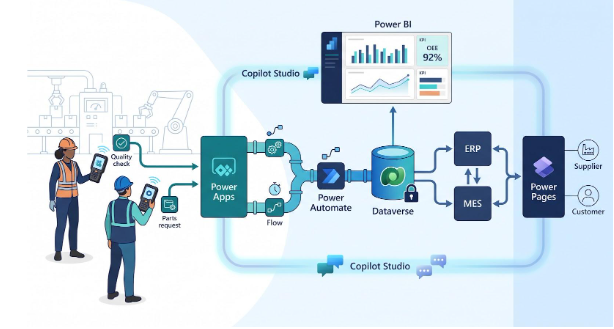
Here’s how each service contributes:
- Power Apps captures data and guides operators step by step.
- Power Automate moves that data between people and systems.
- Dataverse stores operational records under role-based security.
- Power BI turns numbers into at-a-glance insight.
- Power Pages opens secure portals for suppliers and customers.
- Copilot Studio threads AI through every step so technicians can ask questions in plain language.
Technology alone falls short. A partner must know takt time versus OEE, a maintenance ticket versus a non-conformance report, and why offline sync matters when Wi-Fi drops on the shop floor. MCA Connect’s overview of manufacturing process automation shows the low-code scope we evaluated: apps, flows, and dashboards that replace spreadsheets, email, and manual steps in sales orders, production planning, time tracking, and customer service. Every firm on our list met the same evidence bar for manufacturing proof, Microsoft credentials, and measurable results.
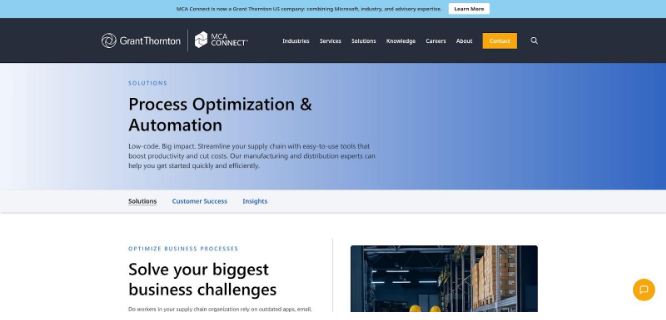
MCA Connect manufacturing process automation page screenshot
If that level of rigor matches your expectations, keep reading. Next, we draw the line between workflows suited to Power Platform and those that require hard real-time control.
Where Power Platform shines on the factory floor
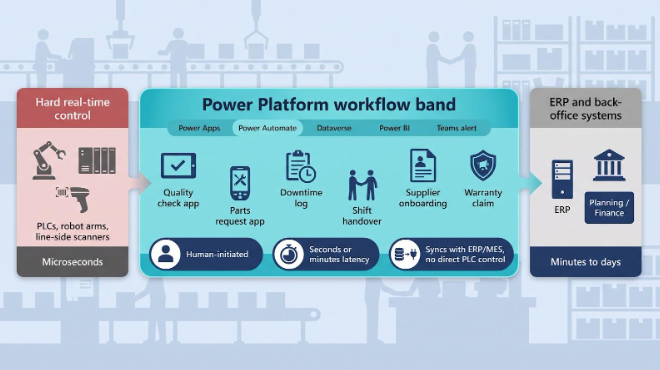
Power Platform fills the workflow gap between a line-side scanner and the ERP, covering jobs measured in seconds, not microseconds.
- A quality-check app logs the lot number, snaps a photo, and starts an approval flow. Maintenance sees the alert in Teams before a bad batch advances, with no PLC edits and no extra MES licences.
- A parts-request app at each work centre reserves inventory, prints a pick ticket, and pings the forklift driver. Twenty minutes later the line is still running, not waiting. Dataverse stores the history, and supervisors track progress in Power BI.
What ties these wins together?
- A human starts the action.
- Seconds or minutes of latency are acceptable.
- Data syncs with core systems and never touches hard real-time control.
In that band—quality checks, downtime logs, shift handovers, supplier onboarding, warranty claims—Power Platform delivers quick wins without rewiring the plant. The next section explains where to stop and hand control back to deterministic systems.
Know when to hit the brakes
Low code is powerful, until someone expects it to stop a robot arm in 5 ms. That speed is outside Power Platform’s lane.
Factory control loops rely on deterministic signals, safety-rated PLCs, and sub-millisecond response times. Cloud or even edge apps cannot guarantee that pace or the required validation, and the stakes include worker safety and regulatory compliance.
A competent partner keeps the line clear:
- Use Power Apps only where seconds or minutes are acceptable, then hand off to equipment through an MES, OPC UA broker, or IoT edge.
- Never rewrite a safety-instrumented system in a canvas app or let Power Automate drive a servo.
Think of the ISA-95 stack: enterprise planning at the top, real-time control at the bottom, and a collaboration layer in between. Power Platform belongs in that middle tier, orchestrating data across ERP, MES, maintenance, quality, and supply chain, and it complements rather than replaces hard real-time systems.
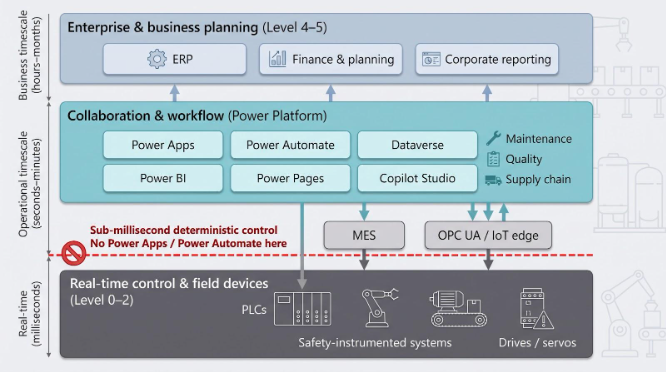
That bright line is what separates a true manufacturing specialist from a generic app shop.
How we scored the twenty partners
First, we ignored glossy vendor decks and relied only on public evidence: Microsoft customer stories, Marketplace listings, press releases, and case studies. Any claim without a published source earned zero points.
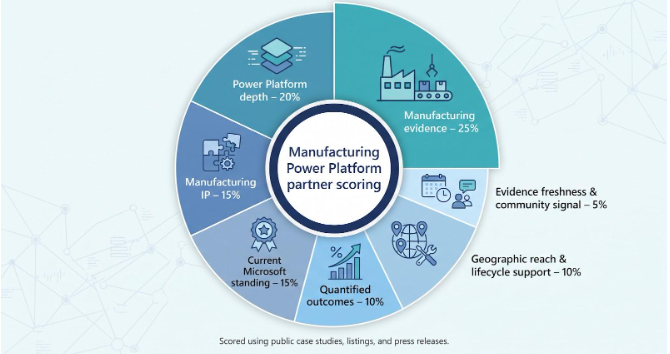
We weighted seven criteria that matter on the factory floor:
| Criterion | Weight | What we looked for |
| Manufacturing evidence | 25 percent | Multiple recent plant-floor or supply-chain projects |
| Power Platform depth | 20 percent | Proof across Apps, Automate, Dataverse, BI, Pages, and Copilot |
| Manufacturing IP | 15 percent | Reusable apps, data models, or accelerators that shorten time to value |
| Current Microsoft standing | 15 percent | Solutions Partner designations, specializations, Inner Circle, Partner-of-the-Year wins |
| Quantified outcomes | 10 percent | Hard numbers: time saved, scrap reduced, dollars captured |
| Geographic reach & lifecycle support | 10 percent | Implementation plus managed services where you operate |
| Evidence freshness & community signal | 5 percent | Sources from the past 24 months, open-source work, MVP presence |
Legacy Gold and Silver badges scored zero because Microsoft retired them on September 30, 2022 in favor of Solutions Partner designations, according to Microsoft Partner Center documentation.
One more rule: “Not publicly disclosed” counts as missing evidence, not hidden excellence. That bias rewards the transparency you need in a long-term partner.
Next up: a condensed scorecard so you can see who leads—and why—at a glance.
The evidence-order leaderboard at a glance
Need a shortlist quickly? The table below shows the top 10 by evidence score; the fit guide that follows covers the rest of the field.
| Rank | Partner | Evidence score | Ideal buyer profile | Manufacturing IP depth | Named manufacturing clients | Geographic reach | Public pricing signal |
| 1 | MCA Connect | 97 | Multi-plant Microsoft stack | High | Wenger, Trivium Packaging, Zurn | Global | Free 30-minute discovery assessment |
| 2 | Avanade | 95 | SAP + Microsoft global programs | High | ExxonMobil, Bridgestone | Global | Custom quote |
| 3 | Hitachi Solutions | 94 | Enterprise low-code scale-ups | Medium-high | HCMA, Intralox | Global | Custom quote |
| 4 | Capgemini | 91 | Edge-to-cloud transformation | High | Consumer-goods group (100 k requests) | Global | Custom quote |
| 5 | HSO | 90 | D365 or SAP manufacturers | Medium-high | HEINEKEN UK, Thomas Concrete | Global | Free discovery |
| 6 | HCLTech | 90 | Multisite IT/OT convergence | High | Global building-materials firm | Global | Custom quote |
| 7 | PwC | 90 | Advisory-led operating-model change | Medium | Mustang Machinery, Grande Cheese | Global | Custom quote |
| 8 | RSM US | 88 | North-American middle market | Medium | G&J Pepsi, Lyons Magnus | North America | Custom quote |
| 9 | Alithya | 88 | Packaged manufacturing Power Apps | High | ChemTreat, Gay Lea | N. America, Morocco | Custom quote |
| 10 | TCS | 86 | Industrial AI & autonomous ops | High | DuPont | Global | Custom quote |
A high score signals strong public evidence, not automatic fit. A 76-point regional specialist may still beat a 95-point global SI for a single-site rollout. Match the partner to your context.
Which partner fits your project?
Match your situation to the partners with the strongest published proof:
- Dynamics 365 Finance & Supply Chain plus last-mile automation
MCA Connect, Hitachi Solutions, HSO, RSM, Alithya, Stoneridge - SAP core with Power Platform extensions
Avanade, HSO, Capgemini, Infosys, MCA Connect - MES, OT networks, or multisite integration
Capgemini, HCLTech, Avanade, TCS, PwC - North American middle market (≈1–10 plants)
RSM, Stoneridge, Western Computer, Sunrise, Velosio - Packaged manufacturing apps (quality, OEE, warranty, etc.)
Alithya, COSMO CONSULT, MCA Connect, Western Computer - UK-focused delivery
Bridgeall - Cost-conscious offshore bench
DynaTech (verify references)
Short-list three partners, run the same discovery workshop with each, and compare roadmaps, staffing plans, and five-year total cost before choosing a winner.
Architecture and governance checklist
Pressure-test every proposal against Microsoft’s Power Platform Well-Architected framework:
Data store
- Decide Dataverse, SharePoint, or SQL; clarify schema ownership and scaling plans if volume spikes.
Offline and sync
- Demand proven offline profiles, conflict-resolution logic, and user prompts for collisions.
Integration patterns
- Use idempotent APIs, queues, and retries; never rely on screen scraping for ERP, MES, and historians.
Failure handling & monitoring
- Every flow should log, alert, and auto-retry, and failures must surface on a live dashboard.
ALM & environments
- Implement source control, automated pipelines, and least-privilege service accounts across dev → test → prod.
DLP & connector governance
- Document blocked connectors, service-account scopes, and the exemption process.
Access & segregation of duties
- Quality inspectors should not view payroll data, and citizen developers must not deploy to production.
Disaster recovery
- Define RPO, RTO, and the 2 am call tree before go-live.
Telemetry & business KPIs
- Capture app telemetry plus baseline scrap, downtime, or cycle time for ROI tracking.
Citizen-developer enablement
- Provide training, code templates, and a backlog cadence so apps live beyond the project.
AI governance & Copilot credits
- Validate AI-generated artifacts and budget credit consumption as you would for code.
License & capacity planning
- Model five-year growth for licences, Dataverse storage, and RPA bots so invoices never surprise you.
Data retention & compliance
- Specify retention rules, signatures, and audit-trail access for regulated industries.
Run this list in your next workshop. If a partner blinks at any point, keep looking.
Pricing and engagement models: put total cost on the table
Sticker shock happens when licences, services, and support blur together. Split them early so finance, IT, and operations share the same view.
Microsoft list prices (US, at the time of writing)
- Power Apps Premium – $20 per user/month
- Power Automate Premium – $15 per user/month
- Process (unattended) RPA bot – $150 per bot/month
- Hosted RPA bot – $215 per bot/month
Add-ons such as storage, premium connectors, and Copilot Credits grow as adoption rises, so quote them separately from partner services.
Consulting fees usually fall into three buckets
- Discovery and assessment
Free starting points are common; MCA Connect, for example, offers a free 30-minute low-code discovery assessment, while multi-week governance workshops are usually paid. Treat deeper assessment work as paid due diligence; even if you walk away, the output sharpens your RFP. - Implementation
First app = fixed scope (≈10–16 weeks).
Expansion = time-and-materials.
Ask for a capacity burn chart and a not-to-exceed cap tied to acceptance criteria, not hours. - Managed services
Options include flat monthly fee, per-incident, or enhancement sprints.
Insist on a five-year run rate that covers expected licence growth, Dataverse storage, and bot counts. The cheapest build can become the priciest asset if support doubles every year.
Scope drives price
Never compare a single-app quote with a multi-site Center of Excellence rollout. A transparent partner models cost scenarios so you see the ramp from pilot to enterprise scale before you sign.
2026 product and market trends: why today’s bet still pays tomorrow
Microsoft now ships new Power Platform features every month through an AI-driven roadmap, so governance must keep pace. Below are the shifts shaping manufacturing projects in 2026.
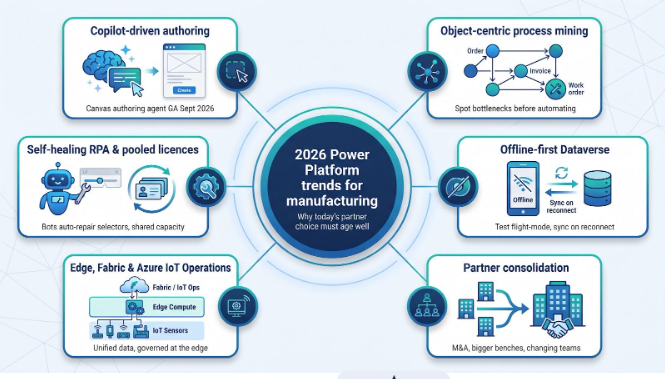
Copilot-driven authoring
Copilot in Power Apps lets engineers draft screens and apps with plain language. Speed rises, but version sprawl follows unless generated artefacts go through the same review and test gates as code.
Object-centric process mining
Power Automate now maps orders, invoices, and maintenance jobs in one model. Manufacturers use it to spot bottlenecks before automating the wrong step. Ask partners how they weave mining into value-stream mapping.
Self-healing RPA and pooled licences
Desktop flows auto-repair UI selectors, while new flow-group licencing lets unused capacity shift to other bots. Confirm that your plan exploits pooling instead of overbuying stand-alone bots.
Offline-first Dataverse
Offline profiles and sync diagnostics let teams test flight-mode behaviour in minutes. A credible partner will demo a Faraday-cage capture and clean sync on reconnect.
Edge, Fabric, and Azure IoT Operations
Fabric unifies data across ERP, MES, and historian feeds; Azure IoT Operations extends governance to the edge. Winning architectures layer insight over existing PLCs instead of ripping them out.
Ongoing partner consolidation
Mergers and private-equity deals keep reshaping the partner field. Larger benches can broaden skills, but ownership changes can also shuffle delivery teams, so lock escalation paths and SLAs into any contract.
Trends will keep swinging, yet the fundamentals remain: governed data, measurable outcomes, and partners who ship value before the next feature lands.
Copy-and-paste RFP questions
Use the questions below to turn a glossy proposal into a concrete delivery plan. Drop them into your RFP and compare responses side by side.
- Project proof Name three manufacturing Power Platform projects delivered in the past 24 months and list the team members on each.
- Local skills How many Power Platform-certified professionals work in the region where our plants operate?
- Delivery model Break down on-site, near-shore, and offshore work; include percentages and time-zone overlap.
- Architecture Provide a production diagram that shows failure handling, monitoring, and offline sync.
- Offline demo Demonstrate an app capturing data offline, generating a conflict, and resolving it automatically.
- Systems integration Show how the solution connects to our ERP, MES, PLM, WMS, historian, and identity services.
- Accelerators/IP Which accelerators do you own, and how are they licensed after contract end?
- Code ownership Who owns source code and DevOps pipelines once the project closes?
- ALM process Describe branches, environments, automated tests, and release cadence.
- Flow resilience How are Power Automate failures surfaced and retried? Who receives the first alert?
- RPA security Detail storage, rotation, and audit of unattended RPA credentials.
- Adoption plan Outline training, citizen-developer support, and backlog grooming.
- KPIs List the operational metrics you will baseline and the target improvements.
- Five-year cost Provide a cost model for licences, support, enhancements, and Dataverse storage.
- References Give two manufacturing clients we may contact; include names, roles, and contact details.
- Recent M&A List acquisitions in the past two years and explain changes to staffing or support.
- Technology boundaries Where would you advise us not to use Power Platform, and what would you use instead?
Red flags: signs you should walk away
Watch for these warning signs before you sign:
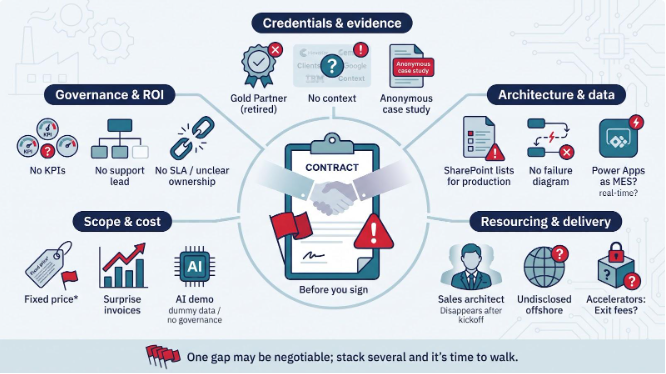
Credentials and evidence
- Website still shows a “Gold Partner” badge; Microsoft retired it in 2022.
- No named manufacturing case studies, only anonymous “global leader” claims.
- Client logos appear with no project context.
Architecture and data
- Defaulting to SharePoint lists for production data; cheaper now, costly later compared with Dataverse.
- No diagram for failed-flow handling, offline conflicts, or automated retries.
- Power Apps pitched as a full MES replacement with no real-time caveats.
Resourcing and delivery
- Sales architect disappears after kickoff, replaced by junior staff you never met.
- Offshore staffing undisclosed until contract signature.
- Proprietary accelerators have opaque licence terms or exit fees.
Scope and cost
- “Fixed-price” excludes integration, testing, deployment, or support in the fine print.
- AI demos use dummy data with no governance plan or Copilot-credit budget.
- No five-year licence or capacity model, making surprise invoices likely.
Governance and ROI
- No operational KPIs baselined, so ROI will be impossible to prove.
- Post-go-live ownership unclear: no named support lead, SLA, or escalation path.
A single gap may be negotiable; stack several and it is time to walk.