












Multi-Cloud Use Cases
Multi-cloud is a cloud strategy where organizations use multiple cloud service providers to run applications, store data, and manage workloads. It is widely used in real-world scenarios to improve flexibility, performance, and reliability. Understanding multi-cloud use cases helps students and professionals connect concepts with practical applications.
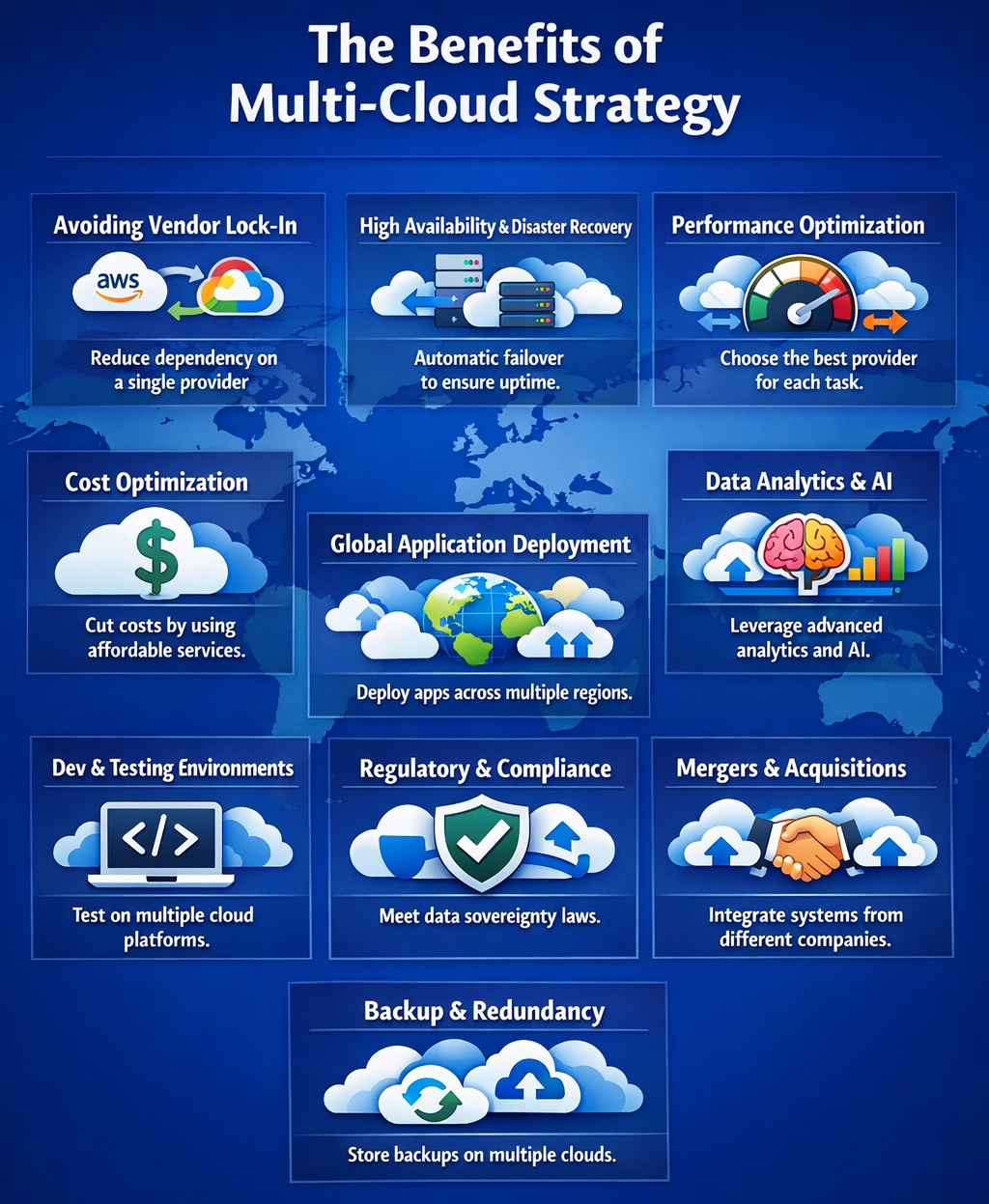
Let us explore the major multi-cloud use cases in detail.
1. Avoiding Vendor Lock-In
Organizations adopt multi-cloud to avoid dependency on a single cloud provider and maintain flexibility.
Use Case Details
- Multiple Providers: Applications and services are distributed across different cloud platforms.
- Freedom of Migration: Organizations can switch providers without major disruptions.
- Risk Reduction: Reduces reliance on a single vendor for critical operations.
Example
A company uses AWS for storage and Google Cloud for analytics to avoid depending on one provider.
2. High Availability and Disaster Recovery
Multi-cloud ensures continuous availability of services and supports disaster recovery strategies.
Use Case Details
- Backup Systems: Applications are deployed across multiple providers.
- Failover Support: Traffic automatically shifts if one provider fails.
- Business Continuity: Ensures uninterrupted service during outages.
Example
If one cloud provider goes down, the system redirects traffic to another provider to maintain availability.
3. Performance Optimization
Organizations use multi-cloud to achieve better performance by selecting the best provider for each workload.
Use Case Details
- Service Specialization: Use providers known for specific strengths.
- Reduced Latency: Deploy services closer to users geographically.
- Optimized Workloads: Run applications where they perform best.
Example
A company uses one cloud for data processing and another for content delivery to improve performance.
4. Cost Optimization
Multi-cloud helps organizations manage costs by choosing the most cost-effective services.
Use Case Details
- Flexible Pricing: Select providers with lower costs for specific services.
- Efficient Resource Usage: Avoid paying for unnecessary resources.
- Budget Control: Distribute workloads based on pricing advantages.
Example
A company uses a low-cost provider for storage and another provider for computing resources.
5. Global Application Deployment
Multi-cloud enables organizations to deploy applications across different regions worldwide.
Use Case Details
- Geographic Distribution: Applications run in multiple regions.
- Low Latency: Users access services from nearby data centers.
- Global Reach: Supports users across different countries.
Example
A streaming platform uses multiple cloud providers to deliver content quickly to users worldwide.
6. Data Analytics and AI
Multi-cloud supports advanced analytics and artificial intelligence workloads by using specialized tools.
Use Case Details
- Best-in-Class Tools: Use different providers for AI and analytics.
- Scalable Processing: Handles large datasets efficiently.
- Flexible Environment: Supports various frameworks and technologies.
Example
A company uses Google Cloud for AI services and AWS for data storage.
7. Application Development and Testing
Multi-cloud is useful for developing and testing applications across different environments.
Use Case Details
- Testing Flexibility: Applications are tested on multiple platforms.
- Tool Diversity: Access to a wide range of development tools.
- Faster Deployment: Improves development and release cycles.
Example
Developers test applications on different cloud platforms before final deployment.
8. Regulatory and Compliance Requirements
Multi-cloud helps organizations meet regulatory requirements by controlling where and how data is stored.
Use Case Details
- Data Location Control: Store data in specific regions as required by law.
- Compliance Support: Meet industry and regional standards.
- Flexible Deployment: Choose providers based on compliance needs.
Example
A financial company uses different cloud providers to comply with regional regulations.
9. Mergers and Acquisitions
Multi-cloud supports smooth integration during mergers and acquisitions.
Use Case Details
- System Integration: Combine systems from different organizations.
- Provider Compatibility: Continue using existing cloud providers.
- Smooth Transition: Avoid immediate migration complexities.
Example
Two merging companies continue using their existing cloud platforms without disruption.
10. Backup and Data Redundancy
Multi-cloud is used to ensure data safety through backup and redundancy.
Use Case Details
- Data Replication: Data is stored across multiple providers.
- Failure Protection: Prevents data loss if one provider fails.
- Reliable Storage: Ensures high data availability.
Example
A company stores backup data on a different cloud provider to ensure safety and recovery.
Top 5 FAQs (Interview & Exam Focused)
1. What are multi-cloud use cases?
Multi-cloud use cases include high availability, cost optimization, performance improvement, and disaster recovery. It is commonly used in scenarios where organizations need flexibility, reliability, and the ability to use multiple cloud providers for different tasks.
2. Why do companies use multi-cloud?
Companies use multi-cloud to avoid vendor lock-in and gain flexibility in choosing services. It allows them to select the best features from different providers, improving performance, cost efficiency, and overall system reliability.
3. Is multi-cloud used for disaster recovery?
Yes, multi-cloud is widely used for disaster recovery. Organizations deploy backup systems across multiple providers, enabling failover support and ensuring business continuity even if one cloud provider fails.
4. Can multi-cloud improve performance?
Yes, multi-cloud improves performance by allowing workloads to run on the most suitable cloud platform. This helps reduce latency, optimize resource usage, and deliver a better user experience.
5. Which industries use multi-cloud?
Industries such as finance, healthcare, IT, e-commerce, and research use multi-cloud. These sectors benefit from its ability to meet performance, cost, scalability, and compliance requirements.
Conclusion
Multi-cloud is widely used in real-world scenarios to enhance flexibility, performance, and reliability.
- Avoids Vendor Lock-In: Reduces dependency on a single provider
- Improves Performance and Scalability: Optimizes workloads across platforms
- Supports Global and Secure Applications: Enables worldwide deployment with strong data protection
Understanding these use cases helps learners and professionals apply multi-cloud concepts effectively in modern cloud environments.