












Binary Division
Binary division is an arithmetic operation used to divide one binary number by another. It follows the long division method, similar to decimal division, but uses only two digits (0 and 1). The process involves dividing, multiplying, subtracting, and bringing down the next digit to find the quotient and remainder.
Binary division is an important operation in computer arithmetic and digital electronics. It helps computers perform calculations and process binary data efficiently.
Components of Binary Division
Binary division consists of four main components:
- Dividend: The binary number being divided.
- Divisor: The binary number used to divide the dividend.
- Quotient: The result obtained after division.
- Remainder: The value left after division, if any.
The following diagram shows the basic components of the binary division process

Binary Division Rules
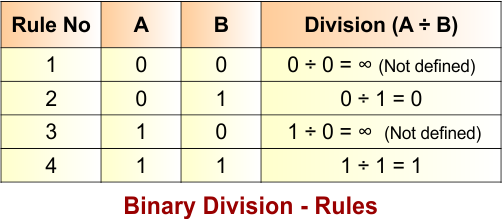
Binary division has four basic rules. These rules are similar to decimal division.
Important Points:
- Dividing 0 by 1 always gives 0.
- Dividing 1 by 1 always gives 1.
- Division by 0 is undefined.
- Binary division follows the same long-division process as decimal division.
- Subtract the divisor from the dividend when possible and bring down the next bit.
How to Perform Binary Division?
Binary division uses a process similar to decimal long division. It involves four basic steps to divide one binary number by another.
- Step 1: Compare the divisor with the dividend bits and determine the first quotient digit (0 or 1).
- Step 2: Multiply the divisor by the quotient digit and write the result below the selected dividend bits.
- Step 3: Subtract the product from the selected bits to find the difference.
- Step 4: Bring down the next bit of the dividend and repeat the same process until all bits have been used.
Binary Division Examples
Binary division can be performed using the long division method. The following examples explain how to divide binary numbers step by step.
Binary Division Example: 1
Divide the binary number (11)₂ by (11)₂.

The result description of example 1 is
- Binary: 11 ÷ 11 = 1
- Quotient: 1
- Remainder: 0
- Decimal Proof: 3 ÷ 3 = 1
Binary Division Example: 2
Divide the binary number (111)₂ by (11)₂.

The result description of example 2 is
- Binary: 111 ÷ 11 = 10
- Quotient: 10
- Remainder: 1
- Decimal Proof: 7 ÷ 3 = 2, remainder 1.
Binary Division Example: 3
Divide the binary number (11)₂ by (10)₂.

The result description of example 3 is
- Binary: 11 ÷ 10 = 1
- Quotient: 1
- Remainder: 1
- Decimal Proof: 3 ÷ 2 = 1, remainder 1.
Binary Division Example: 4
Divide the binary number (1110)₂ by (10)₂.

The result description of example 4 is
- Binary: 1110 ÷ 10 = 111
Quotient: 111
Remainder: 0
Decimal Proof: 14 ÷ 2 = 7
Binary Division Example: 5
Divide the binary number (111001)₂ by (10)₂.

The result description of example 5 is
- Binary: 111001 ÷ 10 = 11100
- Quotient: 11100
- Remainder: 1
- Decimal Proof: 57 ÷ 2 = 28, remainder 1.
Binary Division Example: 6
Divide the binary number (1110011)₂ by (10)₂.

The result description of example 6 is
- Binary: 1110011 ÷ 10 = 111001
- Quotient: 111001
- Remainder: 1
- Decimal Proof: 115 ÷ 2 = 57, remainder 1.
Difference Between Binary and Decimal Division
Binary and decimal division use similar methods, but they have different number systems.
| Binary Division | Decimal Division |
|---|---|
| Uses digits 0 and 1. | Uses digits 0 to 9. |
| Base is 2. | Base is 10. |
| Uses powers of 2. | Uses powers of 10. |
| Commonly used in computers. | Commonly used in everyday calculations. |
Applications of Binary Division
Binary division is used in several areas of computer science and digital systems.
- Computer Arithmetic: Used by processors to perform division operations.
- Digital Electronics: Helps in understanding arithmetic operations in digital circuits.
- Programming: Used when programs perform integer and binary calculations.
- Data Processing: Helps computers process and manipulate numerical data.
- Computer Architecture: Forms part of arithmetic logic unit (ALU) operations.
Conclusion
Binary division is an important arithmetic operation in the binary number system. It follows the long division method and uses only 0 and 1. By learning binary division rules and practicing different examples, students can easily understand how computers perform division operations.